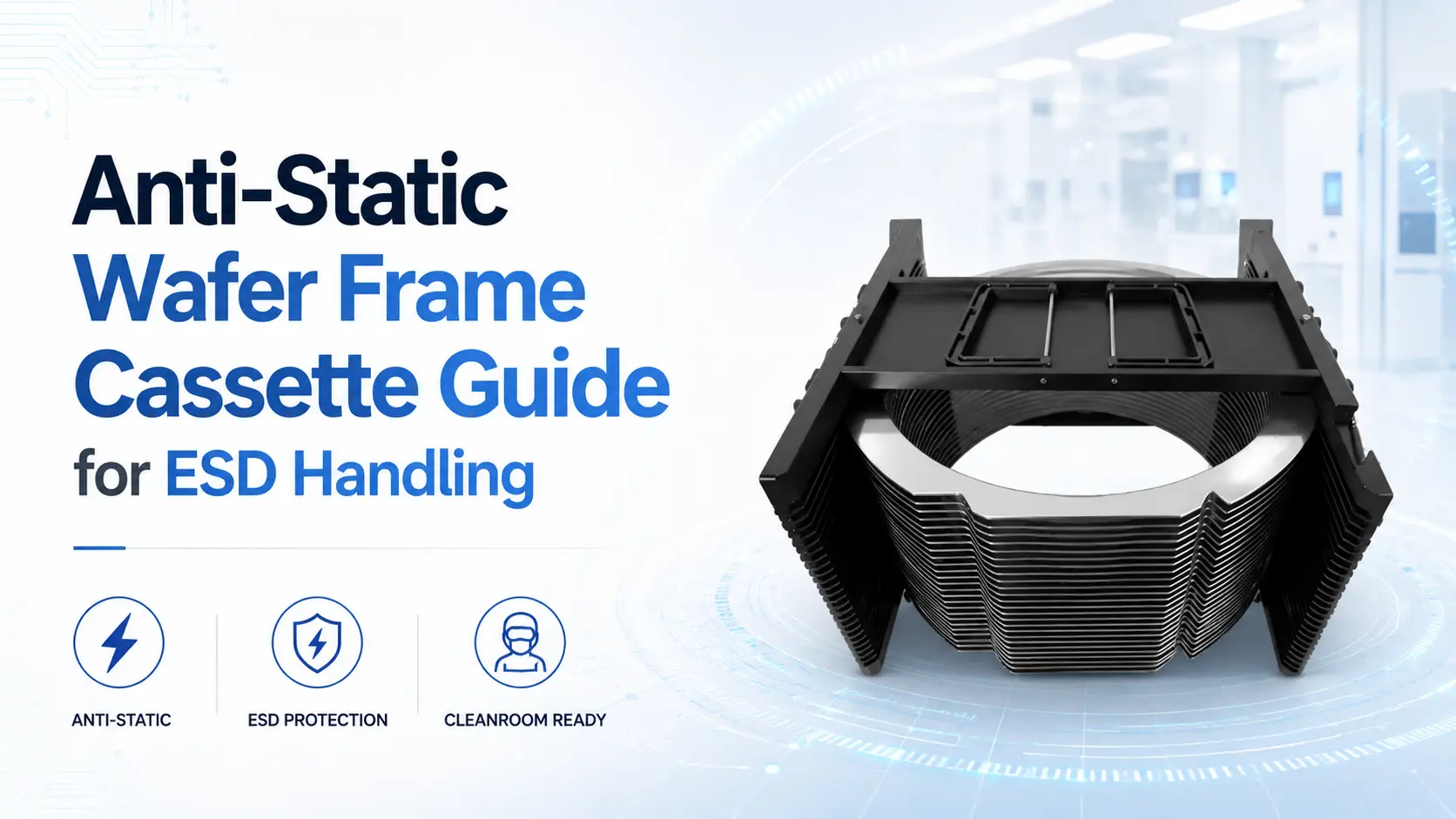
Anti-Static Wafer Frame Cassette Guide for ESD-Sensitive Handling
An anti-static wafer frame cassette is used when wafer frames, dicing frames, or tape frames need better ESD control during semiconductor back-end handling. This is especially important when wafers have already been processed, diced, inspected, or prepared for die pick-up.
From practical cleanroom and back-end handling experience, cassette selection should not depend only on whether the product is labeled “anti-static.” The cassette should be reviewed as part of the full ESD-safe handling process, including cleanroom movement, cleaning, storage, packaging, and shipment.
If you are still comparing basic carrier types, you may first review our article on wafer frame cassette applications before deciding whether an anti-static option is required.
Static risk can appear during loading, unloading, cleanroom transfer, cleaning, storage, packaging, or shipment. This is why anti-static wafer frame cassette selection should be reviewed together with the actual handling environment, not only the material name.
When Do You Need an Anti-Static Wafer Frame Cassette?
Not every wafer frame cassette needs anti-static material. The requirement depends on wafer condition, device sensitivity, customer requirements, and how the frames are handled.
An anti-static wafer frame cassette is usually considered when:
- The wafer or device is ESD-sensitive
- Wafers are already processed, diced, or prepared for inspection
- Diced wafers on tape need safer handling before die pick-up
- Frames are moved frequently between cleanroom workstations
- The customer requires ESD-safe handling
- Frames will be sent to another facility, supplier, or customer
In practice, the goal is not to over-specify every cassette. The goal is to match the cassette to the actual ESD risk of the process.
If the handling need is more about enclosed storage or shipment protection, you may also compare wafer frame cassette vs wafer frame box before choosing the final carrier type.
Anti-Static Cassette Is Only One Part of ESD Control
A common mistake is thinking that an anti-static cassette alone can solve all ESD risks. It cannot.
ESD control depends on the full handling system, including operators, gloves, workstations, transfer carts, trays, racks, packaging, storage, and shipping routes.
For wafer frame handling, the cassette is one important part of that process. But if operators use non-ESD-safe gloves, if the cassette is placed on an uncontrolled cart, or if the frames are packed with unsuitable materials, the anti-static cassette alone may not provide enough control.
From an engineering point of view, cassette selection should include the operators, workstations, packaging, cleaning method, and transport process.
Anti-Static Material or Surface Treatment?
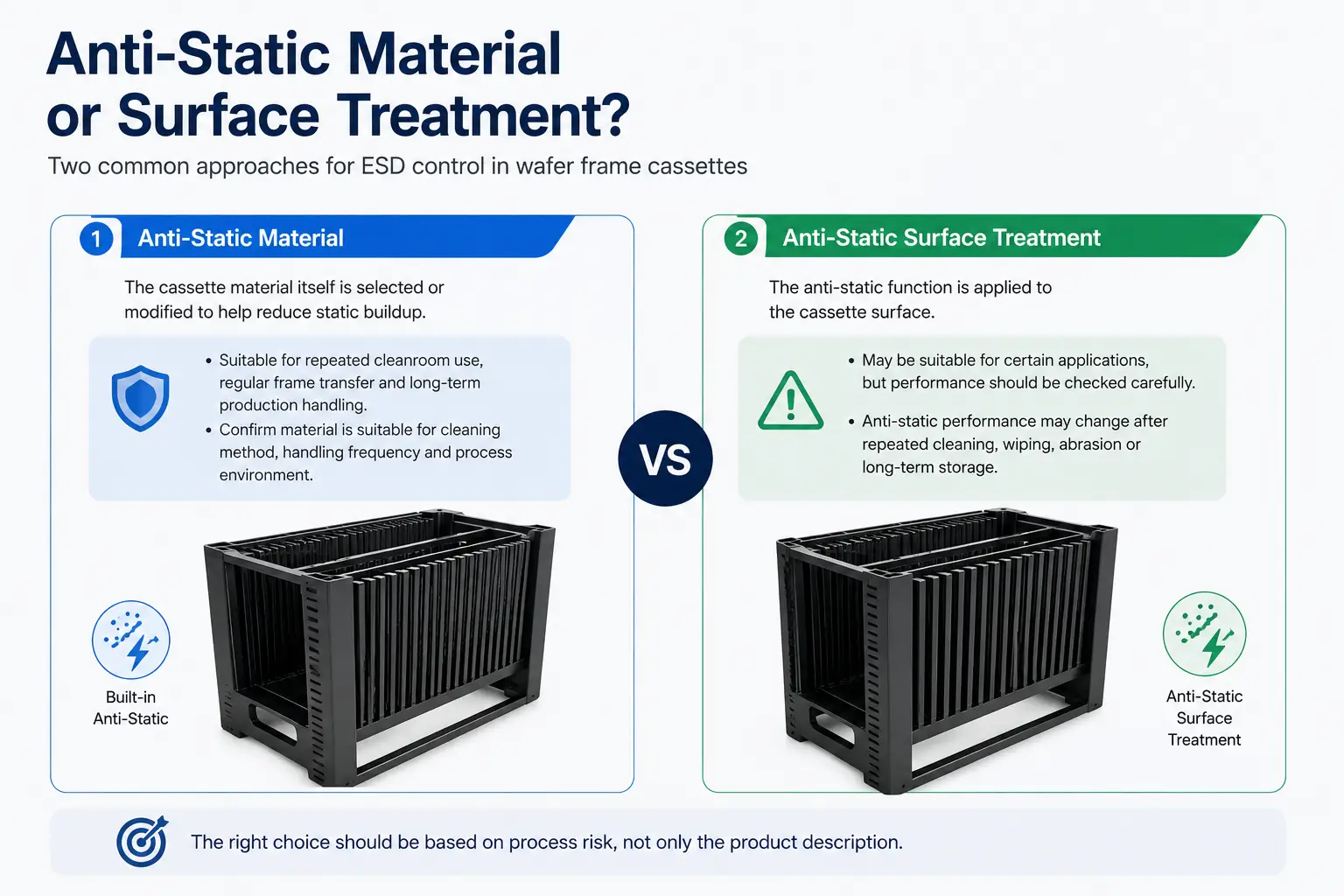
There are two common approaches: using anti-static material or applying anti-static surface treatment.
1. Anti-Static Material
Anti-static material means the cassette material itself is selected or modified to help reduce static buildup. This is usually considered for repeated cleanroom use, regular frame transfer, and long-term production handling.
For long-term use, buyers should confirm whether the material is suitable for the expected cleaning method, handling frequency, and process environment.
2. Anti-Static Surface Treatment
Surface treatment means the anti-static function is applied to the cassette surface. This may be suitable for certain applications, but it should be checked carefully if the cassette will be cleaned, wiped, handled repeatedly, or stored for a long time.
In practical use, this point is often overlooked. A surface-treated cassette may perform differently after repeated cleaning or abrasion. If ESD control is critical, buyers should confirm whether the anti-static performance remains stable under actual use conditions.
The right choice should be based on process risk, not only the product description.
ESD Review Points Before Choosing
Use this checklist before confirming an anti-static wafer frame cassette.
| Review Point | Why It Matters | What to Ask |
|---|---|---|
| Wafer or device sensitivity | Different devices may have different ESD risk levels | Is ESD-safe handling required by the process or customer? |
| Handling frequency | Repeated movement increases contact and friction points | How often will frames be loaded, moved, stored, or removed? |
| Cleaning method | Cleaning may affect surface condition or anti-static performance | Will the cassette be wiped, washed, or reused many times? |
| Process environment | Cleanroom, storage, and shipping conditions may differ | Will the cassette stay inside the cleanroom or leave the facility? |
| Packaging method | Packaging can also create or reduce static risk | Will anti-static inner or outer packaging be required? |
| Customer requirement | Some customers may require specific ESD-safe handling rules | Is there a required material, resistance range, or document? |
Where Static Risk May Appear
ESD risk does not only happen when the frame is placed inside the cassette. It may also appear when operators load or remove frames, when the cassette moves between workstations, when it is cleaned and reused, or when the frames are packed for outsourcing or shipment.
For dicing and post-dicing processes, frame stability and ESD control should be reviewed together. If your main concern is dicing frame handling, see our guide on how to choose a wafer frame cassette for dicing frames.
For this reason, ESD protection should be planned as a handling process, not only as a product feature.
Questions to Ask Before Ordering
Before ordering an anti-static wafer frame cassette, prepare these questions:
- Is anti-static material required, or is surface treatment acceptable?
- Will the cassette be used only inside the cleanroom, or also for shipment?
- Will the cassette be cleaned, wiped, or reused many times?
- Does the customer require specific ESD-safe handling documentation?
- Does the cassette need to work with anti-static packaging?
- Is the wafer already diced, inspected, or prepared for die pick-up?
- Will operators handle the cassette manually or with tools?
These questions help avoid choosing a cassette based only on a product label.
YJ Corevia Anti-Static Wafer Frame Cassette Support
YJ Corevia provides custom wafer frame cassette solutions for ESD-sensitive handling, cleanroom transfer, post-dicing processes, and customer delivery.
When customers are not sure whether a standard cassette or anti-static cassette is suitable, YJ Corevia can review the frame condition, ESD requirement, material option, surface treatment, cleaning method, storage condition, and packaging process before recommending a suitable design.
For ESD-sensitive applications, the review should include both the cassette and the surrounding handling process. This helps customers choose a solution that supports safer wafer frame handling instead of relying only on the material label.
Conclusion
An anti-static wafer frame cassette is useful when wafer frames need better ESD control during semiconductor back-end handling.
However, anti-static cassette selection should not be based on material alone. Buyers should also review wafer sensitivity, process flow, cleaning method, reuse condition, packaging, and customer requirements.
The right cassette should support both frame handling and ESD-safe process control.
Contact us today to discuss your anti-static wafer frame cassette requirements for ESD-sensitive wafer handling, cleanroom transfer, and post-dicing processes.
FAQ
1. What is an anti-static wafer frame cassette?
An anti-static wafer frame cassette is a carrier used to hold wafer frames while helping reduce static buildup during ESD-sensitive semiconductor handling.
2. When should I use an anti-static wafer frame cassette?
Use it when handling processed wafers, diced wafers, ESD-sensitive devices, or wafer frames that must follow customer ESD-safe handling requirements.
3. Is an anti-static cassette enough for ESD control?
No. The cassette is only one part of ESD control. Operators, tools, carts, packaging, storage, and cleanroom procedures should also be reviewed.
4. Can anti-static wafer frame cassettes be customized?
Yes. Anti-static wafer frame cassettes can be customized based on ESD requirement, material, surface treatment, cleaning method, packaging process, and handling environment.