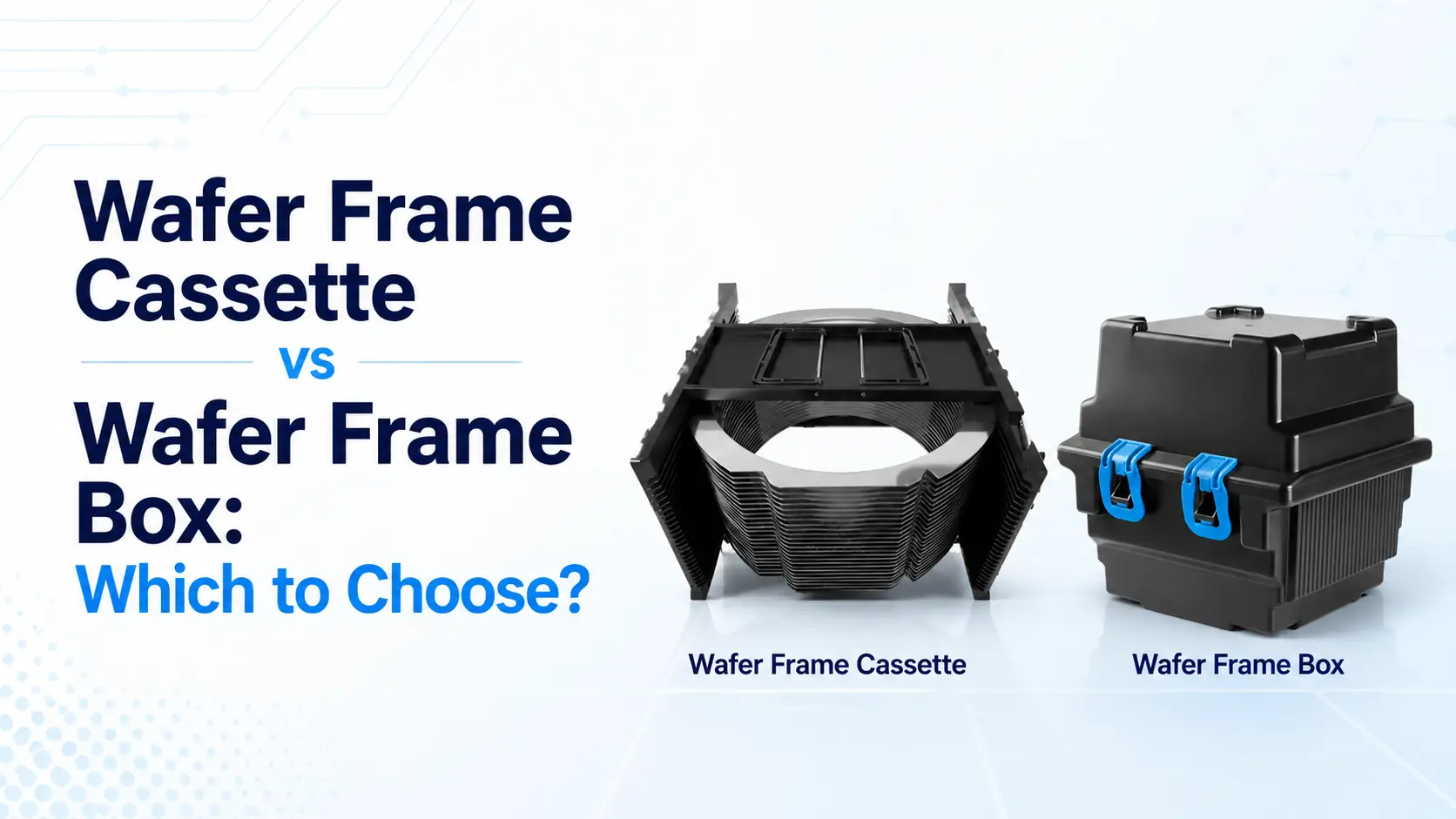
Wafer Frame Cassette vs Wafer Frame Box: Which Should You Choose?
A wafer frame cassette and a wafer frame box are both used to support wafer frames during semiconductor back-end handling. However, they are not used for the same purpose.
If wafer frames need frequent loading, unloading, and movement between process steps, a wafer frame cassette is usually the better choice. If wafer frames need enclosed protection, storage, transport, or shipment, a wafer frame box is usually more suitable.
In daily production, the decision is not only about the product name. It is about how the frame will be handled, how often it needs to be accessed, and how much protection it needs during movement.
This article compares wafer frame cassettes and wafer frame boxes, explains when to use each one, and helps buyers choose the right solution for wafer dicing, post-dicing handling, cleanroom transfer, storage, and shipping.
Main Difference Between a Wafer Frame Cassette and a Wafer Frame Box
The main difference is simple:
A wafer frame cassette is for organized process handling.
A wafer frame box is for enclosed frame protection.
A cassette usually holds multiple wafer frames in slots. It is useful when operators need to move frames between dicing, cleaning, inspection, storage, or die pick-up preparation.
A box usually protects wafer frames inside a covered or enclosed container. It is useful when frames need to be stored, transported, delivered, or shipped with better protection from contact and exposure.
| Item | Wafer Frame Cassette | Wafer Frame Box |
|---|---|---|
| Main Purpose | Organize wafer frames in slots | Protect wafer frames inside an enclosed box |
| Best For | Process transfer, storage, cleanroom handling | Storage, protection, transport, shipment |
| Handling Style | Slot-based and easy to access | Covered or enclosed protection |
| Typical Use | Dicing, cleaning, inspection, internal movement | Frame storage, delivery, outsourcing, shipment |
| Selection Focus | Frame size, slot pitch, slot number, loading direction | Frame fit, inner support, cover, closure, packaging |
For a basic introduction to cassette structure and applications, please read our article: Wafer frame cassette guide.
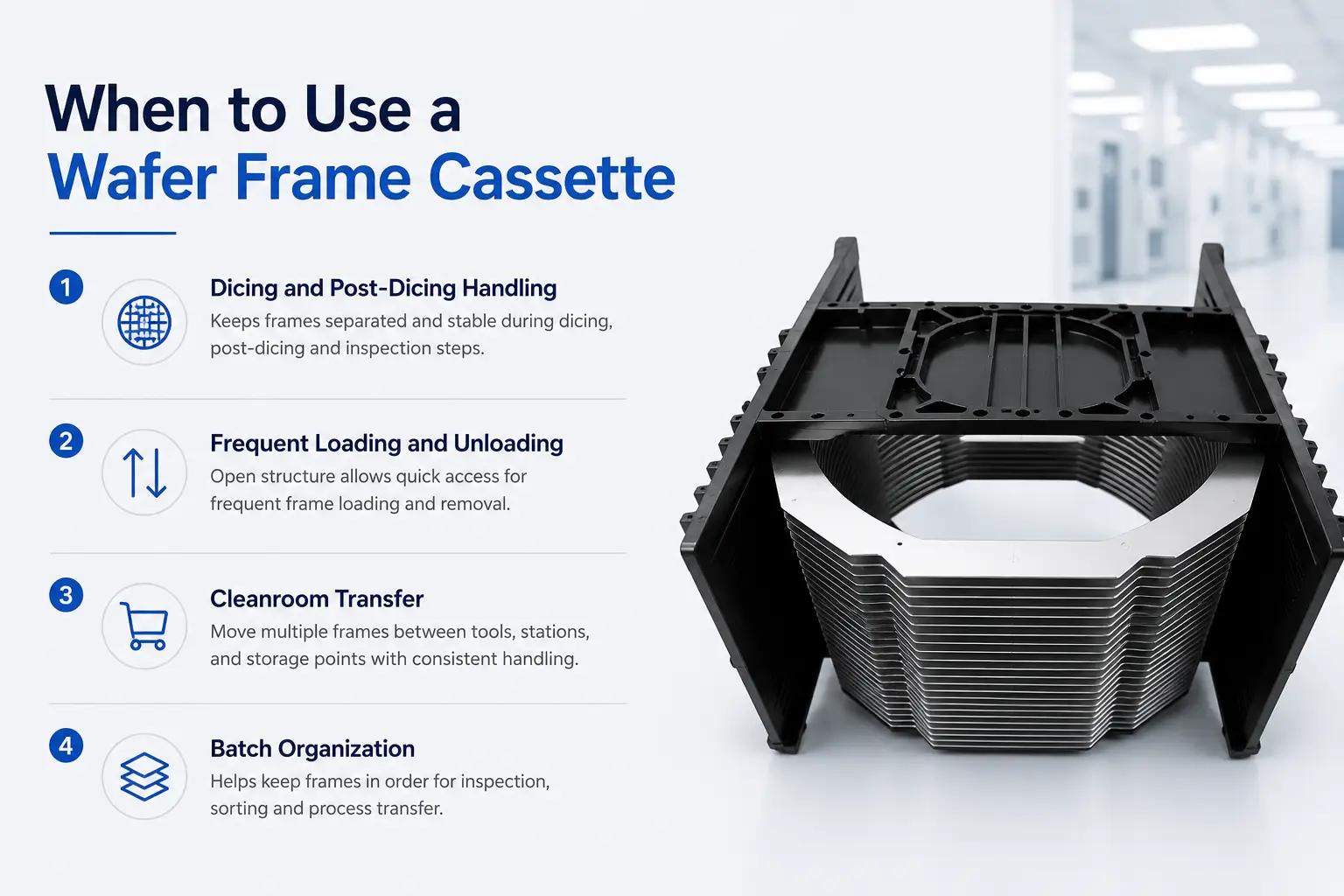
When to Use a Wafer Frame Cassette
A wafer frame cassette is usually the better choice when wafer frames need to remain accessible during production.
1. Dicing and Post-Dicing Handling
During wafer dicing, frames often move between mounting, cutting, cleaning, inspection, and die pick-up preparation. A cassette keeps each frame separated and easier to manage.
After dicing, stable handling becomes more important because the wafer has already been separated into individual dies. The cassette should help reduce frame movement and keep the process flow organized.
2. Frequent Loading and Unloading
If operators need to load and remove wafer frames many times during the day, a cassette is usually easier to use than a closed box.
However, slot pitch matters. A higher slot count is not always better if the spacing becomes too tight. Operators still need enough room to remove frames smoothly without contact.
3. Cleanroom Transfer
A wafer frame cassette is useful for moving multiple frames between cleanroom tools, inspection stations, cleaning areas, carts, or temporary storage points.
The main benefit is consistency. Operators can move several frames at once while keeping the batch organized.
4. Batch Organization
When frame sequence matters, a cassette helps keep frames arranged in order. This can be useful during inspection, sorting, process transfer, or internal tracking.
When to Use a Wafer Frame Box
A wafer frame box is usually the better choice when the main concern is protection instead of repeated access.
1. Enclosed Storage
If wafer frames need to be stored with better dust reduction or external protection, a wafer frame box may be more suitable than an open cassette.
The cover or enclosed structure helps reduce exposure during storage.
2. Transport or Delivery
When wafer frames need to move outside a process area, a box can provide better containment. This is useful for inter-department transfer, outsourcing, customer delivery, or local transport.
If the box will be used for shipping, outer packaging should also be reviewed.
3. Frame Protection
A wafer frame box is useful when frames need to be protected from direct touch, accidental contact, or environmental exposure.
For processed wafers or diced wafers on tape, the box should be selected based on frame size, inner support, and closure stability.
4. Customer Shipment
If wafer frames are sent to a customer or packaging partner, a wafer frame box usually provides better protection and presentation.
For external shipment, the box should be used together with proper cushioning, labeling, sealing, and outer packaging.
Key Factors to Check Before Choosing
Before choosing between a wafer frame cassette and a wafer frame box, start with the actual handling process.
1. Handling Frequency
If frames need frequent access, choose a cassette.
If frames will be stored or shipped with less frequent opening, choose a box.
2. Protection Level
If the main need is organization and process flow, a cassette is usually enough.
If the main need is enclosed protection, dust reduction, or transport protection, a box is usually better.
3. Frame Size
Both cassettes and boxes should be selected by frame size, not only wafer diameter. A wafer mounted on a frame is larger than the wafer itself.
Check:
- Frame outer diameter
- Frame thickness
- Frame shape
- Tape condition
- Loading direction
- Movement allowance
4. Slot Design or Inner Support
For cassettes, slot pitch and slot fit are important.
For boxes, inner support and closure stability are important.
A cassette with poor slot pitch can make loading difficult. A box with weak inner support can allow frame movement during transport.
5. Cleanroom and ESD Requirements
If the wafer or device is ESD-sensitive, anti-static material or surface treatment should be reviewed for both cassette and box designs.
For cleanroom use, also consider surface condition, particle risk, material choice, and repeated handling.
Can You Use Both Together?
Yes. In many semiconductor processes, a wafer frame cassette and wafer frame box can be used at different stages.
For example, a cassette may be used inside the cleanroom for daily transfer between dicing, cleaning, and inspection. Later, a wafer frame box may be used for storage, outsourcing, customer delivery, or shipment.
This is often more practical than trying to use one product for every step.
A simple way to decide is:
- Use a cassette when frames need easy access.
- Use a box when frames need better protection.
- Use a custom design when the frame size, process flow, or protection requirement is not standard.
Custom Wafer Frame Cassette and Box Options
Standard wafer frame cassettes and boxes may not fit every process. Custom design may be needed when the frame size, slot pitch, material, loading method, closure design, or equipment layout is different from standard products.
Custom options may include:
- 6-inch, 8-inch, and 12-inch wafer frame applications
- Custom frame size support
- Custom cassette slot number and slot pitch
- Custom box inner support and closure design
- Metal, plastic, or anti-static material options
- Handle, cover, labeling, or identification support
- Cleanroom and ESD-related material options
- Equipment or automation compatibility
A custom solution can improve frame fit, handling stability, protection level, and process compatibility.
YJ Corevia Wafer Frame Handling Solutions
YJ Corevia provides wafer frame, dicing ring, wafer ring, wafer frame cassette, wafer frame box, and custom semiconductor handling solutions.
When customers are not sure whether they need a wafer frame cassette, wafer frame box, or custom design, YJ Corevia can review the frame size, frame thickness, process flow, loading method, material requirement, ESD need, and shipping condition before recommending a suitable solution.
YJ Corevia supports 6-inch, 8-inch, and 12-inch wafer frame applications, as well as custom cassette and box designs based on frame size, slot pitch, material, protection requirement, and process use.
Our goal is to help customers choose the right handling solution for wafer frames during dicing, cleanroom transfer, post-dicing handling, storage, and transport.
Conclusion
A wafer frame cassette and a wafer frame box serve different purposes.
Choose a wafer frame cassette when framed wafers need frequent loading, unloading, cleanroom transfer, batch organization, or movement between process steps.
Choose a wafer frame box when framed wafers need enclosed protection, storage, transport, customer delivery, or shipment support.
For special frame sizes or process requirements, a custom cassette or custom box may be the best option.
Contact us today to discuss your wafer frame size, slot design, box protection requirement, material option, ESD need, and custom wafer frame handling solution.
FAQ
1. What is the difference between a wafer frame cassette and a wafer frame box?
A wafer frame cassette organizes wafer frames in slots for process transfer and handling. A wafer frame box protects wafer frames inside an enclosed container for storage, transport, or shipment.
2. When should I use a wafer frame cassette?
Use a wafer frame cassette when wafer frames need frequent loading, unloading, cleanroom transfer, batch organization, or movement between process steps.
3. When should I use a wafer frame box?
Use a wafer frame box when wafer frames need enclosed protection, storage, transport, customer delivery, or shipment support.
4. Should I choose by wafer size or frame size?
For framed wafers, choose by wafer frame size, not only wafer diameter. Check the frame outer size, thickness, and shape before confirming the design.
5. Can wafer frame cassettes and wafer frame boxes be customized?
Yes. Both can be customized based on frame size, slot pitch, material, ESD requirement, closure design, handle design, and equipment compatibility.