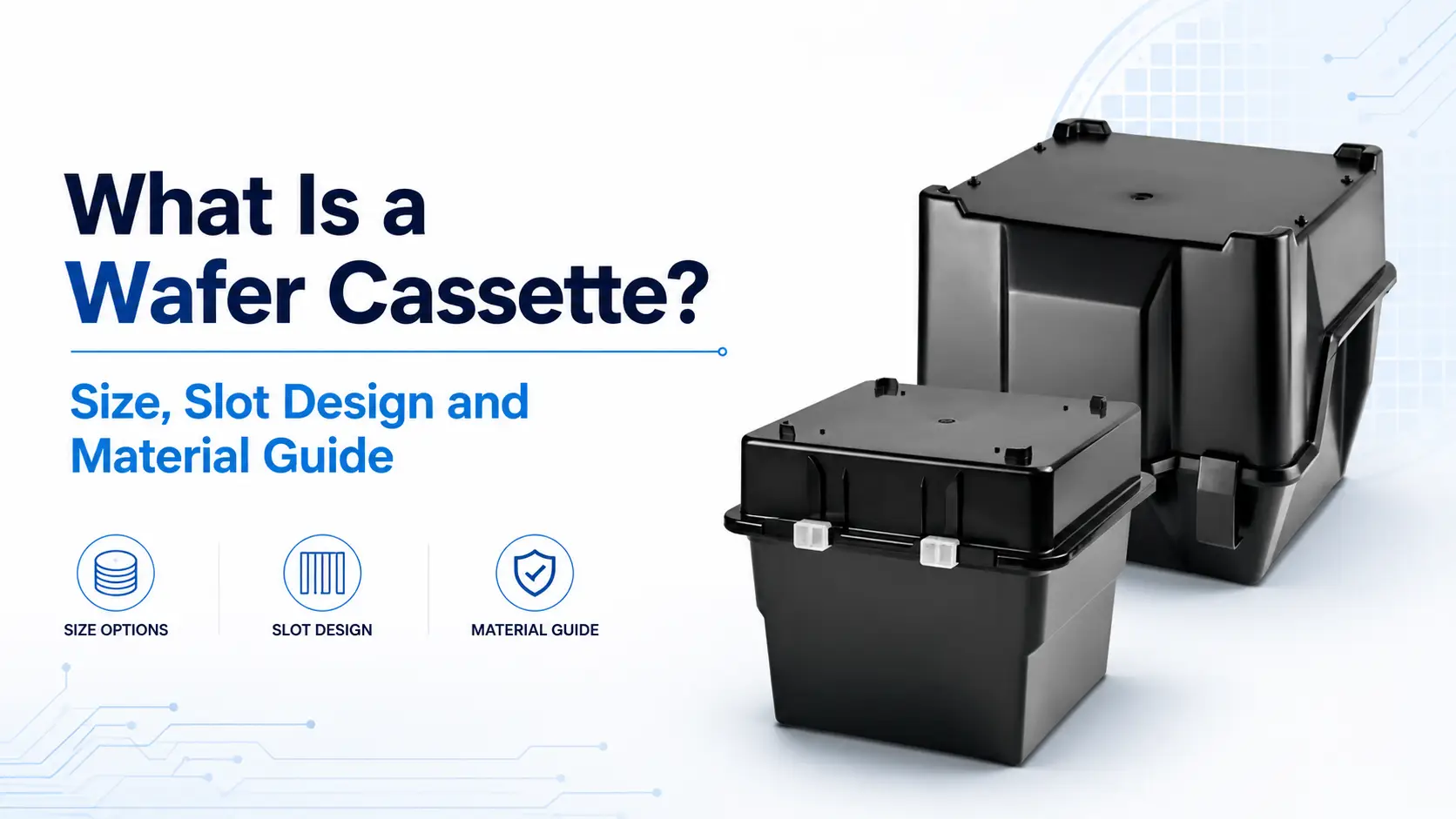
What Is a Wafer Cassette? Size, Slot Design and Material Guide
A wafer cassette is a slotted carrier used to hold bare wafers or processed wafers during storage, transfer, cleaning, inspection, and cleanroom handling. Each slot keeps one wafer separated, so multiple wafers can be moved or stored without stacking them directly.
The right cassette depends on more than wafer diameter. Slot spacing, edge support, material, cleaning method, ESD requirements, and equipment compatibility can all affect daily handling. A cassette that looks correct by size may still be difficult to use if it does not match the actual process.
This article explains how wafer cassettes work, how they differ from wafer frame cassettes, and what buyers should check before choosing one.
How a Wafer Cassette Works
A wafer cassette keeps wafers separated by holding each wafer in its own slot. The slot structure helps maintain spacing between wafers and supports more consistent handling during storage, transfer, cleaning, or inspection.
In practice, the details of the cassette matter. Wafer diameter, slot count, slot spacing, material, and process environment can all affect loading smoothness, wafer stability, and compatibility with tools or racks.
Depending on the supplier or application, a wafer cassette may also be called a wafer carrier, wafer storage cassette, wafer transfer cassette, or wafer handling cassette.
Wafer Cassette vs Wafer Frame Cassette
A wafer cassette and a wafer frame cassette are different because they hold different things.
A wafer cassette holds bare or processed wafers. A wafer frame cassette holds wafers that are already mounted on dicing tape and supported by a wafer frame, dicing ring, or tape frame.
| Item | Wafer Cassette | Wafer Frame Cassette |
|---|---|---|
| Holds | Bare or processed wafers | Wafer frames, dicing rings, or tape frames |
| Selection Basis | Wafer diameter | Frame outer size |
| Common Use | Wafer storage, transfer, cleaning, inspection | Dicing, post-dicing handling, die pick-up preparation |
| Design Focus | Wafer slot, spacing, edge support | Frame slot, frame pitch, frame stability |
In simple terms, a wafer cassette holds wafers. A wafer frame cassette holds wafer frames.
If the wafer is already mounted on a frame, the carrier should be selected by frame size, not only wafer diameter.
Common Uses of Wafer Cassettes
Wafer cassettes are used when wafers need to be stored, transferred, or prepared for the next process step without direct stacking.
Common uses include:
- Bare wafer storage before processing or inspection
- Processed wafer transfer between workstations or tools
- Cleanroom movement between carts, benches, racks, or temporary holding areas
- Cleaning and drying support when the cassette material and structure match the process
- Inspection preparation when wafer sequence and batch organization need to be maintained
The exact use depends on wafer condition, cleanroom requirement, tool compatibility, and handling method.
How to Choose a Wafer Cassette?
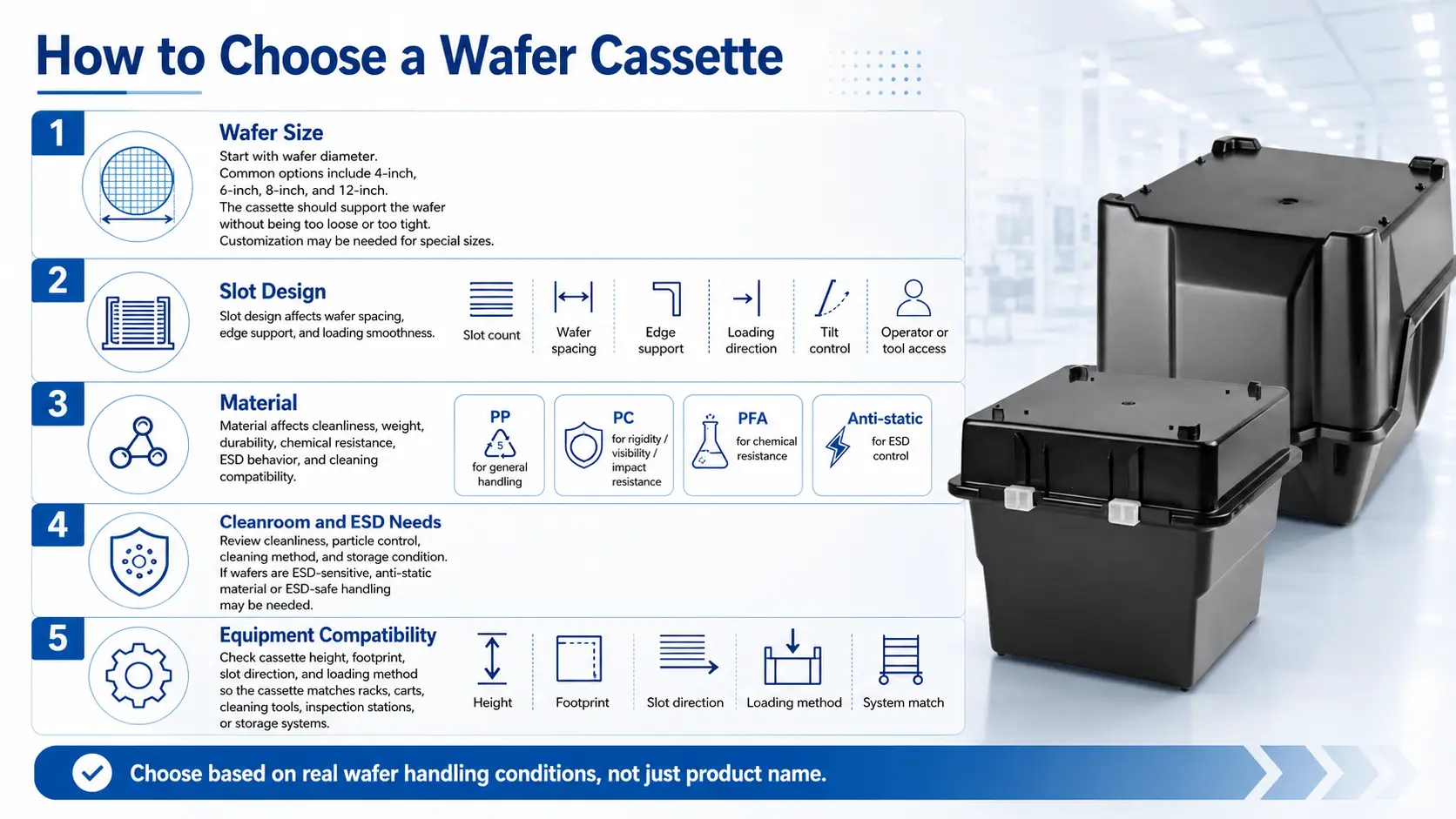
A wafer cassette should be selected based on how the wafers will actually be handled. The main points are wafer size, slot design, material, cleanroom use, ESD requirement, and equipment compatibility.
1. Wafer Size
Start with wafer diameter. Common options include 4-inch, 6-inch, 8-inch, and 12-inch wafer cassettes.
The cassette should support the wafer without excessive looseness or tight contact. If the fit is poor, wafers may tilt, move too much, or become difficult to load and remove.
For special wafer sizes, the cassette may need to be customized.
2. Slot Design
Slot design affects wafer spacing, wafer edge support, and loading smoothness.
When reviewing slot design, check:
- Slot count
- Wafer spacing
- Edge support
- Loading direction
- Wafer tilt control
- Operator or tool access
A higher slot count is not always better if spacing becomes too tight. The cassette should allow wafers to be loaded and removed smoothly without unnecessary contact.
3. Material
Material affects cleanliness, weight, durability, chemical resistance, ESD behavior, and cleaning compatibility.
Common material options may include:
- PP wafer cassette for general wafer handling and storage
- PC wafer cassette when rigidity, visibility, or impact resistance is needed
- PFA wafer cassette for stronger chemical resistance or more demanding process conditions
- Anti-static wafer cassette when ESD control is required
Material should not be selected only by name. It should be matched to the real wafer handling environment, cleaning method, and process requirement.
4. Cleanroom and ESD Needs
For cleanroom wafer handling, material cleanliness, particle control, cleaning method, and storage condition should be reviewed.
If wafers or devices are ESD-sensitive, anti-static material or ESD-safe handling may be needed. The cassette should also work with the surrounding process, including operators, carts, workstations, packaging, and storage procedures.
5. Equipment Compatibility
Some wafer cassettes need to fit specific racks, carts, cleaning tools, inspection stations, or storage systems.
Before confirming a cassette, check whether the cassette height, footprint, slot direction, and loading method match the actual equipment or production flow.
When Do You Need a Custom Wafer Cassette?
A custom wafer cassette may be needed when standard cassette sizes or slot designs do not match the process.
Custom design may be useful when:
- Wafer size is not standard
- Slot number or spacing needs adjustment
- Material requirement is specific
- Cassette height or footprint must match equipment
- Cleaning or drying process requires a special structure
- ESD control is required
- The cassette must fit carts, racks, tools, or storage systems
Custom wafer cassette design can improve wafer fit, handling stability, process compatibility, and operator convenience.
YJ Corevia Wafer Cassette Solutions
YJ Corevia provides wafer cassette, wafer carrier, wafer storage box, wafer frame cassette, dicing ring, and custom semiconductor handling solutions.
For wafer cassette projects, YJ Corevia can review wafer size, slot count, slot spacing, material requirement, cleanroom condition, ESD need, cleaning method, and equipment compatibility before recommending a suitable design.
YJ Corevia supports 4-inch, 6-inch, 8-inch, and 12-inch wafer handling applications, as well as custom wafer cassette solutions based on customer process needs.
The goal is to help customers choose a wafer cassette that supports stable wafer storage, clean transfer, and reliable semiconductor handling.
Conclusion
A wafer cassette is used to hold, organize, store, and transfer bare or processed wafers during semiconductor handling. The right cassette should be selected based on wafer size, slot design, material, cleanroom condition, ESD requirement, and equipment compatibility.
For general wafer handling, start with wafer diameter and slot design. For more demanding applications, material, cleaning method, ESD control, and process environment should also be reviewed.
Contact us today to discuss your wafer cassette size, slot design, material requirement, ESD need, and custom semiconductor handling requirements.
FAQ
1. What is a wafer cassette?
A wafer cassette is a slotted carrier used to hold bare or processed wafers during storage, transfer, cleaning, inspection, and cleanroom handling.
2. What is a wafer cassette used for?
It is used for wafer storage, cleanroom transfer, cleaning support, inspection preparation, and temporary holding between semiconductor process steps.
3. What is the difference between a wafer cassette and a wafer frame cassette?
A wafer cassette holds bare or processed wafers. A wafer frame cassette holds wafers that are already mounted on dicing tape and supported by a wafer frame, dicing ring, or tape frame.
4. How do I choose a wafer cassette?
Start by checking wafer size, slot count, wafer spacing, material, cleanroom condition, ESD requirement, and equipment compatibility.
5. Can wafer cassettes be customized?
Yes. Wafer cassettes can be customized based on wafer size, slot number, wafer spacing, material, cassette height, equipment fit, cleaning method, and ESD requirement.