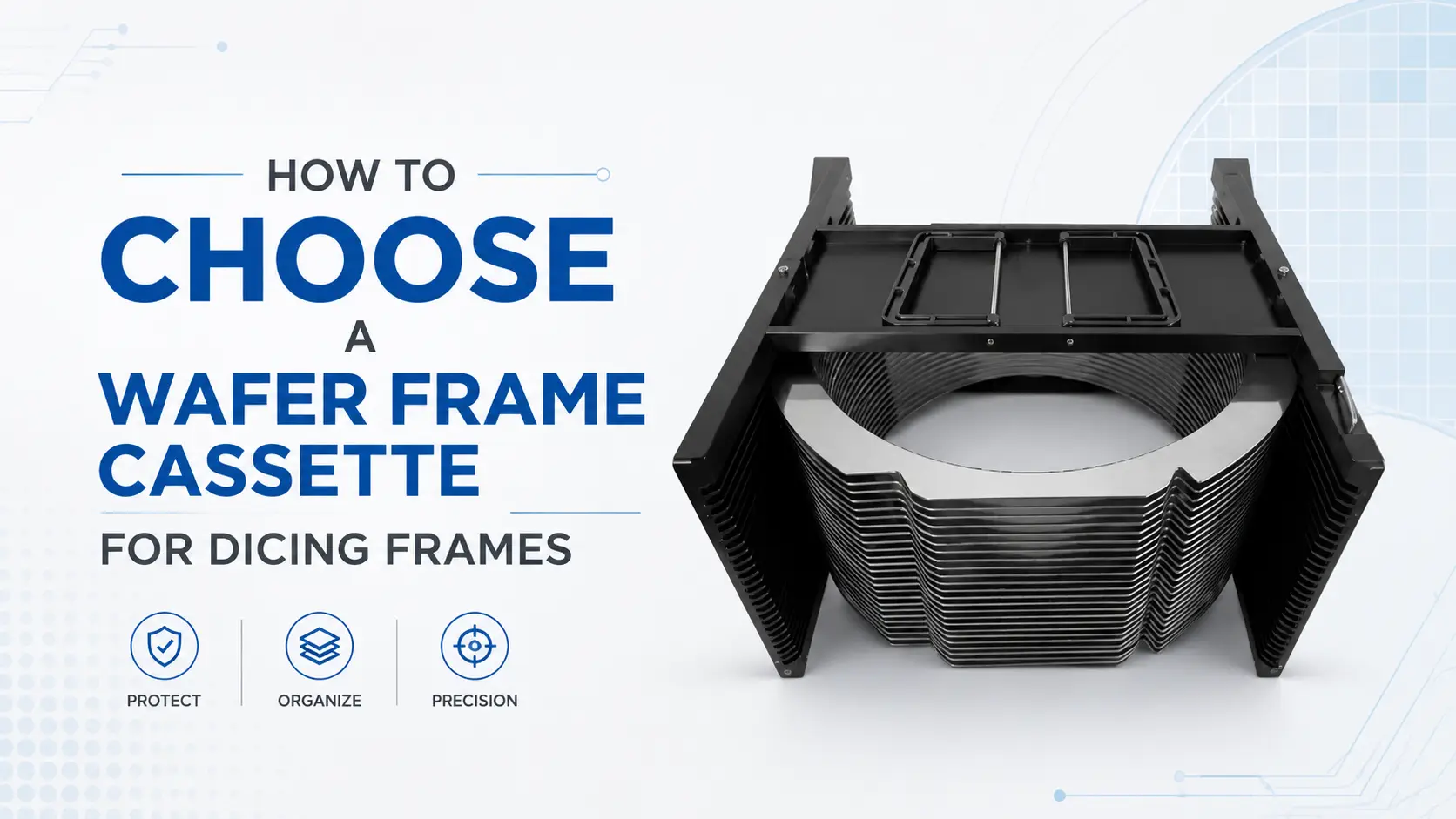
How to Choose a Wafer Frame Cassette for Dicing and Post-Dicing Handling?
If you are choosing a wafer frame cassette for dicing frames, the first question is not how many frames it can hold. The more important question is whether the cassette can keep each frame stable, separated, and easy to load during daily production.
After dicing, the wafer has already been separated into individual dies while still staying on tape. Even small frame movement may affect die position, tape stability, or the next handling step. This is why slot pitch, frame thickness, loading direction, and cassette fit matter so much.
This article focuses on how to choose a wafer frame cassette for wafer dicing, post-dicing cleaning, inspection, temporary storage, and die pick-up preparation.
For a basic introduction, please read our article: Wafer Frame Cassette Guide.
Why Cassette Selection Matters After Dicing
Before dicing, the wafer frame mainly supports the wafer and dicing tape. After dicing, the frame still provides support, but the wafer is now separated into individual dies. The handling risk becomes higher.
In practice, the cassette has to keep frames steady through dicing, cleaning, inspection, and die pick-up preparation. It should also make daily handling easier for operators, especially when frames are moved many times between tools, carts, and temporary storage areas.
A suitable wafer frame cassette should help:
- Keep dicing frames separated
- Reduce frame movement during transfer
- Support smooth loading and unloading
- Maintain frame sequence during batch handling
- Reduce unnecessary contact between frames
- Support stable handling after wafer dicing
The goal is not only to store frames. The goal is to keep the process stable after the wafer has already been cut.
Start with the Dicing Frame Size
The cassette should be selected by dicing frame size, not only by wafer diameter.
Once the wafer is mounted on a frame, the outer frame dimensions become the key specification. A cassette chosen only by wafer size may not fit the actual frame correctly.
Before confirming a cassette, check:
- Frame outer diameter
- Frame shape
- Frame thickness
- Frame material
- Tape condition
- Loading direction
- Required clearance
This is especially important for 6-inch, 8-inch, and 12-inch wafer frame applications, because frame dimensions may vary depending on the frame design, supplier, or process.
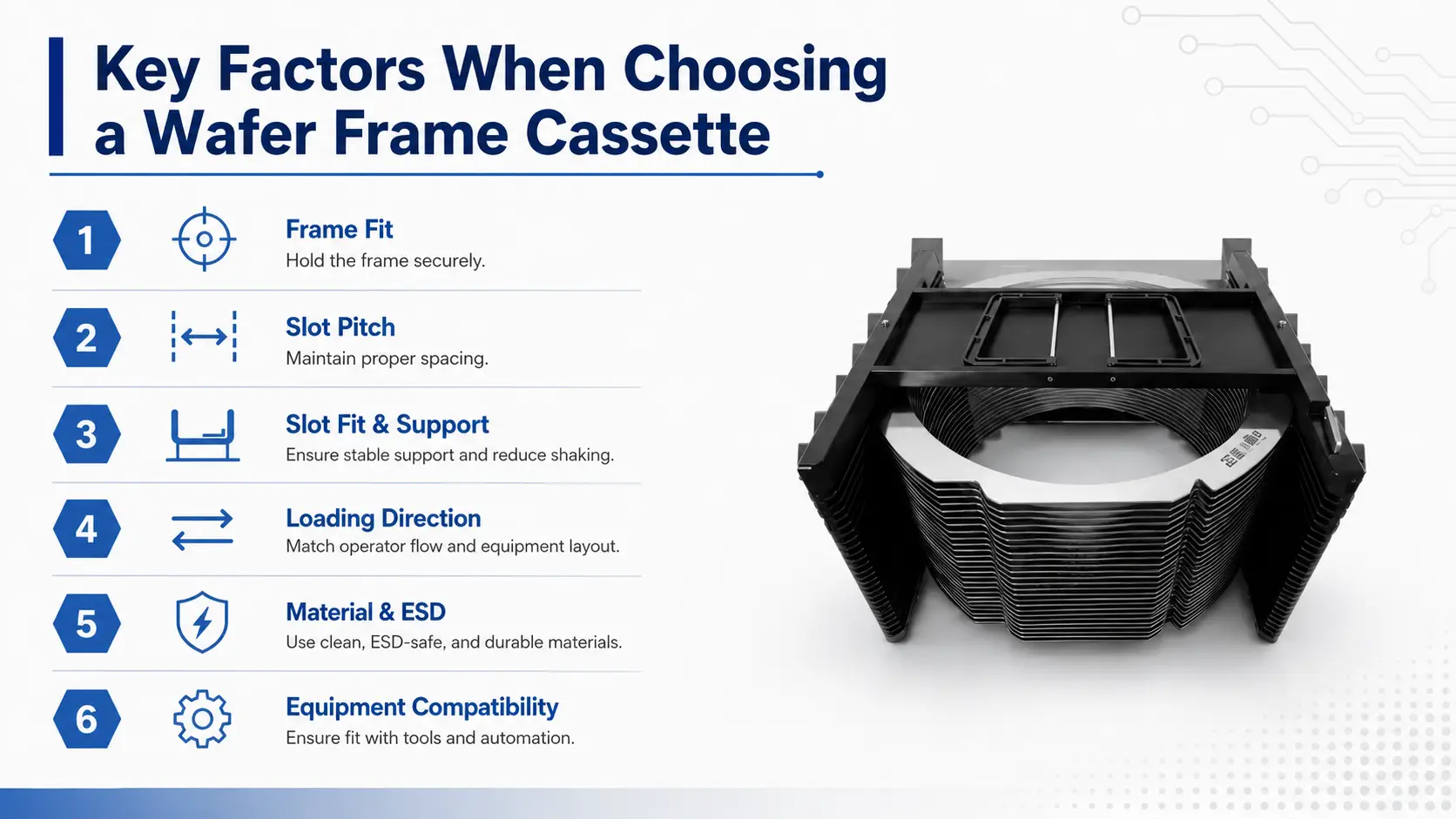
Key Factors When Choosing a Wafer Frame Cassette
1. Frame Fit
Frame fit is the most important factor. The cassette should hold the frame securely without forcing it into the slot.
If the fit is too loose, the frame may tilt or move during transfer. If the fit is too tight, operators may have difficulty loading and unloading frames. It may also increase unnecessary contact with the cassette.
A good fit should support the frame while still allowing smooth handling.
2. Slot Pitch
Slot pitch affects the spacing between frames. It also affects how easily operators can load and remove frames.
A higher slot count is not always better. If the slot pitch is too narrow, the cassette may hold more frames, but handling becomes harder. Frames may sit too close to each other, increasing the risk of contact during loading or unloading.
For dicing and post-dicing handling, slot pitch should be selected based on frame size, frame thickness, tape condition, and operator access.
3. Frame Thickness and Slot Fit
Different dicing rings, tape frames, or metal frames may have different thicknesses. The cassette slot should match the frame thickness closely enough to support the frame, but not so tightly that operators struggle to remove it.
A poor slot fit can cause tilting, shaking, unstable transfer, or friction during handling.
4. Slot Depth and Support Area
The slot should support the frame at stable contact points. It should not allow excessive shaking or uneven support.
For post-dicing handling, this matters because the wafer has already been separated into dies. The cassette should reduce unnecessary frame movement during transfer, cleaning, inspection, and temporary storage.
5. Loading and Unloading Direction
A cassette may look correct by dimensions but still be inconvenient in daily use. The loading direction should match the operator flow or equipment layout.
Before confirming the design, check:
- Is the frame loaded from the top or side?
- Is manual loading required?
- Will operators wear gloves?
- Is the cassette used with carts, racks, or tools?
- Does the loading direction match the production layout?
In many cases, the problem is not that the cassette cannot hold the frame. The real issue appears during daily loading, unloading, cleaning, or transfer.
6. Material and Rigidity
Material affects cassette weight, rigidity, durability, cleanliness, and ESD control.
Common options may include metal, plastic, anti-static material, or custom material. The right choice depends on handling frequency, cleanroom use, frame weight, ESD requirement, and expected service life.
For repeated production use, rigidity and long-term stability are important. For frequent manual movement, weight and ease of handling also matter.
7. Cleanroom and ESD Needs
If the cassette is used in a cleanroom, surface condition, particle risk, cleaning method, and material choice should be reviewed.
If wafers or devices are ESD-sensitive, anti-static material or surface treatment may be needed. ESD control should not be treated as only a material issue; it should also be considered together with operator handling, outer packaging, and process environment.
8. Equipment Compatibility
Some wafer frame cassettes need to fit cleaning tools, inspection stations, storage racks, transfer carts, or machine loading areas.
Before ordering, confirm whether the cassette must match:
- Tool dimensions
- Rack size
- Cart design
- Loading position
- Automation layout
- Operator handling flow
This step helps avoid problems after the cassette enters production.
Wafer Frame Cassette Selection Checklist
Use this checklist before confirming a cassette design.
| Item to Check | Why It Matters | What to Confirm |
|---|---|---|
| Frame size | The cassette must fit the full dicing frame, not only the wafer | Outer diameter, shape, thickness |
| Slot pitch | Affects spacing, access, and frame contact risk | Frame spacing, loading comfort, slot count |
| Slot fit | Controls frame stability during transfer | Loose fit, tight fit, tilt risk |
| Loading direction | Must match operator or equipment workflow | Top loading, side loading, manual or tool use |
| Material | Affects rigidity, weight, durability, and cleanliness | Metal, plastic, anti-static, or custom material |
| ESD requirement | Important for sensitive wafers or devices | Anti-static material or surface treatment |
| Equipment fit | Prevents production use problems | Tool, rack, cart, storage, or transfer compatibility |
When Do You Need a Custom Wafer Frame Cassette?
A custom wafer frame cassette is usually needed when standard cassette designs do not match the actual process.
Custom design may be required when:
- Frame size is not standard
- Frame thickness varies
- Slot pitch needs adjustment
- Loading direction is different
- Equipment layout has fixed dimensions
- ESD control is required
- Operators need special handle or access design
- The cassette must fit racks, carts, or machines
- Long-term repeated use requires stronger structure
Custom design is not only about changing dimensions. It can improve handling stability, reduce process friction, and make daily production smoother.
YJ Corevia Wafer Frame Cassette Support
YJ Corevia provides wafer frame, dicing ring, wafer ring, wafer frame cassette, wafer frame box, and custom semiconductor handling solutions.
When customers need a cassette for dicing or post-dicing handling, YJ Corevia can review the wafer frame size, frame thickness, slot number, slot pitch, material preference, ESD need, cleanroom use, and equipment compatibility before recommending a suitable design.
YJ Corevia supports 6-inch, 8-inch, and 12-inch wafer frame applications, as well as custom cassette solutions based on frame size, process flow, slot design, material, and handling requirements.
The goal is to help customers choose a wafer frame cassette that supports stable frame handling, clean transfer, and reliable semiconductor back-end production.
Conclusion
A wafer frame cassette for dicing and post-dicing handling should be selected based on frame size, slot pitch, slot fit, frame thickness, loading direction, material, ESD requirement, and equipment compatibility.
The best cassette is not always the one with the highest slot count. It is the one that fits the frame properly, supports smooth loading and unloading, keeps frames stable, and works with the actual production flow.
For dicing frames, post-dicing handling, cleanroom transfer, or custom frame cassette design, YJ Corevia can help review your frame size, slot requirement, material option, and process needs.
Contact us today to discuss your wafer frame cassette design for dicing frames and post-dicing handling.