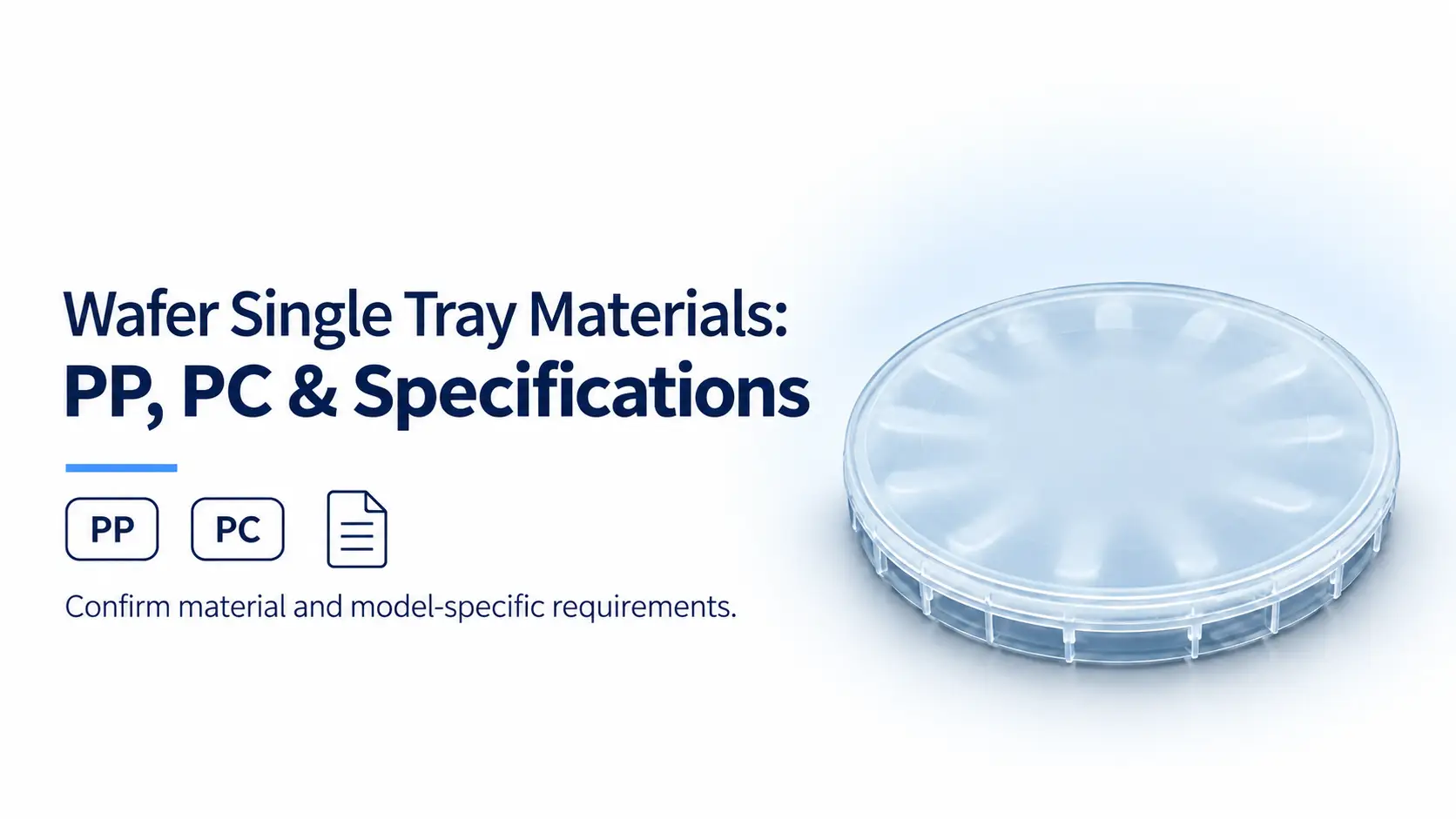
Wafer Single Tray Materials: PP, PC, and Specification Checks
PP and PC are two materials used in YJ COREVIA’s wafer single trays. PP means polypropylene; PC means polycarbonate. In the TJF-O series, the 2-, 4-, and 6-inch models are listed as PP, while the 8- and 12-inch models are listed as PC.
For material selection, PP’s chemical resistance and PC’s mechanical strength and potential transparency are relevant starting points. However, the suitable tray depends on the actual product design, wafer specifications, cleaning process, and quality requirements. Neither polymer name establishes ESD protection or a measured cleanliness level.
This guide compares the material considerations, summarizes YJ COREVIA’s published specifications, and explains what to confirm before purchasing a single wafer tray.
PP vs PC: What Matters for a Wafer Single Tray?
A useful comparison separates general polymer characteristics from the specifications of the finished tray.
Polypropylene is recognized for its resistance to many chemical environments. Polycarbonate is known for its combination of mechanical strength, impact resistance, and clarity. These characteristics help identify questions to investigate; they do not demonstrate that one finished tray performs better than another.
YJ COREVIA lists PP for its 2-, 4-, and 6-inch TJF-O models, and PC for its 8- and 12-inch models. Material is specified by model, so PP and PC should not be treated as interchangeable options for every size.
| Nominal Wafer Size | Model | Listed Material |
|---|---|---|
| 2 inch | TJF-O2 | PP — polypropylene |
| 4 inch | TJF-O4 | PP — polypropylene |
| 6 inch | TJF-O6 | PP — polypropylene |
| 8 inch | TJF-O8 | PC — polycarbonate |
| 12 inch | TJF-O12 | PC — polycarbonate |
The linked pages identify each model’s base material. This table summarizes those listings; it does not compare tested mechanical properties or establish electrical performance.
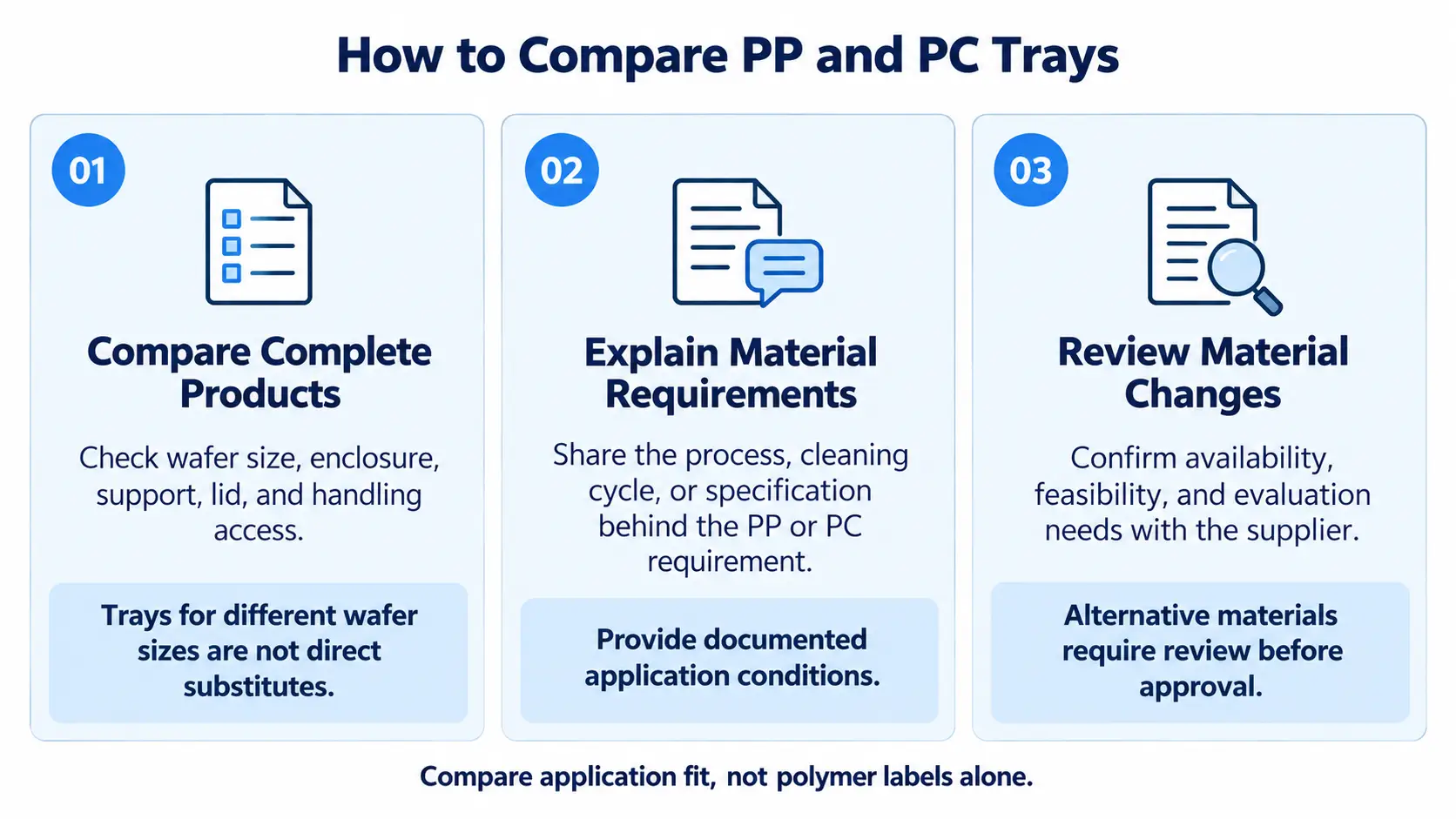
How to Compare PP and PC Trays
1. Compare Complete Products
Review the enclosure, internal support, lid, and handling access together.
Two trays made from different polymers may also have different dimensions and support arrangements. Material properties are only one part of the comparison. Products intended for different wafer sizes are not direct substitutes.
For example, TJF-O6 and TJF-O8 differ in both nominal wafer size and listed material. Their material labels alone cannot determine which product fits a particular wafer.
2. Explain Why a Material Is Required
If a purchasing specification requests PP or PC, identify the reason behind that requirement.
It may relate to an existing process, cleaning procedure, customer specification, or approved product. Share that information with the supplier so the review addresses the application.
Compatibility with a documented cleaning cycle gives the supplier more useful information than a general request for a durable material.
3. Review Proposed Material Changes
Confirm availability before specifying another polymer for an existing model.
A material change may require a separate design and manufacturing review. Discuss feasibility and evaluation needs before treating an alternative material as an approved replacement.
ESD Information to Request for the Selected Model
1. Identify the Exact Product and Material Version
PP and PC labels do not classify a tray as anti-static, dissipative, or conductive.
If ESD control is required, request the electrical specification for the exact model and material version being supplied. Information for a base resin or another carrier may not apply to the finished tray.
An ESD specification for a PC FOUP, for example, should not be transferred to a PC wafer single tray solely because both products use PC.
2. Provide the Required Acceptance Criteria
Include the relevant facility or customer requirements in the inquiry. Where resistance or charge-related criteria apply, specify the required values, test method, and conditions.
Ask whether the available information covers the supplied product and the intended use. An undefined “ESD-safe” label leaves these details unresolved.
Electrical characteristics, wafer fit, and shipping-package suitability require separate checks.
Cleanliness, Cleaning, and Reuse Requirements
1. Specify the Delivery Condition
A cleanliness requirement should identify the acceptance criteria and expected delivery condition.
Describe how the tray will be received, stored, and introduced into the process. Ask what preparation options or product-specific documentation are available for the selected model.
A general cleanroom-use statement does not identify a measured particle limit or residue requirement.
2. Describe the Cleaning Process
For compatibility review, provide:
- Cleaning agent and concentration.
- Process temperature.
- Exposure time.
- Rinsing and drying methods.
- Expected cleaning frequency.
These conditions give the supplier a basis for reviewing the intended process. Broad material descriptions are less useful when the application has a defined cleaning procedure.
3. Define Evaluation and Reuse Criteria
Begin with a candidate model that fits the wafer, then evaluate the relevant cleaning and quality requirements.
Define what must remain acceptable after handling and cleaning. Depending on the application, checks may include lid operation, support geometry, enclosure condition, cleanliness, and required electrical characteristics.
Record the model, supplied material version, process conditions, and results. If the cleaning process or product specification changes, review whether the previous evaluation still applies.
An inspection after one cleaning cycle supports only that evaluation scope; it does not establish an unlimited service life.
Specification Checklist Before Purchasing
| Requirement | Information to Confirm | Insufficient on Its Own |
|---|---|---|
| Material identity | Material listed for the exact model and supplied version | A description of another product in the same family |
| Wafer fit | Thickness compatibility, support locations, and handling access | Polymer name or nominal wafer size |
| ESD control | Applicable electrical specification and product-specific test information | “PP,” “PC,” or an undefined “ESD-safe” label |
| Cleanliness | Acceptance criteria, preparation, and delivery condition | A general cleanroom-use statement |
| Cleaning compatibility | Compatibility with the documented cleaning process | A broad chemical-resistance claim |
| Repeated use | Inspection criteria and the required evaluation after use or cleaning | An unspecified “reusable” description |
Use this checklist to identify missing information before placing an order. Resolve mandatory requirements for the selected product rather than assuming they apply across the series.
Contact YJ COREVIA for Material and Procurement Questions
For wafer single tray purchasing, contact us with the wafer specifications, candidate model, application, and required quantity.
Include any ESD acceptance criteria, cleaning conditions, cleanliness requirements, or customer specifications. For a replacement project, provide the current tray information and the reason for the proposed change.
The inquiry can cover available product information, model selection, sample evaluation, pricing, and lead time. Alternative materials or special requirements are subject to confirmation.
Conclusion
PP and PC identify the base materials used in YJ COREVIA’s TJF-O series. Selecting a suitable tray also requires product-specific checks on wafer fit, electrical characteristics, delivery condition, and cleaning compatibility.
Clear acceptance criteria help the supplier review the application and identify any information or evaluation still needed before purchasing.
For the broader overview of applications, sizes, and selection, read What Is a Wafer Single Tray? Uses, Sizes, and Selection Guide.
FAQ
1. Is PC Always Better Than PP for a Wafer Single Tray?
No universal preference applies. The complete tray design, wafer fit, handling method, and process requirements determine suitability. In the TJF-O series, PP and PC are listed for different models and sizes.
2. Does a PP or PC Tray Automatically Provide ESD Protection?
No. Request the electrical specification for the exact product being supplied. Material identification alone does not establish ESD performance.
3. Can I Use the Same Cleaning Process for Every Tray?
Provide the cleaning agent, concentration, temperature, and exposure conditions for each model’s compatibility review. Approval for one product does not automatically cover another.
4. Can a Standard Tray Be Ordered in a Different Material?
Availability must be confirmed with the supplier. A material change is subject to feasibility review and may require additional evaluation.