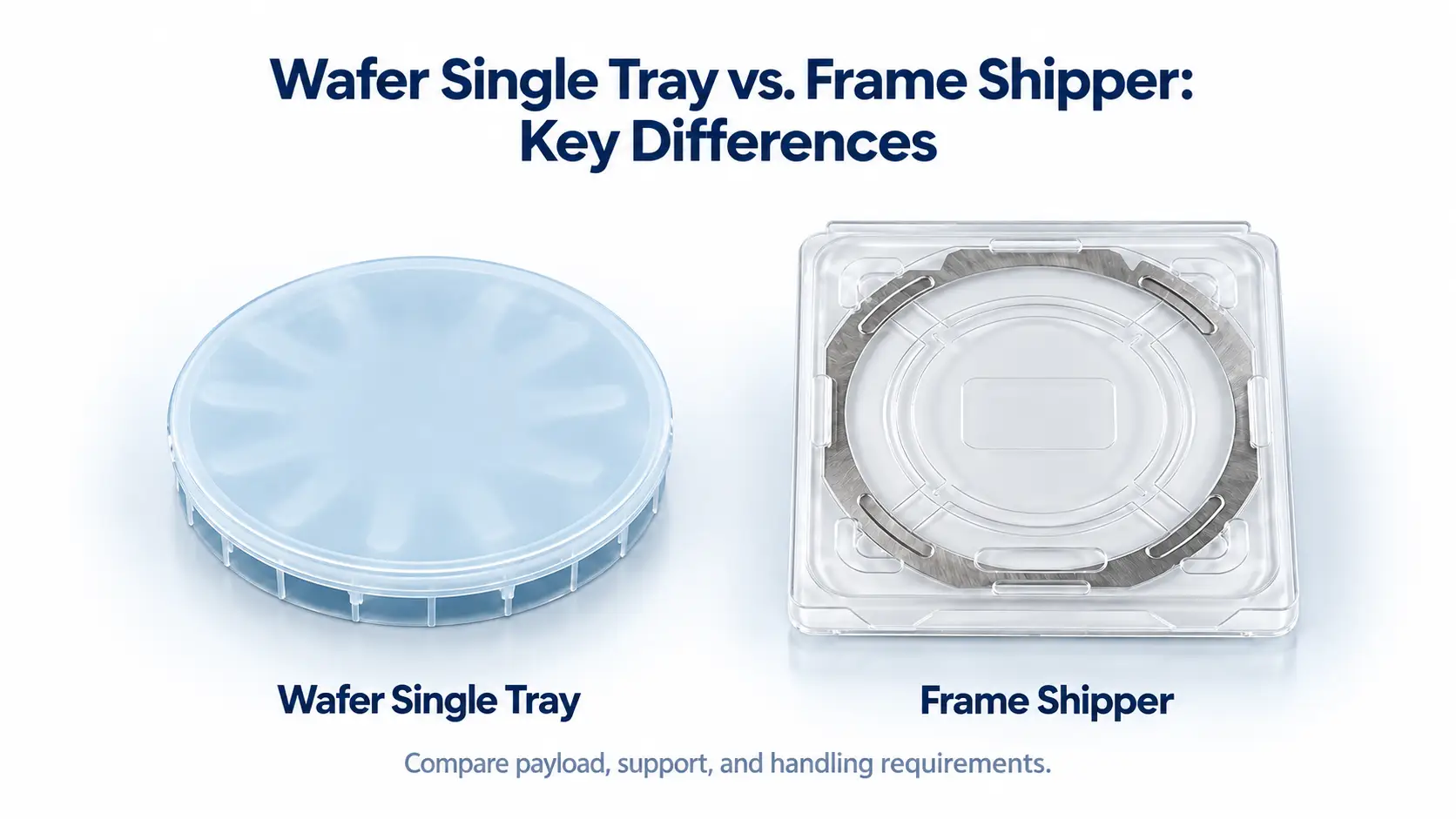
Wafer Single Tray vs. Frame Shipper: Key Differences
For an individual wafer handled without a frame, start with a wafer single tray designed for that wafer. For a wafer that remains on tape and a frame, start with a frame shipper matched to the complete assembly.
This guide compares YJ COREVIA’s TJF-O6 and TJF-S6. Product names may overlap between suppliers, so the intended payload and support design should guide selection.
Wafer Single Tray vs. Frame Shipper at a Glance
| Selection Point | Wafer Single Tray | Frame Shipper |
|---|---|---|
| Payload evaluated here | An individual wafer without a frame | A wafer mounted on tape and a frame |
| First dimensions to check | Wafer diameter and thickness | Frame outline and complete assembly dimensions |
| Support requirements | Contact locations permitted on the wafer | Suitable frame contact locations and clearance for the wafer and tape |
| Handling requirements | Access for the intended wafer pickup tool | Access for lifting and placing the frame assembly |
| YJ COREVIA example | TJF-O6 | TJF-S6 |
Choose by payload first. For an individual wafer without a frame, evaluate a single wafer tray. For a wafer that remains on tape and a frame, evaluate a frame shipper. If a proposed carrier supports both configurations, request confirmation of the support arrangement for each payload before ordering.
After identifying the carrier type, review three practical conditions: the payload fits, all intended contact locations are acceptable, and loading and retrieval can be completed with the intended handling method.
Identify What Will Be Loaded
1. Individual Wafer
For a wafer handled without a frame, provide its diameter, thickness, surface features, and contact restrictions.
The tray must support the wafer at permitted locations and provide enough access for loading and retrieval. A suitable nominal size does not confirm compatibility with a thinned, bonded, or otherwise modified wafer.
YJ COREVIA’s TJF-O series provides single wafer trays. Review the selected model against the actual wafer specification.
2. Wafer Mounted on Tape and a Frame
For a frame-mounted wafer, provide the complete assembly information.
The frame outline, thickness, orientation, and any protruding features affect fit. The carrier must also provide clearance for the wafer and tape where contact is restricted.
A “6-inch wafer” description alone leaves out the frame dimensions needed for selection.
3. Why Product Names Can Be Confusing
Suppliers may use terms such as single wafer tray, single wafer shipper, film frame shipper, and metal frame shipper differently. A product described as a single wafer tray may be designed for a frame-mounted wafer.
Use the name to find candidate products, then review the intended payload, drawing, and support arrangement. This guide compares specific YJ COREVIA models rather than treating those names as universal categories.
TJF-O6 and TJF-S6: Published Product Specifications
Both products are associated with 6-inch wafer applications, but their published specifications describe different carrier designs.
| Published Specification | TJF-O6 | TJF-S6 |
|---|---|---|
| Product name | 6-Inch Wafer Single Tray | 6 Inch Wafer Metal Frame Shipper |
| Listed material | PP — polypropylene | PET — polyethylene terephthalate |
| Listed dimensions | Ø164 × 21(H) mm | 249(L) × 255(W) × 0.98(Th) mm |
| Application reviewed here | Individual wafer handling | Frame assembly handling |
| Official product specifications | TJF-O6 wafer single tray | TJF-S6 wafer frame shipper |
For an individual 6-inch wafer, TJF-O6 is a candidate for evaluation. For a 6-inch wafer mounted on a metal frame, TJF-S6 is a candidate. Neither nominal size nor listed product dimensions establish compatibility with every wafer or frame configuration.
For help identifying a model, send us your wafer or frame assembly specifications. Include the payload dimensions, contact restrictions, and handling method.
1. Product Height and Thickness Are Different Measurements
TJF-O6 lists height as H. TJF-S6 lists a thickness value as Th. These figures should not be compared as if they were both enclosure heights.
The 0.98 mm value does not establish usable internal height or allowable assembly thickness. Request the relevant internal dimensions or drawing to confirm fit.
2. “Metal Frame Shipper” Does Not Mean a Metal Enclosure
TJF-S6 is listed as a PET shipper for metal wafer frames. “Metal” describes the frame being carried, not the shipper’s material.
The official description also mentions horizontal placement of wafers or wafer frames. For an individual wafer application, confirm the support and positioning arrangement of the supplied configuration.
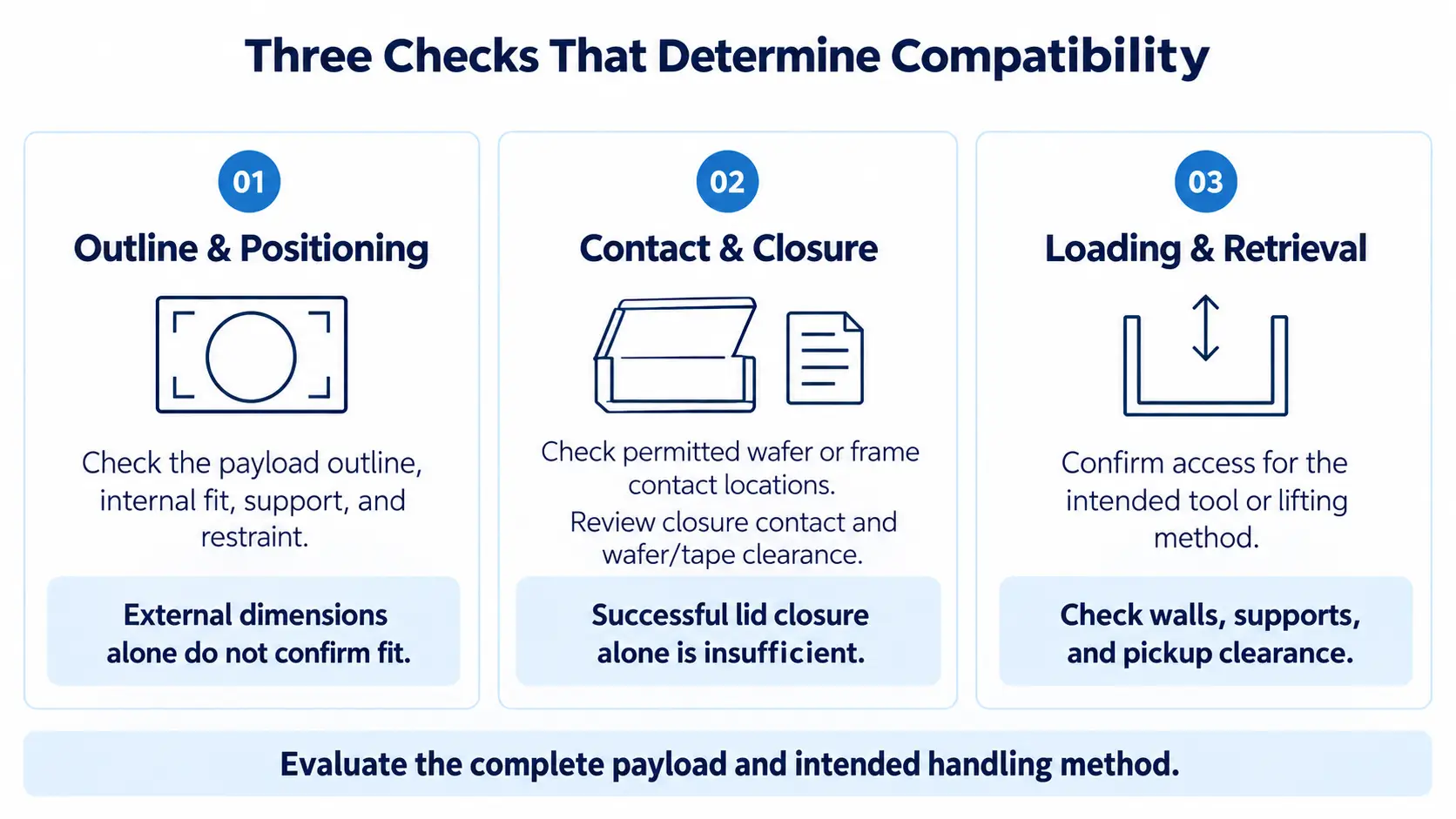
Three Checks That Determine Compatibility
1. Outline and Positioning
An individual wafer presents the wafer outline to the carrier. A frame assembly presents the larger frame outline and the complete assembly profile.
Review how the payload sits inside the carrier and how it is located. The design should provide appropriate support and restraint without interference.
External product dimensions help with storage and packaging planning. Internal dimensions and support information are needed for the fit review.
2. Contact and Closure
For an individual wafer, compare every intended contact location with the process restrictions.
For a frame assembly, review frame contact locations and clearance around the wafer and tape. Check whether closing the enclosure introduces additional contact.
If contact is part of the retention design, its location and loading must be acceptable for the payload. Successful lid closure alone is insufficient.
3. Loading and Retrieval
Evaluate access using the intended handling method.
Wafer tweezers, vacuum tools, and frame lifting methods may require different space. The operator or tool should be able to reach the pickup location without interference from the carrier walls or supports.
Include this check when replacing an existing carrier with a different design.
Choosing for Common Handling Situations
1. Individual Test Wafer Delivery
For a test wafer delivered without a frame, begin with a carrier designed for individual wafer support.
Provide the wafer specifications and retrieval method. Evaluate fit and contact locations, then review the complete packaging arrangement for the delivery route.
2. Transfer of a Frame-Mounted Wafer
For a wafer that must remain on its tape and frame, begin with a shipper matched to that assembly.
Provide the frame drawing or model information, tape contact restrictions, and required handling orientation. Evaluate the complete assembly rather than the wafer alone.
3. A Payload Change Between Process Steps
Recheck carrier suitability when the payload changes.
A wafer may be handled individually at one stage and as a frame assembly at another. Approval for the earlier configuration does not automatically cover the later one.
If spacers or adapters are proposed, review their effect on support, clearance, and retrieval before use.
Information to Provide Before Purchasing
Prepare the following information for a model recommendation:
- Payload: individual wafer or complete frame assembly.
- Dimensions: wafer diameter and thickness, or frame outline and assembly thickness, with relevant tolerances.
- Contact restrictions: permitted support locations and areas that must remain untouched.
- Handling method: tool type, pickup location, and orientation.
- Use conditions: storage, internal transfer, or external delivery.
- Purchasing requirements: quantity, delivery date, and sample evaluation needs.
Include any ESD or cleanliness requirements for the exact product being supplied. Material names alone do not establish compliance.
For sample evaluation, record the carrier model, payload configuration, and handling procedure so the approval scope is clear.
Contact YJ COREVIA for Carrier Selection
For model selection, sample evaluation, or volume purchasing, contact us.
Send the wafer or frame assembly specifications, application, quantity, and requested delivery date. Drawings and photographs can help explain contact restrictions or replacement needs.
The inquiry can cover candidate models, available product information, pricing, and lead time.
Conclusion
An individual wafer without a frame calls for a review of wafer support and pickup access. A frame-mounted wafer calls for a review of the complete frame outline, contact locations, and clearance around the wafer and tape.
Choose the carrier type by payload, then evaluate fit, contact, and retrieval. If one carrier will handle both configurations, evaluate each separately.
For the broader overview of applications, sizes, and selection, read What Is a Wafer Single Tray? Uses, Sizes, and Selection Guide.
FAQ
1. Can a Wafer Single Tray Hold a Frame-Mounted Wafer?
Only if the selected design accommodates the complete assembly. A tray intended for wafer diameter alone may not provide the required frame support or clearance.
2. Can a Frame Shipper Hold an Individual Wafer?
Some designs may accommodate individual wafers. Confirm suitable support, positioning, and handling access for the selected model and configuration.
3. Is TJF-S6 Made from Metal?
No. Its official material listing is PET. The product name refers to the metal wafer frame it is intended to carry.
4. Is a Shipper Ready for Courier Delivery?
Confirm the complete packaging arrangement for the intended delivery conditions. An outer carton, cushioning, or additional restraint may be needed. Carrier fit does not establish shipping suitability.