Wafer Cassette Material Guide: PP, PC, PFA and Anti-Static Options
Choosing a wafer cassette material is not only a cost decision. The material can affect cleanliness, chemical resistance, cassette rigidity, ESD behavior, cleaning compatibility, and long-term use.
In real wafer handling, the same cassette material may work well in one process but not in another. A cassette used for simple wafer storage may not need the same material as one used near cleaning, drying, chemical exposure, or ESD-sensitive handling.
This guide compares common wafer cassette material options, including PP, PC, PFA, and anti-static materials, and explains what buyers should check before choosing a material.
For process-based selection, you may also review our guide on how to choose a wafer cassette by wafer condition and process.
Quick Comparison of Wafer Cassette Materials
Use this table as a quick starting point. Final material selection should still be checked against the actual process, cleaning method, and handling environment.
| Material Option | Common Strength | What to Check |
|---|---|---|
| PP Wafer Cassette | General handling, lightweight use, basic chemical resistance | Cleaning method, cleanroom requirement, reuse condition |
| PC Wafer Cassette | Rigidity, visibility, impact resistance | Chemical compatibility, surface condition, cleaning process |
| PFA Wafer Cassette | Higher chemical resistance and process compatibility | Chemical exposure, process requirement, cost, cleaning environment |
| Anti-Static Wafer Cassette | ESD-sensitive wafer handling | ESD requirement, handling flow, packaging, storage condition |
| Custom Material | Special process or equipment needs | Temperature, chemicals, ESD, cleaning method, tool fit |
PP Wafer Cassette
PP wafer cassettes are commonly used for general wafer storage, transfer, and cleanroom handling. They are often considered when the application needs a lightweight and practical cassette for daily wafer movement.
Polypropylene may be suitable for:
- General wafer storage
- Short-term wafer transfer
- Cleanroom movement
- Basic handling applications
- Processes with moderate chemical exposure
The key is to confirm the actual use condition. A PP cassette may be enough for simple storage, but it still needs to be reviewed if the cassette will be cleaned often, exposed to chemicals, or reused for a long time.
For buyers, PP is often practical, but it should not be selected only because it is common. The cleaning method, wafer condition, and cleanroom requirement still matter.
PC Wafer Cassette
PC wafer cassettes may be considered when rigidity, visibility, or impact resistance is important. In some handling environments, visibility can help operators check wafer position or loading status more easily.
Polycarbonate may be considered for:
- Wafer transfer
- Inspection preparation
- Handling where visibility is useful
- Applications requiring stronger structure
- Cleanroom storage under suitable process conditions
The main point to check is chemical compatibility. PC may not be suitable for every cleaning process or chemical environment.
If the cassette will be wiped, washed, cleaned, or exposed to process chemicals, the material should be reviewed before use. Buyers should also consider surface condition, scratching, and long-term durability.
PFA Wafer Cassette
PFA wafer cassettes are usually considered for more demanding environments, especially when chemical resistance is important.
PFA may be suitable for:
- Chemical-related wafer handling
- Cleaning or wet process environments
- Processes requiring higher material stability
- Applications where chemical compatibility is a major concern
PFA can be a strong option when the process has stricter chemical or cleanliness requirements. However, it may not be necessary for every wafer cassette application.
In practice, the best material is not always the highest-grade material. It is the material that matches the process risk. Before choosing PFA, buyers should confirm the chemical exposure, cleaning method, required cleanliness level, budget, and actual process need.
Anti-Static Wafer Cassette Material
An anti-static wafer cassette may be needed when wafers or devices are ESD-sensitive. This is especially important for processed wafers, sensitive devices, or customer-required ESD-safe handling.
Anti-static options may be considered when:
- Wafers or devices are ESD-sensitive
- Customer requirements specify ESD-safe handling
- Wafers are moved frequently between workstations
- Static buildup may affect handling safety
- The cassette is used with ESD-safe carts, benches, or packaging
Anti-static material should not be treated as a complete ESD solution by itself. The cassette should be reviewed together with operators, gloves, workstations, carts, packaging, storage, and transport conditions.
If anti-static performance comes from surface treatment, buyers should also confirm whether the performance remains stable after cleaning, wiping, or repeated handling.
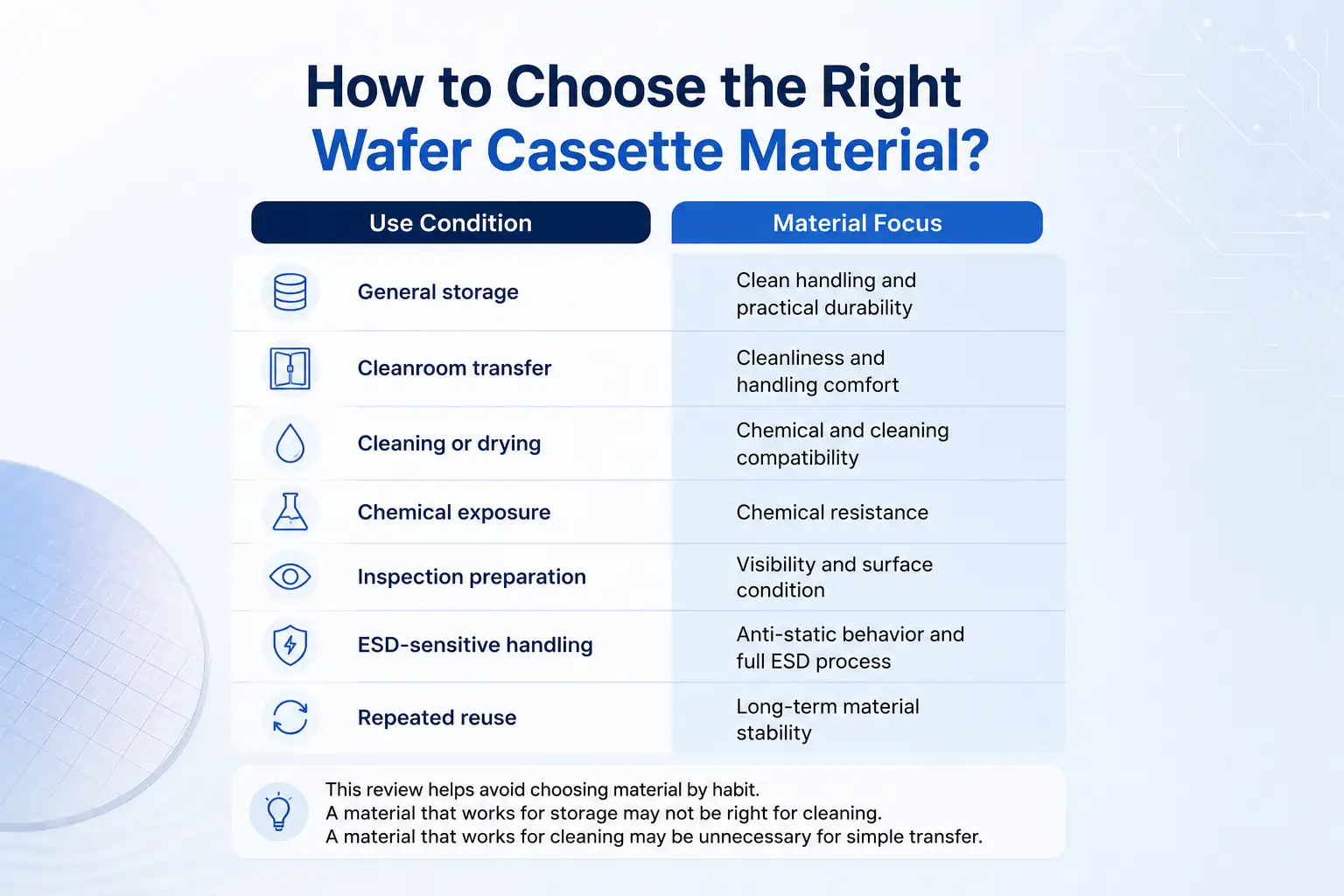
How to Choose the Right Wafer Cassette Material?
The best way to choose material is to start from the actual use condition.
| Use Condition | Material Focus | Key Question |
|---|---|---|
| General storage | Clean handling and practical durability | Does the cassette provide stable and clean storage? |
| Cleanroom transfer | Cleanliness and handling comfort | Does the material match the cleanroom and transfer method? |
| Cleaning or drying | Chemical and cleaning compatibility | Can the material tolerate the cleaning method? |
| Chemical exposure | Chemical resistance | Is stronger chemical resistance required? |
| Inspection preparation | Visibility and surface condition | Does the material help operators check wafer position? |
| ESD-sensitive handling | Anti-static behavior and full ESD process | Does the cassette work with the ESD-safe environment? |
| Repeated reuse | Long-term material stability | Will the material remain suitable after repeated use and cleaning? |
This review helps avoid choosing material by habit. A material that works for storage may not be right for cleaning. A material that works for cleaning may be unnecessary for simple transfer.
When Custom Material Review Is Needed
Custom material review may be needed when standard wafer cassette materials do not match the process.
This may happen when the application has:
- Specific chemical exposure
- Repeated cleaning or wiping
- ESD-sensitive handling
- Special cleanliness requirements
- Higher durability needs
- Tool, rack, or storage compatibility limits
- Customer-specific material requirements
A custom material choice should solve a real handling or process issue. It should not only make the cassette look more advanced.
YJ Corevia Wafer Cassette Material Support
YJ Corevia provides wafer cassette, wafer carrier, wafer storage box, wafer shipper, wafer frame cassette, and custom semiconductor handling solutions.
For wafer cassette material selection, YJ Corevia can review the wafer condition, cleaning method, chemical exposure, ESD need, material preference, reuse frequency, cleanroom requirement, and equipment compatibility before recommending a suitable option.
YJ Corevia supports 4-inch, 6-inch, 8-inch, and 12-inch wafer handling applications, as well as custom wafer cassette solutions based on material, process, cleanroom, and handling requirements.
Conclusion
The right wafer cassette material depends on how the cassette will be used in your process. A cassette for simple storage does not need the same properties as one used for cleaning, drying, chemical contact, ESD control, or repeated transfer inside a cleanroom.
To choose the right option, start from the actual handling conditions. Consider what type of wafer will be stored, how often the cassette will be reused, whether it will contact chemicals or moisture, whether static control is required, and whether it must fit existing tools, racks, or transfer equipment.
Contact us to discuss wafer cassette material options for storage, transfer, cleaning-related use, ESD-sensitive environments, and custom semiconductor handling requirements.
FAQ
1. What materials are used for wafer cassettes?
Common wafer cassette materials may include PP, PC, PFA, anti-static materials, or custom material options depending on the process and handling requirement.
2. How do I choose wafer cassette material?
Choose the material based on wafer condition, cleaning method, chemical exposure, cleanroom use, ESD requirement, reuse frequency, and equipment compatibility.
3. Is PP suitable for wafer cassettes?
PP may be suitable for general wafer storage, transfer, and basic handling applications, but the cleaning method and process conditions should still be reviewed.
4. When should I use a PFA wafer cassette?
PFA may be considered when higher chemical resistance or stricter process compatibility is required, especially in chemical-related or cleaning environments.
5. Do I need an anti-static wafer cassette?
Anti-static wafer cassettes may be needed when wafers or devices are ESD-sensitive, or when the customer requires ESD-safe handling.