
What Is a Wafer FOUP? Front-Opening Carrier and Tool Interface Guide
In semiconductor production, a carrier can hold the correct wafers and still be unsuitable for the equipment using it. The problem is often not wafer capacity, but how the carrier is positioned, opened, and accessed at the tool.
This is where a wafer FOUP differs from a general wafer holder. FOUP stands for Front Opening Unified Pod, but the front-opening structure is only one part of the design. The carrier must also create a repeatable connection between the wafers, the load port, and the tool-side handling system.
When a FOUP reaches a process station, its door position, carrier base, slot height, and wafer access path need to work together. If one of these points does not match the equipment, loading may become difficult even when the carrier dimensions appear correct.
This guide looks at wafer FOUPs from an equipment-interface point of view. It explains how the carrier fits into the handling workflow and what buyers should confirm before selecting or customizing one.
How a Wafer FOUP Works at a Process Station?
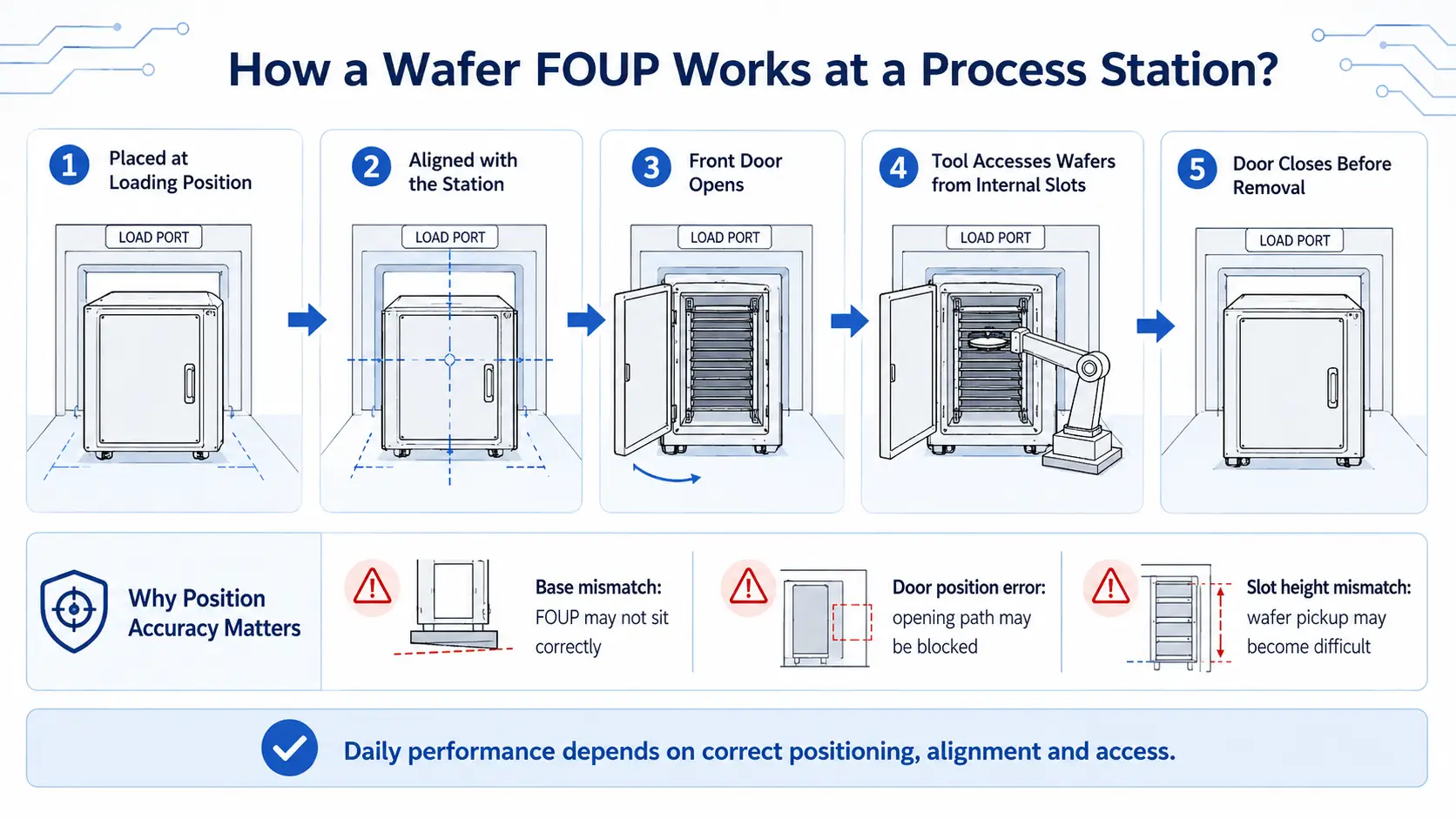
A wafer FOUP arrives at the equipment as a complete carrier. It is placed in a defined position, opened from the front, and kept stable while the tool accesses the wafers inside.
The basic sequence is usually straightforward:
- The wafer FOUP is placed at the loading position.
- The carrier is aligned with the station.
- The front door is opened.
- The equipment accesses wafers from the internal slots.
- The door is closed before the carrier is removed.
What matters is not the number of steps. What matters is whether each step happens in the correct position.
If the carrier base is slightly different from the station layout, the wafer FOUP may not sit correctly. If the door position is wrong, the opening path may be blocked. If the slot height does not match the tool, wafer pickup may become difficult.
These are the issues that often determine whether a wafer FOUP works well in daily use.
Why Front-Opening Access Matters
The front-opening structure allows the wafer FOUP to remain in place while wafers are loaded or removed.
That sounds simple, but it affects several parts of the handling process:
- Where the carrier must be positioned
- How much space is needed in front of the door
- Where the first wafer slot begins
- How the tool approaches each wafer
- Whether the carrier can be opened repeatedly in the same way
A wafer FOUP may fit within the station footprint but still be unsuitable if there is not enough space for the door movement.
This is why outside dimensions alone are not enough for compatibility review.
The Door and Load Port Must Be Reviewed Together
The front door is part of the operating interface. It cannot be reviewed separately from the load port or station.
When the wafer FOUP is placed at the equipment, the door must line up with the opening area. The carrier also needs to stay in a stable and repeatable position during access.
Buyers should confirm:
- Where the wafer FOUP sits
- How the carrier is located or supported
- How the door opens
- How much front clearance is available
- Where the wafer slots sit in relation to the tool
- Whether the carrier can be placed in the same position each time
A common mistake is to confirm that the wafer FOUP can physically fit on the station, but not check whether it can actually operate there.
The carrier may fit. The process may still not work.
Carrier Positioning Is More Important Than It Looks
A wafer FOUP should return to the same position every time it is loaded.
If one operator places it slightly forward and another places it slightly backward, the tool may not see the same wafer access position. In an automated system, even a small difference can affect alignment.
Repeatable positioning may depend on:
- The carrier base
- Locating points
- Support surfaces
- Station guides
- Placement stops
- Loading direction
This is why carrier positioning should be discussed before the wafer FOUP design is finalized.
The goal is not to make the wafer FOUP fit once. It should fit the same way every time.
Wafer Slot Position Must Match the Tool
The internal slot layout also affects equipment compatibility.
The tool needs to know where the first wafer is located and how each following slot is spaced. If the slot position does not match the access path, the equipment may not be able to pick wafers smoothly.
Important points include:
- First-slot height
- Slot spacing
- Wafer support position
- Access depth
- Edge clearance
- Tool pickup direction
A wafer FOUP can hold wafers securely and still be difficult to use if the slot arrangement does not match the equipment.
This is one reason a sample, dimensional drawing, or existing carrier reference can be very useful during the review stage.
What Information Should Buyers Provide?
A request such as “We need a wafer FOUP” is usually not enough to confirm compatibility.
The most useful information is often related to the equipment and working space.
Buyers can provide:
- Equipment model
- Load port or station type
- Loading direction
- Available front clearance
- Carrier placement area
- Door opening method
- Wafer access height
- Manual or automated handling
- Rack or cart dimensions
- Photos or dimensional sketches
A complete equipment drawing is helpful, but it is not always required at the beginning.
A clear photo with dimensions can often show where the wafer FOUP needs to sit, how the door needs to open, and where access problems may occur.
Wafer FOUP Compatibility Checklist
| Check Item | What to Confirm |
|---|---|
| Carrier placement | Height, depth, loading direction, and support position |
| Front opening | Door direction, front clearance, and opening path |
| Load port fit | Carrier base, seating area, and locating method |
| Slot alignment | First-slot height, slot spacing, and wafer position |
| Pickup clearance | Access depth, edge clearance, and tool approach |
| Handling method | Manual placement, cart transfer, robot loading, or automated movement |
| Identification | Label position, carrier ID, or RFID requirement |
This checklist is more useful than choosing a wafer FOUP from the outside dimensions alone.
When a Custom Wafer FOUP Makes Sense
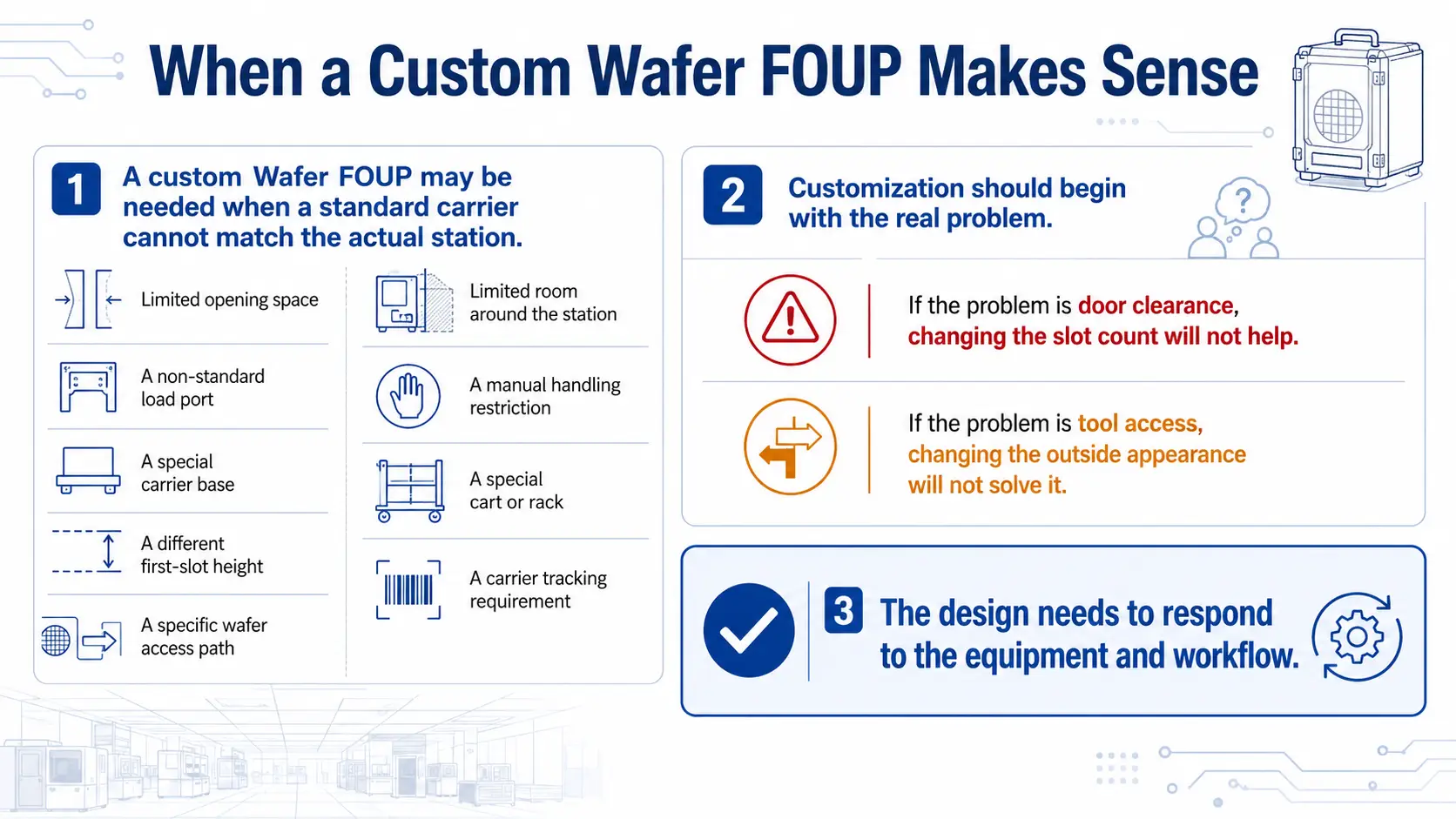
A custom wafer FOUP may be needed when a standard carrier cannot match the actual station.
This may happen when there is:
- Limited opening space
- A non-standard load port
- A special carrier base
- A different first-slot height
- A specific wafer access path
- Limited room around the station
- A manual handling restriction
- A special cart or rack
- A carrier tracking requirement
Customization should begin with the real problem.
If the problem is door clearance, changing the slot count will not help. If the problem is tool access, changing the outside appearance will not solve it.
The design needs to respond to the equipment and workflow.
YJ Corevia Wafer FOUP Support
YJ Corevia supports wafer FOUP and custom semiconductor carrier projects based on actual equipment and handling requirements.
For an initial review, customers can provide equipment photos, drawings, measurements, existing carrier samples, or information about how the wafer FOUP will be loaded and opened.
The review may include:
- Load port fit
- Front-door access
- Carrier positioning
- Slot alignment
- Tool pickup clearance
- Manual or automated handling
- Rack and cart compatibility
- Identification requirements
The aim is to make sure the wafer FOUP works at the station, not only on the product drawing.
Conclusion
A wafer FOUP is a front-opening wafer carrier designed to work with semiconductor handling equipment.
Its suitability depends on more than wafer size or carrier dimensions. The door must open within the available space, the carrier must return to the same position, and the wafer slots must align with the equipment access path.
Before ordering a wafer FOUP, review the station, load port, door clearance, carrier base, slot position, and handling method.
A carrier that fits the wafer is only the starting point. It also needs to fit the process.
Contact us to discuss wafer FOUP compatibility, front-opening access, load port requirements, and custom equipment-side carrier design.
FAQ
1. What is a wafer FOUP?
A wafer FOUP is a Front Opening Unified Pod used to hold wafers in fixed slots and provide front-side access for semiconductor handling equipment.
2. How does a wafer FOUP work with a load port?
The wafer FOUP is placed in a fixed loading position. The front door is opened so the equipment can access wafers from the internal slots.
3. What should be checked before ordering a wafer FOUP?
Check the carrier position, door clearance, load port fit, first-slot height, slot spacing, pickup path, and handling method.
4. Can a wafer FOUP fit the wafer but not the equipment?
Yes. The carrier may hold the wafer correctly but still be incompatible with the station, door interface, or tool access path.
5.When is a custom wafer FOUP needed?
A custom wafer FOUP may be needed when standard carrier dimensions, slot positions, door access, or positioning features do not match the equipment.