How to Choose a Wafer Cassette by Wafer Condition and Process?
Choosing a wafer cassette should not start and end with wafer diameter. Size matters, but in real production, the wafer condition and process stage often decide whether a cassette is easy to use, safe to handle, and suitable for daily operation.
A cassette used for bare wafer storage may not be suitable for processed wafers, cleaning steps, inspection preparation, or equipment loading. The wafer may look the same by diameter, but the handling risk can be very different.
This article focuses on how to choose a wafer cassette based on wafer condition, process use, cleaning method, ESD needs, storage time, and equipment fit.
For a basic overview, see our article on what is a wafer cassette.
Why Wafer Condition Matters
Before choosing a wafer cassette, check the condition of the wafer. A bare wafer, processed wafer, cleaned wafer, or inspection-ready wafer may need different handling support.
| Wafer Condition | Main Handling Concern | What to Check |
|---|---|---|
| Bare wafers | Basic storage and clean transfer | Wafer diameter, slot spacing, material cleanliness |
| Processed wafers | Surface protection and stable handling | Edge support, ESD need, cleanroom compatibility |
| Wafers before cleaning | Material and process compatibility | Chemical exposure, drainage, cleaning method |
| Wafers after cleaning | Clean holding and reduced contamination risk | Surface condition, storage environment, cleanliness |
| Wafers before inspection | Sequence control and easy access | Slot count, loading method, batch organization |
In practice, the same cassette may not work equally well in every step. A cassette that is fine for temporary storage may not be the best choice for wet cleaning, drying, inspection, or repeated tool loading.
Choose Wafer Cassette by Process Stage
The process stage affects what the cassette needs to support. Instead of choosing only by catalog size, review where the cassette will actually be used.
1. Storage Between Steps
For temporary storage, the cassette should keep wafers separated, stable, and easy to identify. The main points are storage time, wafer sequence, cassette capacity, and the surrounding environment.
If wafers will stay in the cassette for a longer period, material cleanliness and storage conditions should also be reviewed.
2. Cleanroom Transfer
For cleanroom movement, the cassette should be easy to carry, place, and remove from carts, racks, or workstations. The cassette should also match the handling method used by operators or tools.
A cassette may fit the wafer but still cause problems if it is awkward to handle in the actual cleanroom layout.
3. Cleaning or Drying Process
If the cassette is used before, during, or after cleaning, material compatibility becomes more important. Buyers should check whether the cassette can work with the cleaning method, chemical exposure, drainage need, and drying process.
This is one of the areas where choosing by wafer diameter alone is not enough.
4. Inspection Preparation
Before inspection or measurement, wafers may need to stay in order. The cassette should support easy access and reduce unnecessary wafer handling.
For inspection steps, slot spacing, batch sequence, and loading method may matter more than maximum cassette capacity.
5. Equipment Loading
Some wafer cassettes need to fit specific tools, racks, cleaning systems, storage cabinets, or transfer carts. In this case, equipment fit should be confirmed before ordering.
A cassette can match the wafer size but still fail in production if the height, footprint, slot direction, or loading position does not match the workflow.
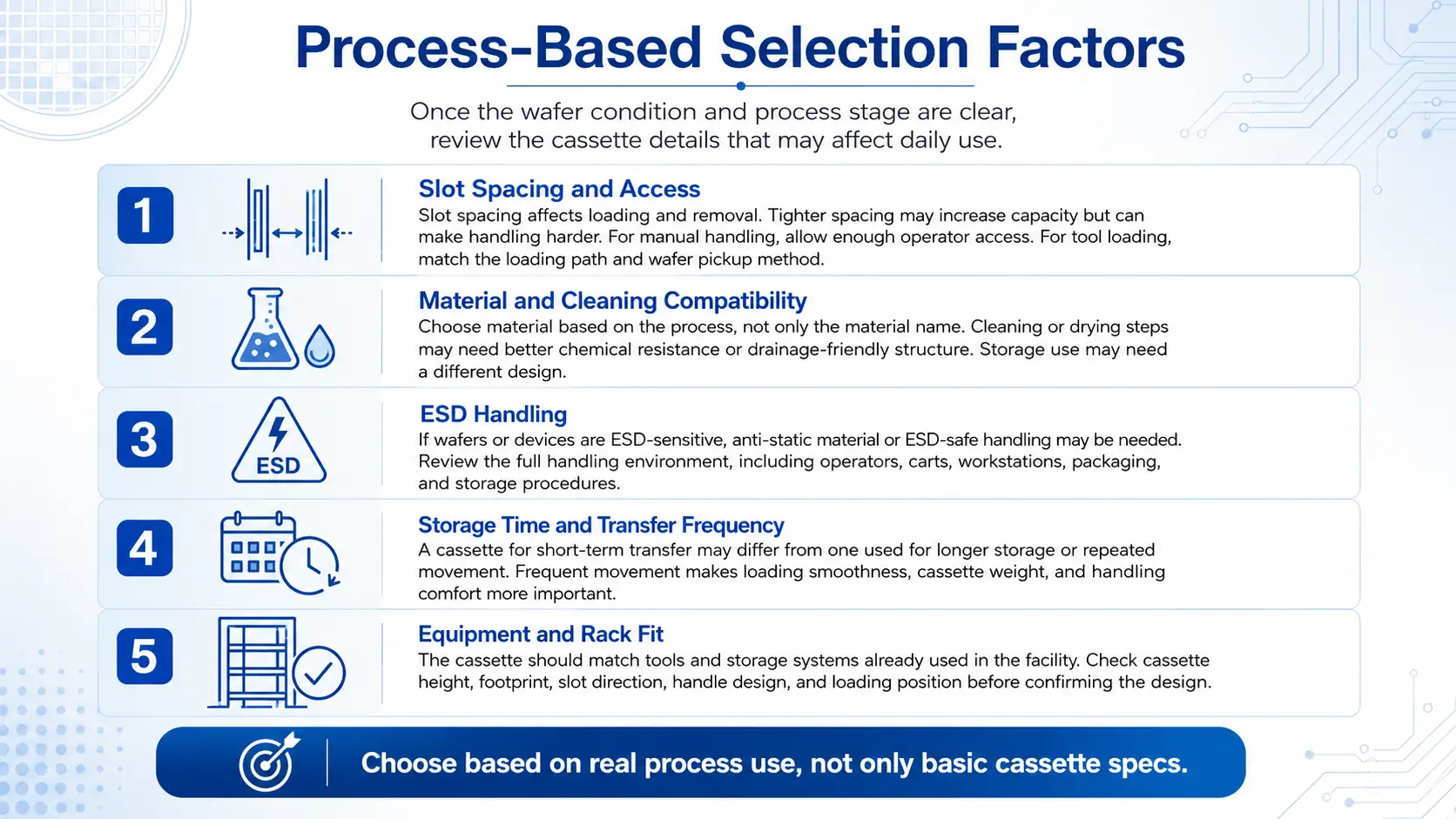
Process-Based Selection Factors
Once the wafer condition and process stage are clear, review the cassette details that may affect daily use.
1. Slot Spacing and Access
Slot spacing affects how easily wafers can be loaded and removed. Tighter spacing may increase capacity, but it can also make handling more difficult.
For manual handling, operators need enough access space. For tool loading, the cassette must match the tool’s loading path and wafer pickup method.
2. Material and Cleaning Compatibility
Material should be selected based on the process, not only the material name.
For example, a cassette used around cleaning or drying steps may need better chemical resistance or a structure that supports drainage. A cassette used mainly for storage may have different requirements.
3. ESD Handling
If wafers or devices are ESD-sensitive, anti-static material or ESD-safe handling may be needed.
The cassette should be reviewed together with the full handling environment, including operators, carts, workstations, packaging, and storage procedures.
4. Storage Time and Transfer Frequency
A cassette used for short-term transfer may not need the same design as one used for longer storage or repeated movement.
If wafers are moved many times a day, loading smoothness, cassette weight, and handling comfort become more important.
5. Equipment and Rack Fit
The cassette should match the tools and storage systems already used in the facility. Check cassette height, footprint, slot direction, handle design, and loading position before confirming the design.
This step can prevent problems that only appear after the cassette enters daily use.
Wafer Cassette Process Checklist
Use this checklist before confirming a wafer cassette for a specific process.
| Item to Check | Why It Matters | What to Confirm |
|---|---|---|
| Wafer condition | Different wafer conditions have different handling risks | Bare, processed, cleaned, or inspection-ready wafer |
| Process stage | The cassette must match how it will be used | Storage, transfer, cleaning, drying, inspection, loading |
| Cleaning method | Cleaning may affect material choice and cassette structure | Chemical exposure, drainage, drying, reuse |
| Storage time | Longer holding may require cleaner or more stable storage | Short-term transfer or longer temporary storage |
| Transfer frequency | Repeated handling increases the need for smooth access | Manual handling, tool loading, cart movement |
| ESD need | Important for sensitive wafers or devices | Anti-static material, packaging, ESD-safe handling |
| Equipment fit | Prevents workflow problems after production use | Tool, rack, cart, cabinet, or cleaning system compatibility |
When Custom Wafer Cassette Design Is Needed
Custom wafer cassette design may be needed when standard cassette options do not match the process.
This is common when the process has:
- Special wafer thickness or handling requirement
- Process-specific slot spacing
- Cleaning or drying compatibility needs
- ESD-sensitive handling conditions
- Fixed rack, cart, tool, or cabinet dimensions
- Special loading direction
- Long storage time or frequent transfer
- Custom material requirement
A custom cassette should solve a real process problem, not only change the size. The design should make wafer handling more stable, easier to repeat, and more compatible with the production flow.
YJ Corevia Wafer Cassette Support
YJ Corevia provides wafer cassette, wafer carrier, wafer storage box, wafer shipper, wafer frame cassette, and custom semiconductor handling solutions.
For wafer cassette projects, YJ Corevia can review the wafer condition, process stage, cleaning method, storage environment, transfer method, ESD need, material requirement, and equipment compatibility before recommending a suitable design.
YJ Corevia supports 4-inch, 6-inch, 8-inch, and 12-inch wafer handling applications, as well as custom wafer cassette solutions for cleanroom storage, transfer, cleaning, inspection, and process-specific handling needs.
Conclusion
A wafer cassette should be selected based on wafer condition and process use, not only wafer diameter or slot count.
Before ordering, review where the cassette will be used, how often wafers will be moved, whether cleaning or ESD control is required, and whether the cassette must fit existing tools, racks, carts, or storage systems.
The best cassette is the one that fits the wafer, supports the process, and works smoothly in daily operation.
Contact us today to discuss your wafer cassette requirement for storage, cleanroom transfer, cleaning, inspection, ESD-sensitive handling, or custom process use.
FAQ
1. How do I choose a wafer cassette by process?
Start by checking the wafer condition, process stage, cleaning method, transfer frequency, storage time, ESD requirement, and equipment compatibility.
2. Why is wafer condition important when choosing a cassette?
Bare wafers, processed wafers, cleaned wafers, and inspection-ready wafers may have different handling risks. The cassette should match the actual wafer condition.
3. Can one wafer cassette be used for every process step?
Not always. A cassette suitable for storage may not be suitable for cleaning, drying, inspection, or tool loading. The process should be reviewed before selection.
4. When do I need a custom wafer cassette?
Custom design may be needed when standard cassettes do not match the wafer condition, cleaning method, slot spacing, loading direction, material requirement, ESD need, or equipment layout.
5.What should I check before ordering a wafer cassette?
Check wafer condition, process stage, slot spacing, material, cleaning compatibility, ESD handling, storage environment, transfer method, and tool or rack compatibility.