Wafer FOUP for Automated Cleanroom Transfer: AMHS and Carrier Handoff Guide
Not every wafer FOUP can be placed into an automated material handling system without additional checks.
A wafer FOUP may work well when an operator moves and positions it by hand. In an automated cleanroom system, however, the carrier must arrive, align, transfer, and leave in a repeatable way.
Even a small difference in the carrier base, positioning point, clearance, or identification location may interrupt the transfer flow.
Before using a wafer FOUP with an Automated Material Handling System (AMHS), the complete route should be reviewed. This includes the transport system, stockers, buffers, equipment load ports, carrier identification, and each handoff point between them.
What Does Automated Wafer FOUP Handling Mean?
Automated wafer FOUP handling means moving wafer carriers through a cleanroom with limited manual intervention.
Depending on the fab layout, a wafer FOUP may move through:
- Overhead transport systems
- Stockers
- Buffer stations
- Automated storage areas
- Equipment load ports
- Inspection areas
- Process equipment
The wafer FOUP becomes part of a larger material flow.
It may fit the final process tool but still fail at a stocker, buffer station, or transfer point. This is why checking only one piece of equipment is not enough.
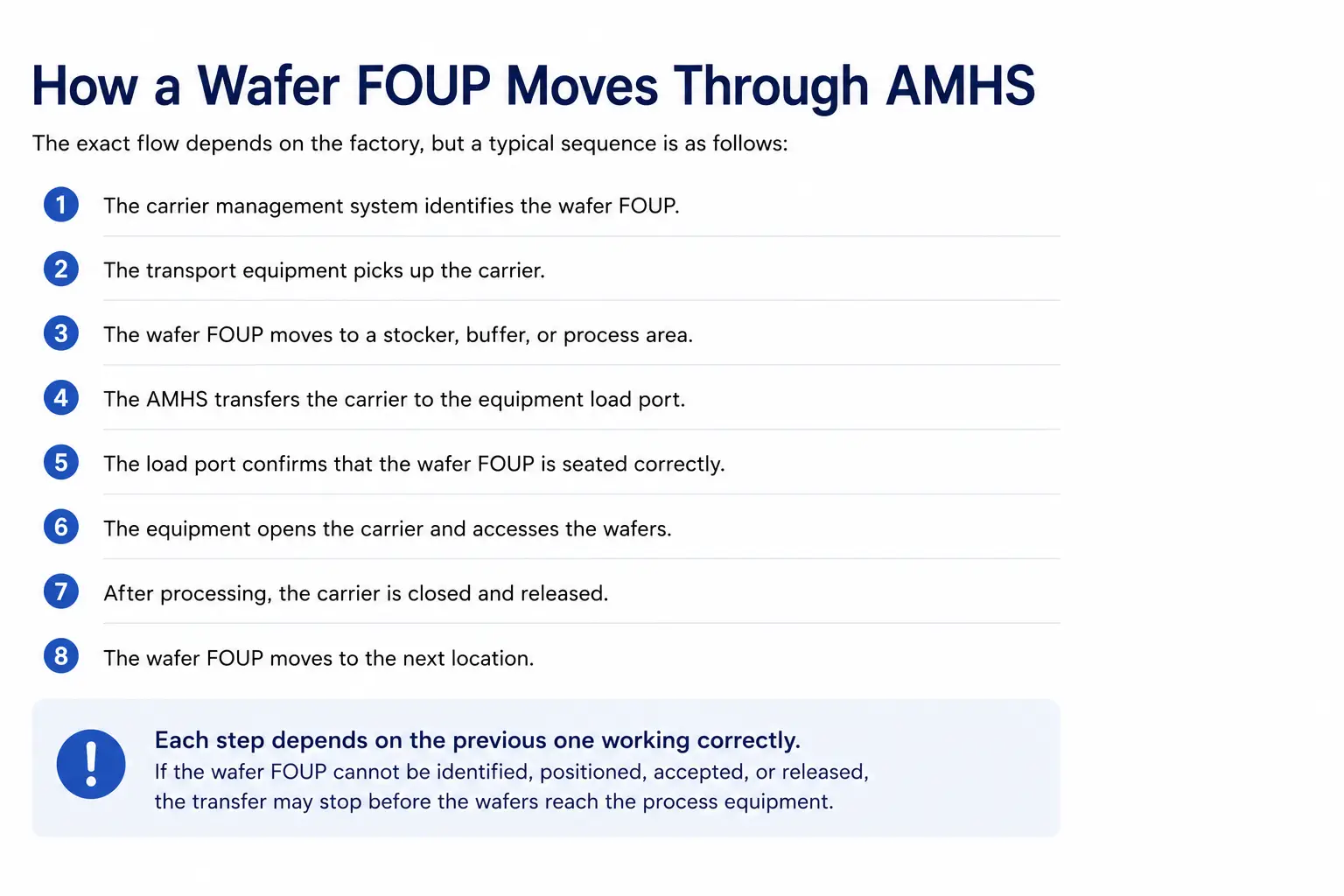
How a Wafer FOUP Moves Through AMHS?
The exact flow depends on the factory, but a typical sequence may look like this:
- The carrier management system identifies the wafer FOUP.
- The transport equipment picks up the carrier.
- The wafer FOUP moves to a stocker, buffer, or process area.
- The AMHS transfers the carrier to the equipment load port.
- The load port confirms that the wafer FOUP is seated correctly.
- The equipment opens the carrier and accesses the wafers.
- After processing, the carrier is closed and released.
- The wafer FOUP moves to the next location.
Each step depends on the previous one working correctly.
If the wafer FOUP cannot be identified, positioned, accepted, or released, the transfer may stop before the wafers reach the process equipment.
Carrier Interface and Positioning
Automated systems need the wafer FOUP to arrive in a predictable position.
Unlike an operator, AMHS cannot turn the carrier slightly, push it forward, or correct a small alignment difference by hand.
The carrier base, support surfaces, locating points, and orientation all affect whether the wafer FOUP can be placed consistently.
Important points include:
- Carrier base dimensions
- Support areas
- Locating features
- Seating position
- Front direction
- Loading orientation
- Position after handoff
The wafer FOUP should return to the same operating position each time it is loaded.
If it sits slightly too far forward, too far back, or at the wrong angle, the load port may not accept it correctly.
For a standard automated setup, interface compatibility should be confirmed before changing the carrier design.
Carrier Handoff to the Equipment Load Port
Carrier handoff is the point where the AMHS transfers the wafer FOUP to the production equipment load port.
This should not be confused with the equipment removing wafers from the carrier.
During carrier handoff, the system needs to confirm that:
- The load port is ready
- The wafer FOUP reaches the expected position
- The transfer path is clear
- The carrier is fully seated
- The transport system can release it
- The load port detects and accepts the carrier
After the handoff is complete, the equipment can open the wafer FOUP and begin internal wafer handling.
Separating these two stages makes troubleshooting easier:
- AMHS transfers the wafer FOUP to the load port
- The equipment accesses wafers from inside the carrier
Wafer FOUP Identification and Tracking
Automated systems often need to identify the wafer FOUP before moving it.
The carrier ID may be linked to:
- A wafer lot
- A destination
- A process step
- A production instruction
- A carrier status
- A slot map
Possible identification methods include:
- Barcodes
- Printed labels
- Carrier ID plates
- RFID
- Other machine-readable identifiers
RFID is one option, but it is not required in every system.
The correct method depends on the fab’s reader and carrier management setup. The label or tag also needs to be installed where the system can read it during normal transfer.
Before confirming the identification method, check:
- Reader position
- Carrier orientation
- Reading distance
- Label or tag location
- Cleaning conditions
- Whether the ID is permanent or replaceable
A carrier ID is only useful if the system can read it at the correct point in the route.
Clearance Around the Wafer FOUP
Checking the outside dimensions is only the beginning.
The transport system also needs enough space to pick up, move, position, and release the wafer FOUP.
Clearance should be reviewed around:
- The carrier top
- The carrier base
- Side surfaces
- Front-opening area
- Handling interfaces
- Sensors
- Guide rails
- Nearby moving parts
A wafer FOUP may fit inside a station but still interfere with the transport equipment during pickup or release.
This is especially important in compact stockers, narrow transfer areas, or older equipment layouts.
What Information Should Buyers Prepare?
A general request such as “We need a wafer FOUP for AMHS” is usually not enough for an accurate review.
Useful information may include:
- AMHS or transport system type
- Complete transfer route
- Stocker and buffer dimensions
- Equipment load port details
- Carrier positioning method
- Available pickup and release clearance
- Identification or reader requirements
- Photos of the handling station
- Existing carrier drawings or samples
A complete engineering drawing is helpful, but it is not always necessary at the first stage.
Clear photos, basic dimensions, and a simple explanation of how the wafer FOUP moves through the system can already help identify potential problems.
YJ Corevia Wafer FOUP Support
YJ Corevia supports wafer FOUP and semiconductor carrier projects for manual and automated cleanroom handling.
For an initial compatibility review, customers can provide equipment information, transfer route drawings, load port details, stocker dimensions, photos, measurements, or existing carrier samples.
Based on the information provided, YJ Corevia can review:
- Wafer FOUP dimensions
- Carrier support and locating features
- Positioning requirements
- Available transfer clearance
- Identification location
- Equipment load port conditions
- Stocker and buffer fit
The aim is to help customers confirm whether the wafer FOUP design matches the intended handling environment before production or customization.
YJ Corevia does not need to design the complete AMHS to support this review. The focus is on whether the wafer FOUP can match the equipment and handling information provided by the customer.
Conclusion
A wafer FOUP used with AMHS must do more than hold wafers and fit the final process tool.
It needs to move through transport systems, stockers, buffers, and equipment load ports in a consistent way. Positioning, clearance, identification, and carrier handoff all affect whether the automated flow works properly.
Before selecting a wafer FOUP for automated cleanroom handling, review the full route from the first pickup point to the equipment load port.
A wafer FOUP that works manually, or at one station, may still be unsuitable for the complete automated system.
Contact us to discuss wafer FOUP requirements for AMHS compatibility, automated cleanroom handling, carrier identification, load port handoff, and special semiconductor carrier applications.
FAQ
1. Can any wafer FOUP be used with AMHS?
No. The wafer FOUP should match the carrier interface, positioning system, transfer route, clearance, identification method, and equipment load port.
2. What is wafer FOUP carrier handoff?
Carrier handoff is the process in which the AMHS transfers the wafer FOUP to or from the equipment load port.
3. Why is positioning important in automated wafer FOUP handling?
The wafer FOUP needs to arrive in the same position each time so the load port can accept it without manual adjustment.
4. Does every automated wafer FOUP need RFID?
No. Depending on the fab, the system may use RFID, barcodes, carrier ID plates, labels, or another identification method.
5. What information is needed to review AMHS compatibility?
Useful information includes the transfer route, transport equipment, stocker and buffer dimensions, load port details, positioning method, clearance, and identification system.