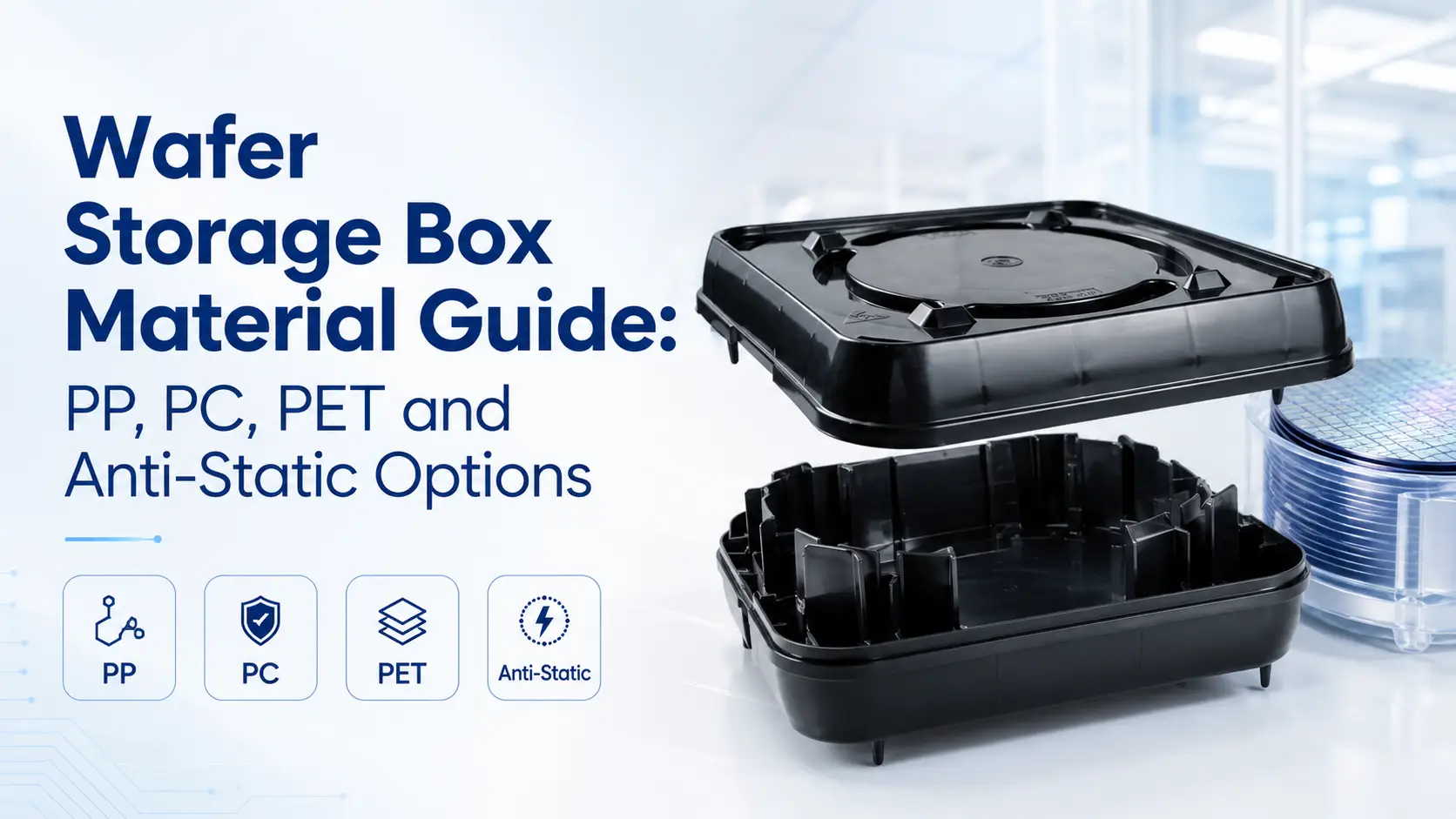
Wafer Storage Box Material Guide: PP, PC, PET and Anti-Static Options
Choosing the right wafer storage box material is important for semiconductor wafer protection. The material affects box strength, cleanliness, transparency, ESD control, impact resistance, shipping protection, and long-term handling stability.
A wafer storage box is not selected only by wafer size. For cleanroom storage, internal transfer, shipping, or post-dicing handling, the material must match the wafer condition and process requirement.
This guide compares common wafer storage box materials, including PP, PC, PET, and anti-static options, and explains how to choose the right material for semiconductor wafer handling.
Why Material Selection Matters for Wafer Storage Boxes
The material of a wafer storage box affects how well the box protects the wafer during storage, handling, and transport.
A suitable material can help reduce:
- Wafer movement
- Surface scratches
- Edge damage
- Particle contamination
- Electrostatic discharge risk
- Box deformation
- Handling damage
- Shipping-related impact
For semiconductor applications, material selection should be reviewed together with wafer size, wafer condition, cleanroom requirement, ESD requirement, shipping method, and whether the wafer is bare or mounted on a frame.
Material is only one part of wafer storage box selection. Buyers should also consider wafer size, wafer condition, handling method, ESD requirement, and whether the box will be used for storage, shipping, or frame handling. For a complete selection overview, please read our wafer storage box guide.
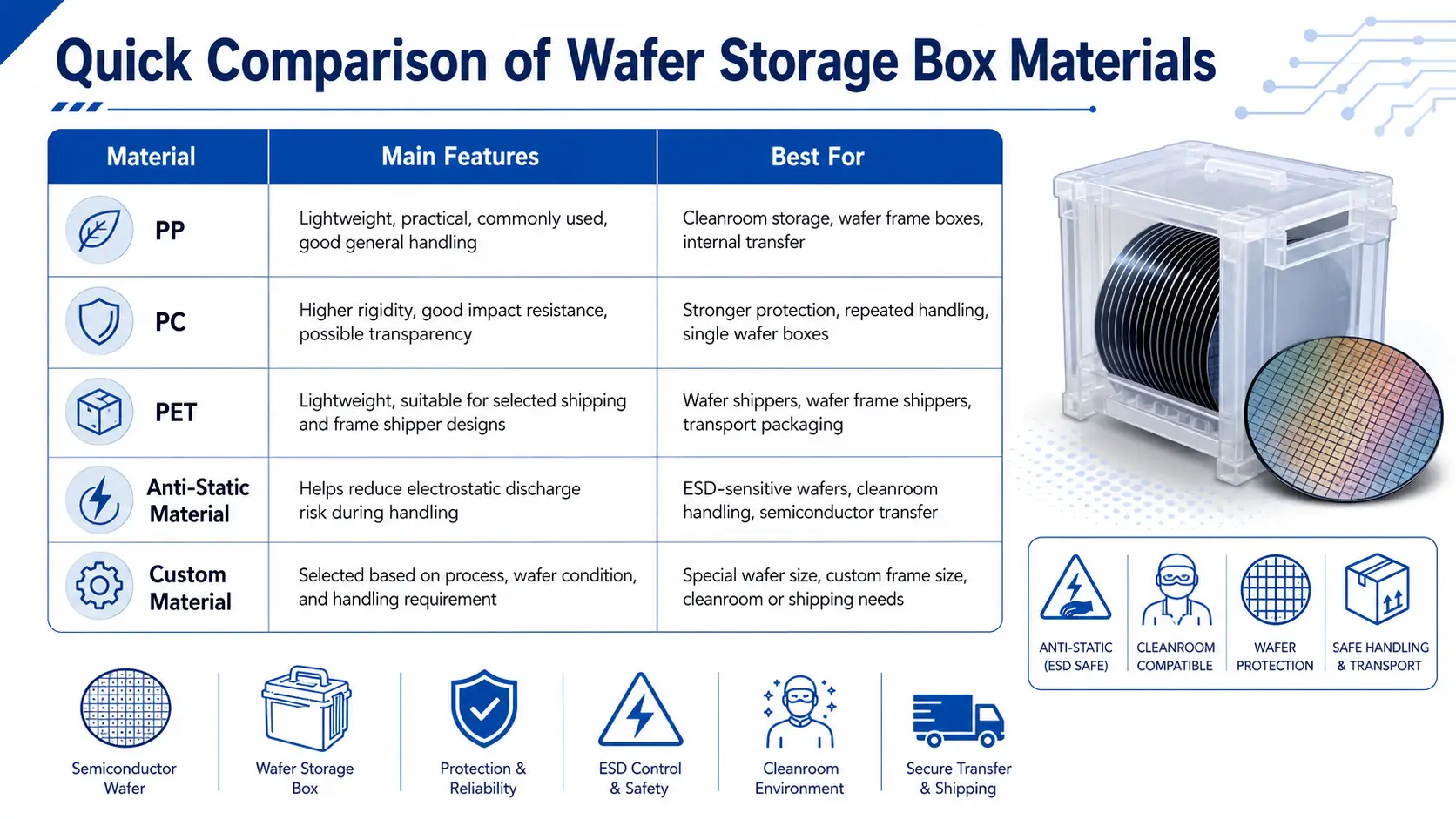
Quick Comparison of Wafer Storage Box Materials
| Material | Main Features | Best For |
|---|---|---|
| PP | Lightweight, practical, commonly used, good general handling | Cleanroom storage, wafer frame boxes, internal transfer |
| PC | Higher rigidity, good impact resistance, possible transparency | Stronger protection, repeated handling, single wafer boxes |
| PET | Lightweight, suitable for selected shipping and frame shipper designs | Wafer shippers, wafer frame shippers, transport packaging |
| Anti-Static Material | Helps reduce electrostatic discharge risk during handling | ESD-sensitive wafers, cleanroom handling, semiconductor transfer |
| Custom Material | Selected based on process, wafer condition, and handling requirement | Special wafer size, custom frame size, cleanroom or shipping needs |
1. PP Wafer Storage Box
PP, or polypropylene, is one of the commonly used materials for wafer storage boxes and wafer frame boxes. It is lightweight, practical, and suitable for many cleanroom handling applications.
PP wafer storage boxes are often used when buyers need a simple and stable solution for wafer storage, internal transfer, or frame handling.
When to Choose PP
PP may be suitable when the application requires:
- Lightweight handling
- General cleanroom storage
- Wafer frame box design
- Internal wafer transfer
- Practical cost-performance balance
- Custom box structure
For many semiconductor handling applications, PP is a common starting point. However, if the wafer is highly sensitive to ESD or requires stronger rigidity, buyers should also consider anti-static treatment or other material options.
2. PC Wafer Storage Box
PC, or polycarbonate, is known for higher rigidity and good impact resistance. It may also be used when transparency is useful for checking the wafer or box contents without frequent opening.
PC wafer storage boxes can be suitable for repeated handling, stronger protection needs, or applications where box structure is important.
When to Choose PC
PC may be suitable when the application requires:
- Higher rigidity
- Better impact resistance
- Repeated handling
- Transparent or semi-transparent box design
- Stronger structure than general lightweight boxes
- Individual wafer protection
For fragile wafers, inspection wafers, or higher-value wafers, PC can be considered when the box needs better mechanical strength.
3. PET Wafer Shipping Box
PET may be used for selected wafer shipping boxes, wafer frame shippers, and transport-related packaging designs. It is lightweight and can support certain transport applications depending on box structure.
For shipping, the material alone is not enough. Buyers should also check the box closure, inner support, wafer fixing design, and outer packaging.
When to Choose PET
PET may be suitable when the application requires:
- Lightweight transport packaging
- Wafer shipping box design
- Wafer frame shipper design
- Controlled transport handling
- Custom packaging structure
For logistics applications, PET should be reviewed together with shipping distance, wafer condition, and packaging protection.
4. Anti-Static Wafer Storage Box Material
In semiconductor handling, ESD protection is an important requirement. Electrostatic discharge may damage sensitive wafers, devices, or processed surfaces.
An anti-static wafer storage box uses anti-static material or surface treatment to help reduce ESD risk during storage, transfer, or shipping.
When to Choose Anti-Static Material
Anti-static material should be considered when:
- Wafers are ESD-sensitive
- Devices or processed wafers may be affected by electrostatic discharge
- Wafers are handled across different process areas
- The box is used inside a cleanroom
- The box is used for shipping or outsourcing
- Customer specifications require anti-static packaging
Anti-static performance should be considered together with cleanroom suitability, material strength, wafer contact design, and handling method.
Material Selection by Application
Different applications require different material priorities.
| Application | Material Priority | Recommended Consideration |
|---|---|---|
| Cleanroom storage | Clean handling, low particle risk, stable structure | PP, PC, or anti-static material depending on ESD requirement |
| Internal wafer transfer | Lightweight handling, closure stability, wafer fit | PP or custom material with suitable box structure |
| External shipping | Impact resistance, movement control, outer packaging compatibility | PET, PC, anti-static option, or custom shipping design |
| Post-dicing handling | Frame support, rigidity, low movement | PP, PET, or custom frame shipper material |
| ESD-sensitive process | Anti-static performance and clean handling | Anti-static material or surface treatment |
| Custom wafer or frame size | Dimension fit, inner support, process compatibility | Custom material and custom box structure |
Material Selection by Wafer Condition
Wafer condition also affects material choice. A bare wafer and a framed wafer may need different box structures and material properties.
| Wafer Condition | Main Risk | Material / Design Focus |
|---|---|---|
| Bare wafer | Surface scratches, edge damage, contamination | Clean material, smooth contact, proper fit |
| Processed wafer | Particle contamination, surface damage, ESD risk | Anti-static option, low-contact design, clean handling |
| Thinned wafer | Bending, breakage, vibration damage | Higher rigidity, stable support, low movement |
| Diced wafer | Die shift, tape movement, frame instability | Frame-based support, controlled contact, secure fixing |
| Wafer mounted on frame | Frame movement, collision, handling damage | Frame size match, rigid structure, custom inner support |
For wafers mounted on frames, the box should be selected by frame size and frame structure, not only by wafer diameter.
PP vs PC vs PET: Which Material Should You Choose?
There is no single best material for every wafer storage box. The right choice depends on the actual handling condition.
Choose PP if:
You need a lightweight and practical material for general wafer storage, internal transfer, or wafer frame box applications.
Choose PC if:
You need higher rigidity, better impact resistance, repeated handling support, or transparent box design.
Choose PET if:
You need a lightweight material for selected shipping box, wafer frame shipper, or transport packaging applications.
Choose Anti-Static Material if:
Your wafer, process, or customer specification requires ESD protection during storage, transfer, or shipping.
Choose Custom Material if:
Your wafer size, frame size, shipping route, cleanroom requirement, or equipment fit cannot be supported by standard box designs.
Key Questions Before Choosing Material
Before confirming wafer storage box material, buyers should ask:
- What wafer size needs to be stored or shipped?
- Is the wafer bare, processed, thinned, diced, or frame-mounted?
- Will the box be used for cleanroom storage, internal transfer, or external shipping?
- Is ESD protection required?
- Does the box need to be transparent?
- Does the box need stronger rigidity?
- Will the box be reused?
- Does the box need to fit a wafer frame, dicing ring, or cassette?
- Does the application require custom inner support?
- What outer packaging will be used for shipment?
These questions help avoid choosing a material based only on cost or appearance.
Common Material Selection Mistakes
1. Choosing Only by Wafer Size
Wafer size is important, but it is not enough. The same 8-inch wafer may need different box materials depending on whether it is bare, processed, thinned, or mounted on a frame.
2. Ignoring ESD Requirement
If the wafer or device is sensitive to electrostatic discharge, a standard plastic box may not be enough. Anti-static material or surface treatment should be considered.
3. Using Storage Material for Shipping Without Checking Protection
A material suitable for cleanroom storage may not always be suitable for transport. Shipping may require stronger rigidity, better closure, inner support, and outer packaging.
4. Overlooking Frame Size
For framed wafers, the wafer frame or dicing ring size is often more important than the wafer diameter. The box must fit the full frame structure.
5. Selecting Material Without Reviewing Box Design
Material is only one part of wafer protection. Box structure, closure, contact points, inner support, and packaging also affect wafer safety.
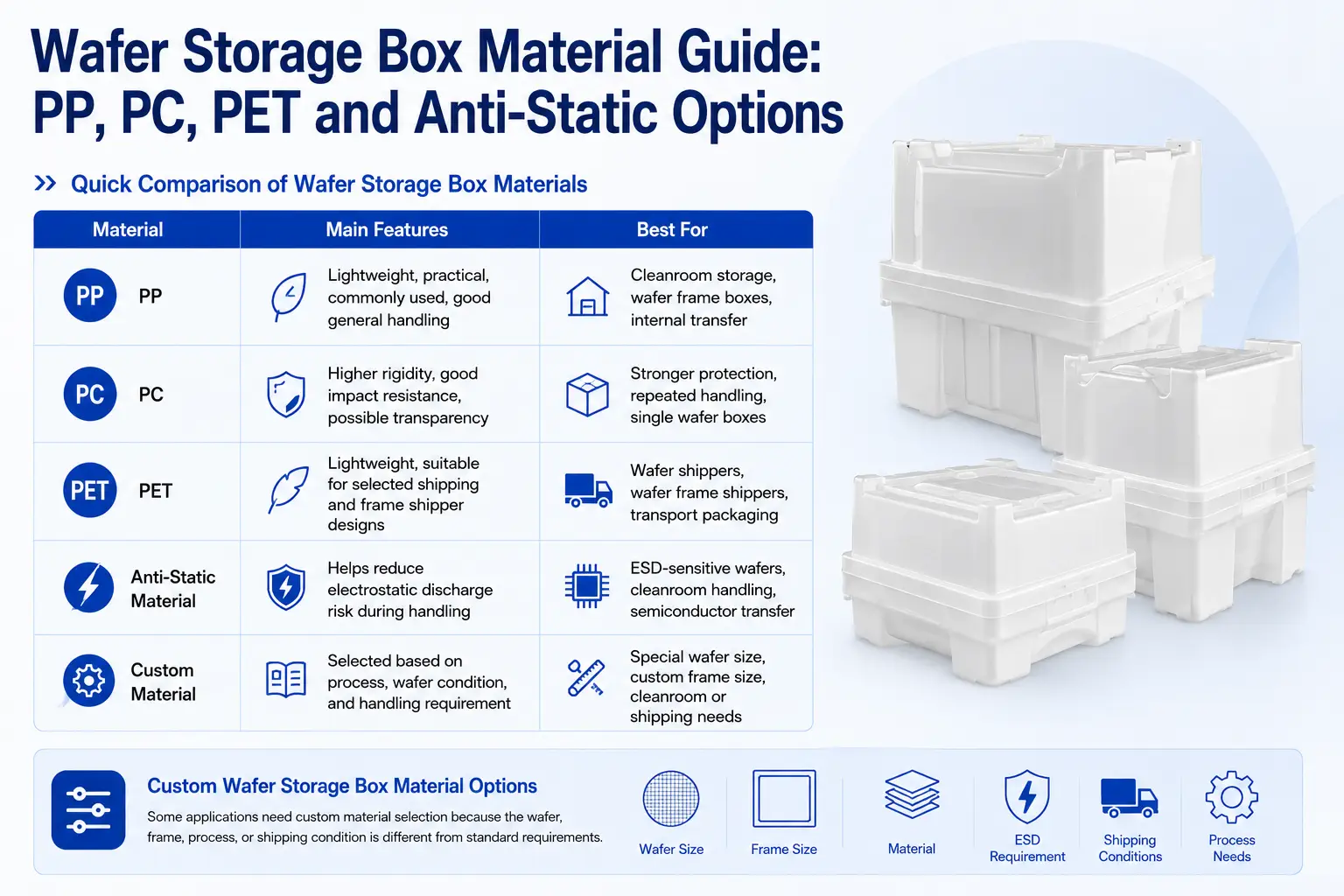
Custom Wafer Storage Box Material Options
Some applications need custom material selection because the wafer, frame, process, or shipping condition is different from standard requirements.
Custom options may include:
- PP, PC, PET, or other material selection
- Anti-static material or surface treatment
- Custom box size for 6-inch, 8-inch, or 12-inch wafers
- Custom frame size support
- Custom inner support or wafer fixing structure
- Custom design for cleanroom handling
- Custom design for shipping and logistics
- Labeling or identification support
- Special packaging support
A custom wafer storage box can improve wafer protection, reduce movement, support cleaner handling, and match customer-specific process needs.
YJ Corevia Wafer Storage Box Material Support
YJ Corevia provides wafer storage boxes, wafer shipping boxes, wafer frame boxes, wafer frame shippers, wafer cassette carriers, and custom semiconductor handling solutions.
When customers are not sure which material to choose, YJ Corevia can review the wafer size, wafer condition, frame size, shipping method, ESD requirement, cleanroom requirement, and handling process before recommending a suitable material and box structure.
YJ Corevia supports 6-inch, 8-inch, and 12-inch wafer handling requirements, as well as custom solutions based on material, wafer size, frame size, anti-static needs, shipping conditions, and process requirements.
Our goal is to help customers choose a wafer storage box that fits the process, protects the wafer, and supports stable semiconductor handling.
Conclusion
The material of a wafer storage box affects wafer protection, cleanroom handling, ESD control, rigidity, durability, and shipping performance. PP, PC, PET, anti-static materials, and custom material options each have different advantages.
For general cleanroom storage, PP may be suitable. For stronger structure or repeated handling, PC may be preferred. For selected shipping or frame shipper designs, PET may be considered. For ESD-sensitive applications, anti-static material or surface treatment should be reviewed.
The best material should be selected based on wafer size, wafer condition, frame size, application, shipping method, and process requirement. For a broader overview of how to choose the right box by application, size, and material, please read our wafer storage box guide.
Contact us today to discuss your wafer storage box material, wafer size, frame size, ESD requirement, and custom box design needs.
FAQ
1. What is the best material for a wafer storage box?
There is no single best material for every application. PP, PC, PET, and anti-static materials can all be suitable depending on wafer size, wafer condition, cleanroom requirement, ESD need, and shipping method.
2. What is a PP wafer storage box used for?
A PP wafer storage box is commonly used for general wafer storage, cleanroom handling, internal transfer, and wafer frame box applications.
3. When should I choose a PC wafer storage box?
PC may be suitable when the application needs higher rigidity, better impact resistance, repeated handling support, or transparent box design.
4. Is PET suitable for wafer shipping boxes?
PET may be used for selected wafer shipping boxes, wafer frame shippers, or transport packaging designs. The final choice should also consider box structure, closure, inner support, and outer packaging.
5. Do wafer storage boxes need anti-static material?
Anti-static material should be considered when wafers, devices, or customer specifications require ESD protection during storage, transfer, or shipping.
6. Can wafer storage box materials be customized?
Yes. Wafer storage box materials can be customized based on wafer size, frame size, cleanroom requirement, ESD need, shipping method, and special process conditions.