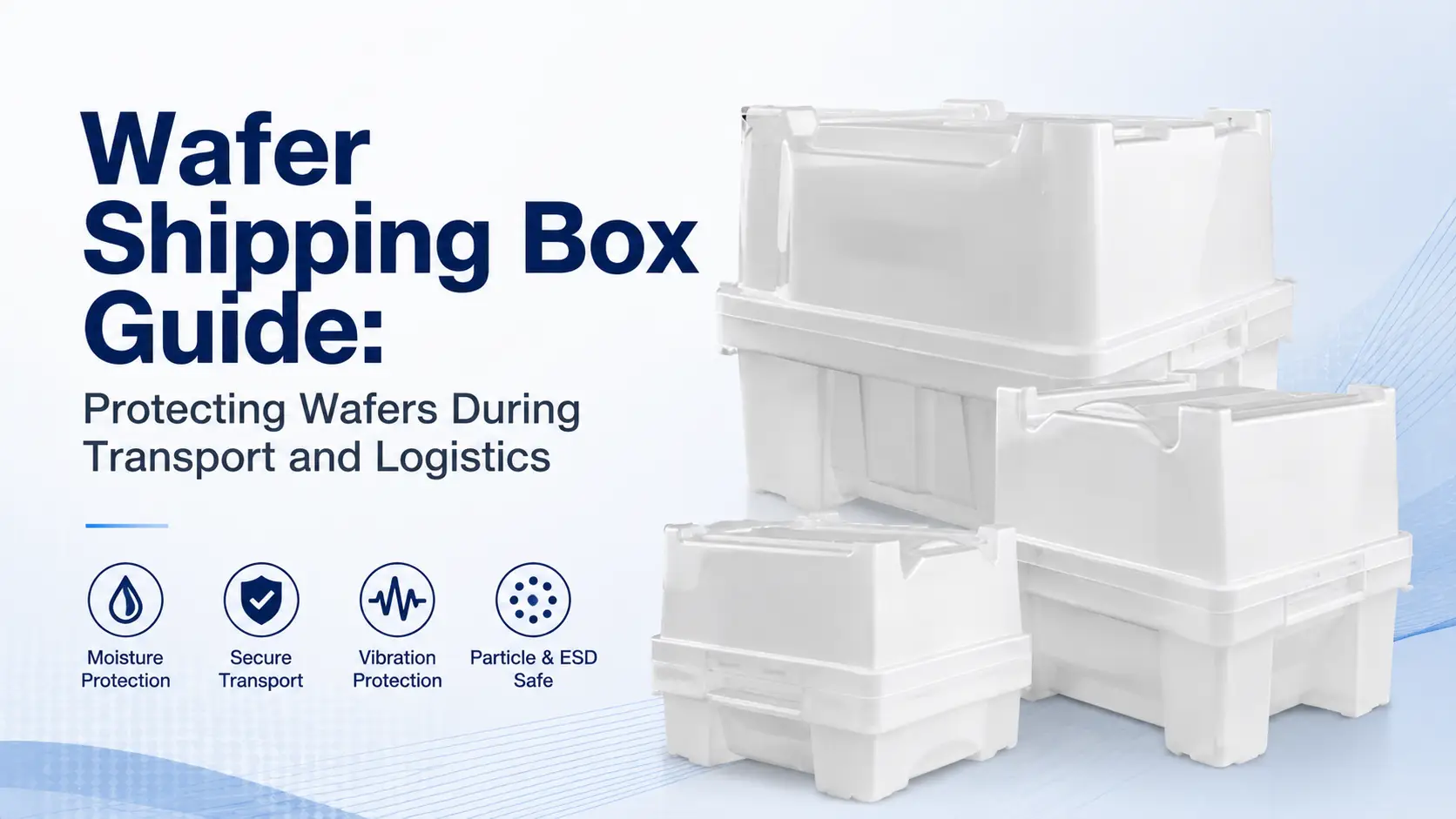
Wafer Shipping Box Guide: Protecting Wafers During Transport and Logistics
A wafer shipping box is used to protect semiconductor wafers during transport, outsourcing, customer delivery, and inter-factory transfer. Compared with a standard storage container, a shipping box must provide stronger protection against vibration, shock, wafer movement, friction, contamination, and handling damage.
In semiconductor manufacturing, wafers may move between suppliers, testing facilities, packaging partners, and customers. During shipping, even small movement inside the box can lead to edge damage, surface scratches, particle contamination, die shift, or wafer breakage.
This guide explains how to choose the right wafer shipping box based on wafer size, wafer condition, frame compatibility, material, ESD protection, inner support design, and shipping requirements.
What Is a Wafer Shipping Box?
A wafer shipping box is a protective container designed for safe semiconductor wafer transport. Depending on the design, it can be used for bare wafers, processed wafers, thinned wafers, wafer stacks, or wafers mounted on wafer frames and dicing rings.
The main purpose is to keep the wafer stable throughout shipping and handling.
A well-designed wafer shipping box helps reduce:
- Wafer movement during transport
- Shock and vibration
- Edge chips and cracks
- Surface scratches
- Friction between wafers
- Particle contamination
- Electrostatic discharge risk
- Damage during loading and unloading
For short-distance movement inside a cleanroom, a standard wafer storage box may be enough. For external shipment, outsourcing, or logistics, buyers should choose a wafer shipping box with stronger transport protection.
How Is a Wafer Shipping Box Different from a Wafer Storage Box?
A wafer storage box is mainly used for cleanroom storage, temporary holding, and internal wafer handling. A wafer shipping box is designed for transport and logistics, where wafers may face stronger vibration, shock, movement, and handling variation.
If the wafer only needs short-distance movement inside a cleanroom, a storage box may be enough. If the wafer needs to be shipped to another facility, supplier, customer, or packaging partner, a wafer shipping box should be selected with stronger transport protection, closure stability, inner support, and outer packaging in mind.
For a broader comparison, please read our Wafer Storage Box Guide.
Quick Selection Guide by Shipping Need
Use this table when you already know the shipping condition but are not sure which wafer box type to choose.
| Shipping Need | Recommended Solution | What to Check |
|---|---|---|
| Ship one wafer individually | Single Wafer Shipping Box | Wafer diameter, surface protection, closure fit |
| Ship multiple wafers together | Wafer Stack Shipping Box | Wafer spacing, friction control, stack stability |
| Ship processed or fragile wafers | Custom Wafer Shipping Box | Contact points, support structure, ESD requirement |
| Ship wafers mounted on frames | Wafer Frame Shipper | Frame size, inner fixing design, movement control |
| Ship metal wafer frames | Wafer Metal Frame Shipper | Frame fit, rigidity, collision protection |
| Ship wafers across facilities | Wafer Shipping Box + Outer Packaging | Shock protection, labeling, sealing, logistics route |
Why Wafer Protection Matters During Shipping
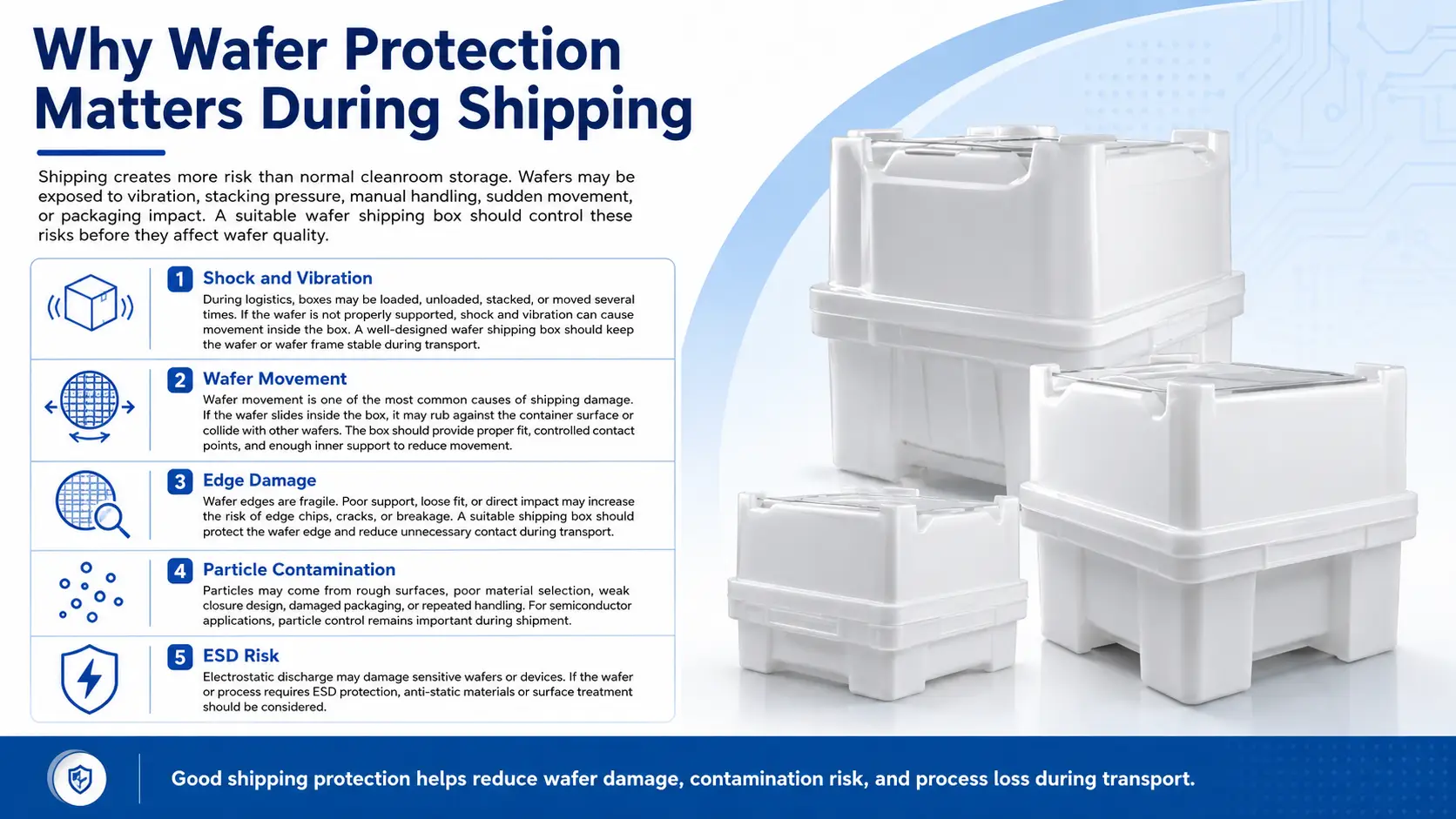
Shipping creates more risk than normal cleanroom storage. Wafers may be exposed to vibration, stacking pressure, manual handling, sudden movement, or packaging impact. A suitable wafer shipping box should control these risks before they affect wafer quality.
1. Shock and Vibration
During logistics, boxes may be loaded, unloaded, stacked, or moved several times. If the wafer is not properly supported, shock and vibration can cause movement inside the box.
A well-designed wafer shipping box should keep the wafer or wafer frame stable during transport.
2. Wafer Movement
Wafer movement is one of the most common causes of shipping damage. If the wafer slides inside the box, it may rub against the container surface or collide with other wafers.
The box should provide proper fit, controlled contact points, and enough inner support to reduce movement.
3. Edge Damage
Wafer edges are fragile. Poor support, loose fit, or direct impact may increase the risk of edge chips, cracks, or breakage.
A suitable shipping box should protect the wafer edge and reduce unnecessary contact during transport.
4. Particle Contamination
Particles may come from rough surfaces, poor material selection, weak closure design, damaged packaging, or repeated handling. For semiconductor applications, particle control remains important during shipment.
5. ESD Risk
Electrostatic discharge may damage sensitive wafers or devices. If the wafer or process requires ESD protection, anti-static materials or surface treatment should be considered.
Choose by Wafer Condition
The wafer condition directly affects the shipping box design. A bare wafer, thinned wafer, diced wafer, and frame-mounted wafer should not be evaluated in the same way.
| Wafer Condition | Main Shipping Risk | Selection Focus |
|---|---|---|
| Bare wafer | Surface scratches, edge damage, contamination | Clean material, proper fit, smooth inner contact |
| Processed wafer | Surface damage, particles, ESD risk | Low-contact design, clean handling, anti-static option |
| Thinned wafer | Breakage, bending, vibration damage | Stable support, low movement, stronger structure |
| Diced wafer | Die shift, tape movement, frame instability | Frame-based support, secure fixing, careful handling |
| Wafer mounted on frame | Frame movement, collision, handling damage | Frame size match, inner fixing structure, rigid support |
For framed wafers, the box should be selected by frame size and frame structure, not only by wafer diameter. This is especially important after dicing, when the wafer has already been separated into individual dies.
Main Types of Wafer Shipping Boxes
Different wafers require different shipping solutions. The right type depends on wafer size, wafer condition, shipping distance, and whether the wafer is bare or mounted on a frame.
1. Single Wafer Shipping Box
A single wafer shipping box protects one wafer at a time. It is suitable for sample wafers, inspection wafers, fragile wafers, or high-value wafers.
This type of box helps reduce wafer-to-wafer contact and is useful when one wafer needs separate handling.
2. Wafer Stack Shipping Box
A wafer stack shipping box is used when multiple wafers need to be transported together in a horizontal format.
The design should reduce wafer movement, friction, and direct contact between wafers.
3. Wafer Frame Shipper
A wafer frame shipper is designed for wafers mounted on wafer frames, dicing rings, or tape frames.
It is commonly used after wafer mounting or dicing, when framed wafers need to be transferred for cleaning, inspection, die pick-up, packaging preparation, or further processing.
4. Wafer Metal Frame Shipper
A wafer metal frame shipper protects metal wafer frames during transfer or shipment. It helps reduce frame movement, friction, collision, and handling damage.
This solution is useful for semiconductor back-end processes where framed wafers or metal frames need stable transport.
5. Custom Wafer Shipping Box
A custom wafer shipping box may be needed when standard boxes cannot match the wafer size, frame size, material requirement, inner support design, or shipping method.
Custom designs can improve fit, reduce movement, and provide better protection for special wafer handling requirements.
How to Choose a Wafer Shipping Box
A wafer shipping box should be selected based on the wafer, shipping route, packaging method, and handling risk.
1. Wafer Size
The box should match the wafer size, such as 6-inch, 8-inch, or 12-inch wafers. For special wafer sizes, custom dimensions may be required.
If the wafer is mounted on a wafer frame or dicing ring, check the frame size instead of only the wafer diameter.
2. Wafer Condition
Different wafer conditions require different protection levels.
Bare wafers need clean surface protection. Processed wafers may need better contamination control. Thinned wafers need stronger movement and breakage protection. Diced or framed wafers need a box that fits the wafer frame, not only the wafer.
3. Shipping Distance
Short-distance transfer may require less protection than long-distance shipment. For external shipping, buyers should consider vibration, shock, loading, unloading, and outer packaging.
The longer or more complex the route, the more important secure holding and packaging design become.
4. Inner Support Design
The inner structure should reduce wafer movement and protect the wafer from unnecessary contact.
Important details include:
- Wafer position control
- Contact point design
- Edge protection
- Friction reduction
- Loading and unloading stability
- Frame support, if wafers are mounted on frames
For fragile wafers or framed wafers, the inner support design is often more important than the outer box shape.
5. Material and Rigidity
Material affects strength, durability, cleanliness, anti-static performance, and impact resistance. Common options include PP, PC, PET, and anti-static treated materials.
Material should not be selected alone. It should be reviewed together with wafer sensitivity, frame weight, closure design, cleaning method, ESD requirement, reuse expectation, and shipping route.
6. ESD Protection
If wafers or devices are sensitive to electrostatic discharge, anti-static material or surface treatment should be considered.
ESD protection is especially important when wafers are handled across different environments or transferred between facilities.
7. Closure and Outer Packaging
The closure design should keep the wafer box secure during movement. For shipping, buyers should also review the outer packaging, sealing method, labeling, and protection against compression or impact.
A strong wafer shipping box still needs suitable outer packaging for safe logistics.
Material Options for Wafer Shipping Boxes
Material selection should be based on protection level, cleanroom requirement, ESD needs, and shipping conditions.
| Material / Option | Main Feature | Common Use |
|---|---|---|
| PP | Lightweight, practical, commonly used for wafer boxes | General wafer storage, internal transfer, cleanroom handling |
| PC | Higher rigidity and good impact resistance | Stronger wafer protection, repeated handling, transparent designs |
| PET | Lightweight and suitable for selected transport designs | Wafer shippers, wafer frame shippers, transport containers |
| Anti-Static Material | Helps reduce ESD risk during handling | ESD-sensitive wafers and semiconductor cleanroom handling |
The best material depends on the wafer condition, shipping distance, cleanroom requirement, reuse expectation, and whether the wafer is bare or frame-mounted.
For example, a lightweight box may be suitable for controlled internal transfer, while a framed wafer shipment may require better rigidity, stronger closure, and a more stable inner fixing structure.
Wafer Shipping Box Checklist Before Ordering
Before confirming a wafer shipping box, buyers should review the full shipping condition, not only the wafer diameter.
Use this checklist:
- Wafer size: 6-inch, 8-inch, 12-inch, or custom size
- Wafer condition: bare, processed, thinned, diced, or frame-mounted
- Frame size: required if the wafer is mounted on a frame or dicing ring
- Shipping distance: internal transfer, local delivery, or long-distance shipment
- Inner support: wafer position, contact points, edge protection, frame support
- Material: PP, PC, PET, anti-static, or custom material
- ESD requirement: anti-static material or surface treatment if needed
- Closure design: stable locking, sealing, or cover fit
- Outer packaging: carton, cushioning, labeling, and compression protection
- Reuse requirement: one-way shipping or reusable handling
- Cleanroom requirement: particle control, smooth surfaces, clean packaging
This checklist helps reduce selection mistakes and makes it easier to communicate requirements with the supplier.
Wafer Shipping Box for Post-Dicing and Frame Handling
After wafer dicing, wafers are often mounted on wafer frames, dicing rings, or tape frames. These framed wafers may need to be transferred to cleaning, inspection, die pick-up, or packaging preparation.
In this case, a regular bare wafer shipping box may not be suitable. The box must fit the frame size and provide stable support for the entire frame.
Suitable solutions may include:
- Wafer frame shipper
- Wafer metal frame shipper
- Wafer frame box
- Wafer frame cassette
- Custom frame shipping solution
For post-dicing handling, stable frame support is important because the wafer has already been separated into individual dies. The shipping box should help reduce frame movement, collision, and handling risk.
Cleanroom and Contamination Considerations
A wafer shipping box should protect the wafer during transport without creating new contamination risks. This is especially important when wafers will return to cleanroom processing after shipment.
Before choosing a box, check:
- Are the internal surfaces smooth?
- Does the box reduce particle generation?
- Does the design reduce direct wafer contact?
- Is the closure stable?
- Is the material suitable for clean handling?
- Is anti-static protection required?
- Is the packaging suitable for the shipping route?
- Can the box be cleaned or reused if needed?
For semiconductor applications, transport protection and clean handling should be considered together.
Custom Wafer Shipping Box Options
Standard wafer shipping boxes may not fit every process. Custom design may be needed when the wafer size, frame size, box structure, material, or packaging method is different from standard requirements.
Custom wafer shipping box options may include:
- 6-inch, 8-inch, and 12-inch shipping box sizes
- Custom dimensions for wafers, wafer frames, or special carriers
- Custom inner support or wafer fixing structure
- Anti-static material or surface treatment
- PP, PC, PET, or other material options
- Labeling or identification support
- Custom outer packaging support
- Special design for cleanroom handling, logistics, or frame shipment
A custom wafer shipping box can improve wafer protection, reduce movement, support safer transport, and match customer-specific handling requirements.
YJ Corevia Wafer Shipping Box Solutions
YJ Corevia provides wafer shipping box and semiconductor wafer handling solutions for cleanroom transfer, logistics, frame handling, and back-end processing applications.
Our product range includes:
- Wafer shipping boxes
- Wafer storage boxes
- Wafer stack boxes
- Wafer pizza boxes
- Single wafer boxes
- Wafer frame boxes
- Wafer frame shippers
- Wafer metal frame shippers
- Wafer cassette carriers
- Custom wafer shipping box solutions
When customers are not sure whether they need a wafer shipping box, wafer frame shipper, wafer metal frame shipper, or custom frame carrier, YJ Corevia can review the wafer size, frame size, shipping method, material requirement, anti-static need, and handling process before recommending a suitable solution.
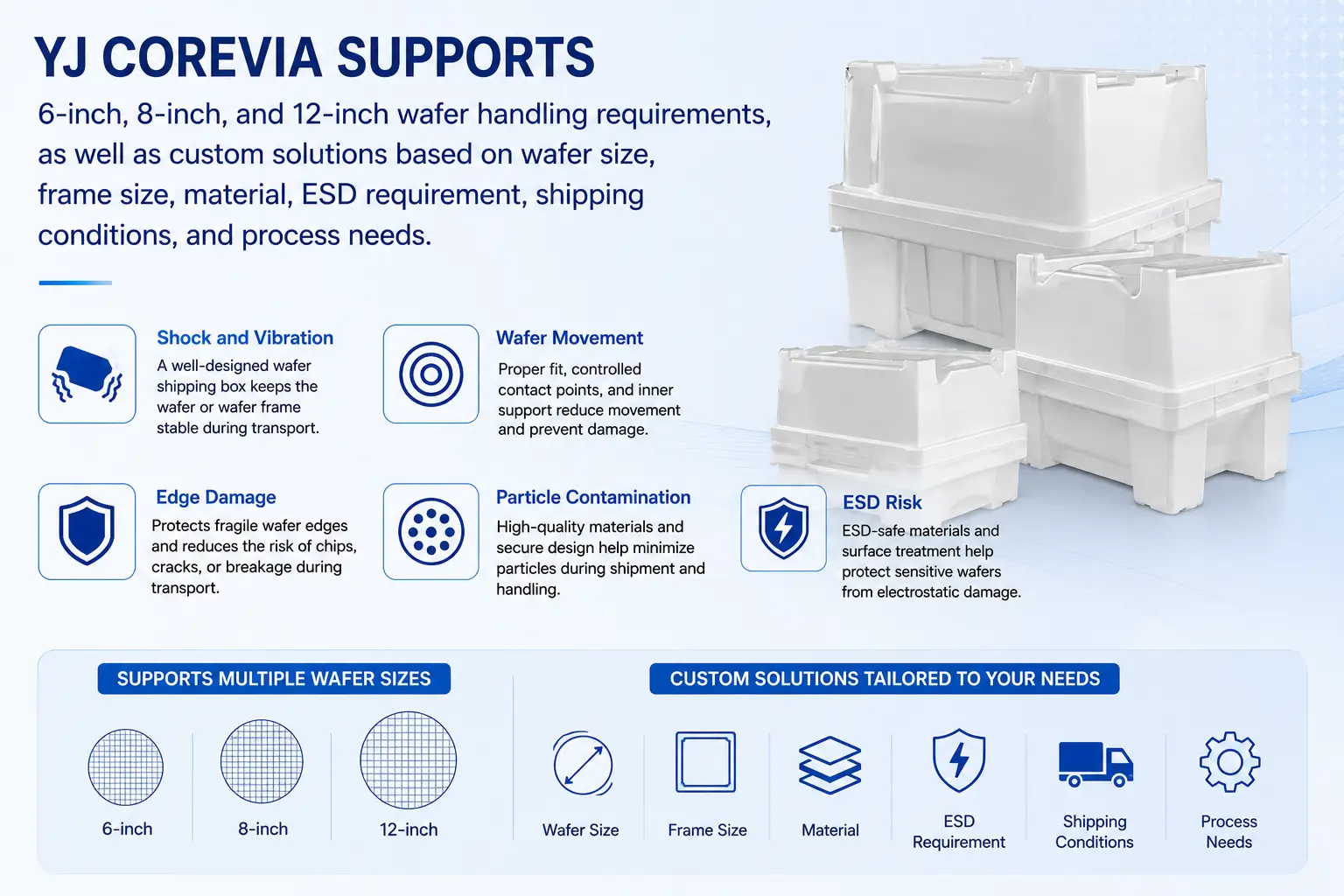
YJ Corevia supports 6-inch, 8-inch, and 12-inch wafer handling requirements, as well as custom solutions based on wafer size, frame size, material, ESD requirement, shipping conditions, and process needs.
With experience in semiconductor-related handling products, YJ Corevia helps customers protect wafers during shipment, storage, inspection transfer, post-dicing handling, and production logistics.
Conclusion
A wafer shipping box protects semiconductor wafers during transport, logistics, outsourcing, and customer delivery. Compared with a basic storage box, it should provide stronger protection against movement, vibration, shock, edge damage, friction, contamination, and handling risk.
The right wafer shipping box depends on wafer size, wafer condition, shipping distance, material, ESD requirement, inner support design, closure stability, and outer packaging. For wafers mounted on frames, buyers should choose a solution that fits the wafer frame or dicing ring, not only the wafer diameter.
YJ Corevia provides wafer shipping boxes and custom semiconductor wafer handling solutions for customers who need stable protection, clean handling, and process-compatible designs.
Contact us today to discuss your wafer size, shipping method, material requirement, anti-static needs, frame size, and custom wafer shipping box specifications.
FAQ
1. What is a wafer shipping box?
A wafer shipping box is a protective container used to transport semiconductor wafers. It helps protect wafers from movement, vibration, shock, contamination, edge damage, and handling risk during shipment.
2. What is the difference between a wafer storage box and a wafer shipping box?
A wafer storage box is mainly used for cleanroom storage and internal handling. A wafer shipping box is designed for transport and logistics, where stronger protection against movement, vibration, and impact may be needed.
3. What type of box is used for shipping wafers mounted on frames?
Wafers mounted on frames may require wafer frame shippers, wafer metal frame shippers, wafer frame boxes, or custom frame shipping solutions. The box should match the frame size, not only the wafer diameter.
4. What material is used for wafer shipping boxes?
Common materials may include PP, PC, PET, and anti-static treated plastics. The right material depends on wafer condition, shipping distance, cleanroom requirement, ESD protection, and box design.
5. Why is ESD protection important for wafer shipping?
Electrostatic discharge may damage sensitive wafers or devices during handling and transport. Anti-static materials or surface treatment can help reduce ESD risk.
6. Can wafer shipping boxes be customized?
Yes. Wafer shipping boxes can be customized based on wafer size, frame size, material, anti-static requirements, inner support design, shipping method, and packaging needs.