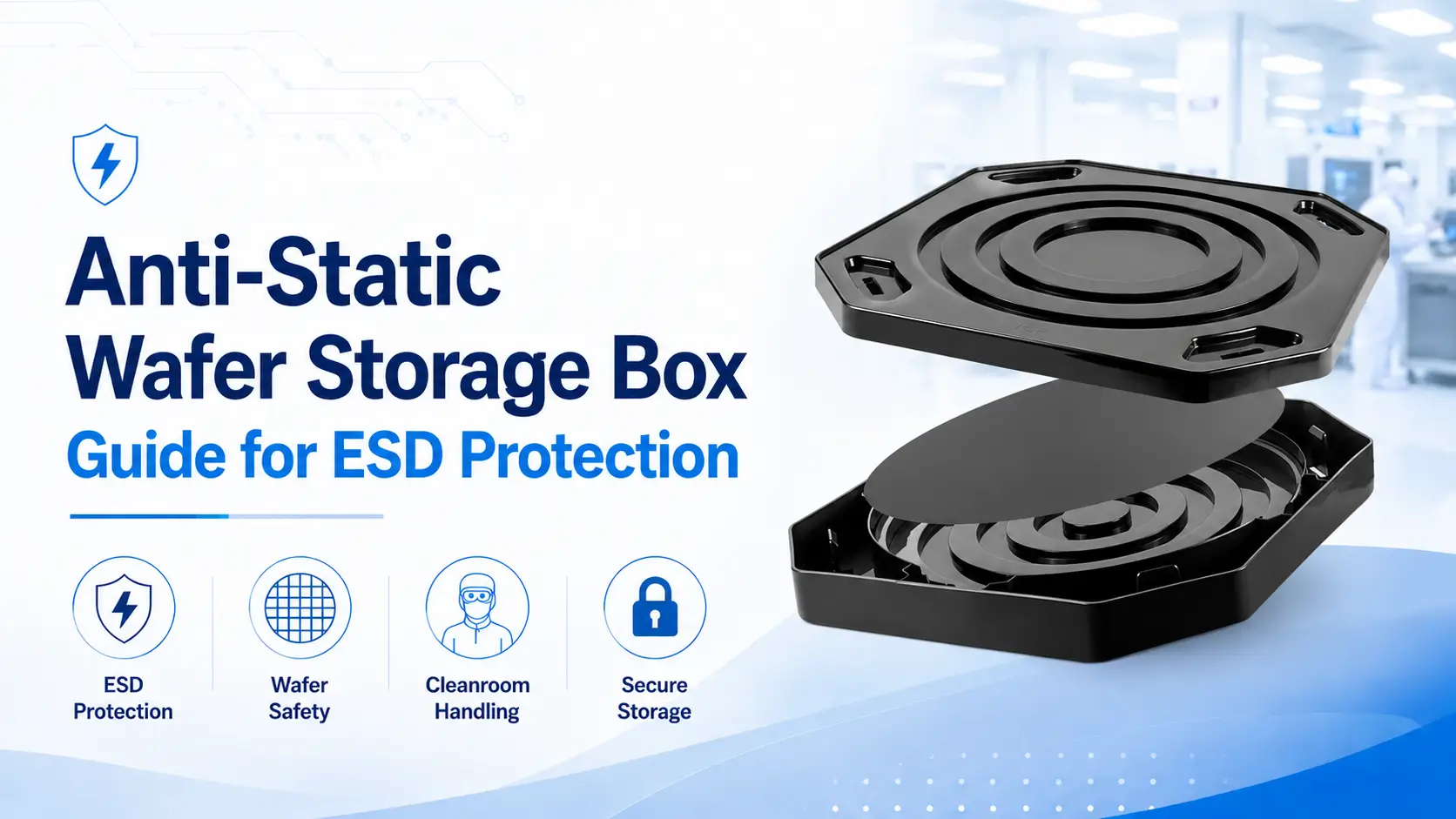
Anti-Static Wafer Storage Box Guide: ESD Protection for Semiconductor Wafer Handling
An anti-static wafer storage box helps reduce electrostatic discharge risk during semiconductor wafer storage, cleanroom transfer, shipping, and frame handling. For many wafer handling processes, physical protection is not the only concern. Static buildup can also become a risk, especially when wafers have already gone through sensitive process steps.
A standard wafer box may protect the wafer from contact, dust, or movement. However, when the wafer, device, or customer specification requires ESD control, anti-static material or surface treatment should be reviewed before selecting the box.
This guide explains when an anti-static wafer storage box is needed, how it supports ESD-sensitive wafer handling, and what buyers should check before choosing a suitable solution.
For a broader overview of box selection by application, size, and material, please read our wafer storage box guide.
What Is an Anti-Static Wafer Storage Box?
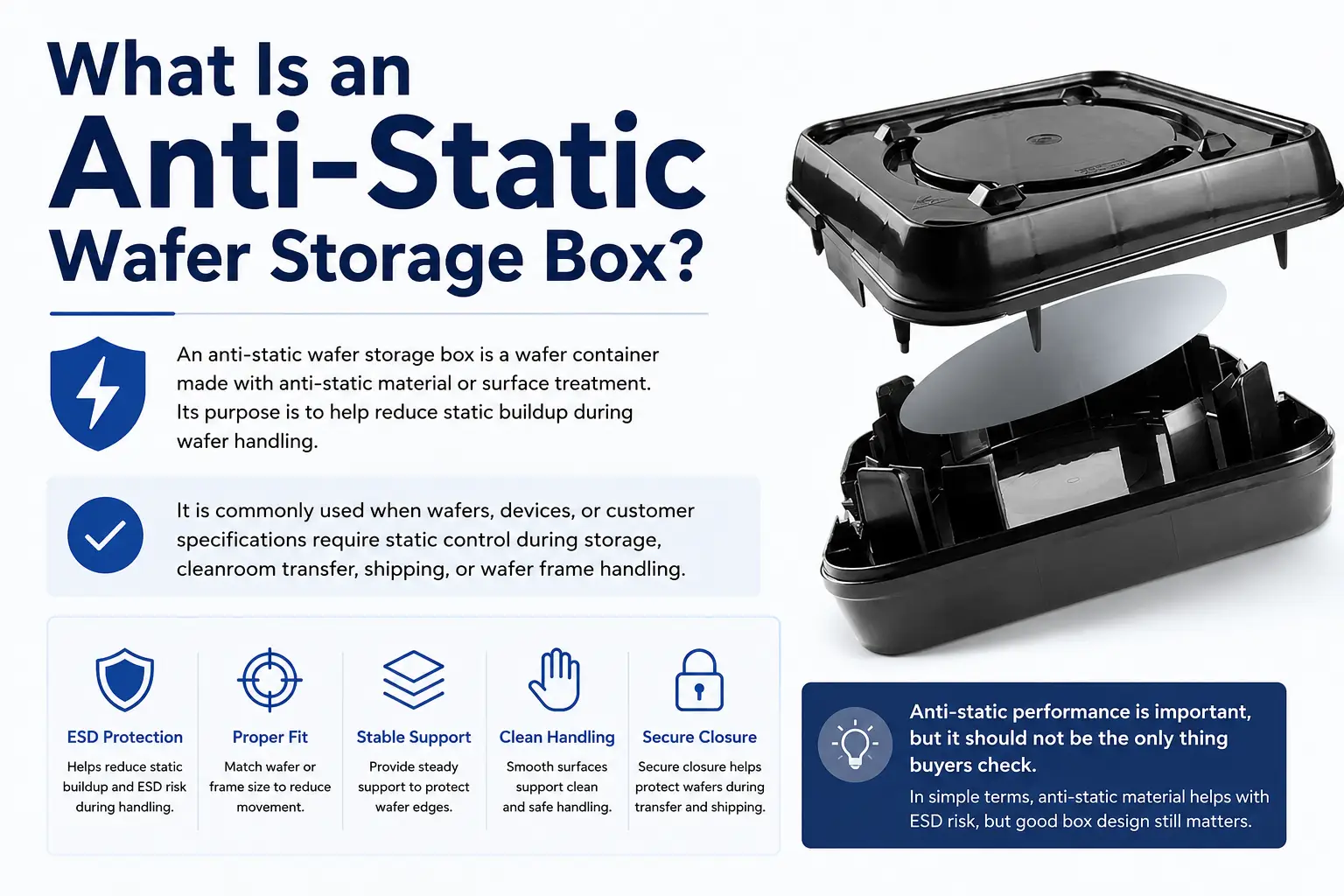
An anti-static wafer storage box is a wafer container made with anti-static material or surface treatment. Its purpose is to help reduce static buildup during wafer handling.
It is commonly used when wafers, devices, or customer specifications require static control during storage, cleanroom transfer, shipping, or wafer frame handling.
Anti-static performance is important, but it should not be the only thing buyers check. The box still needs proper wafer fit, stable support, smooth contact points, clean handling, and secure closure.
In simple terms, anti-static material helps with ESD risk, but good box design still matters.
Why Static Control Matters in Wafer Handling
Electrostatic discharge, usually called ESD, happens when static electricity is suddenly released between two objects. In semiconductor handling, this can become a concern when wafers, devices, operators, tools, trays, or packaging materials come into contact.
The risk is not always visible. A wafer may look fine after handling, but static discharge can still affect sensitive devices or processed surfaces depending on the product and process stage.
ESD protection is often considered for:
- Processed wafers
- Diced wafers
- Thin wafers
- Device wafers
- Wafers mounted on frames
- Wafers shipped to customers or outsourcing partners
- Products with customer-specified ESD requirements
Before choosing the box, first confirm where static risk actually happens: during storage, cleanroom transfer, frame handling, shipping, or unpacking.
Anti-Static vs Standard Wafer Storage Box
A standard wafer storage box focuses mainly on physical protection and clean handling. An anti-static wafer storage box adds another layer of protection by helping reduce static buildup.
| Comparison Item | Standard Wafer Storage Box | Anti-Static Wafer Storage Box |
|---|---|---|
| Static Control | Not the main design focus | Designed to help reduce static buildup |
| Main Protection | Wafer movement, contact, dust, and handling damage | Physical protection plus ESD risk reduction |
| Best For | General wafer storage and internal handling | ESD-sensitive wafers, processed wafers, and controlled handling |
| Material Focus | PP, PC, PET, or other suitable plastic material | Anti-static material or surface treatment |
| Selection Focus | Wafer fit, cleanliness, closure, and handling method | ESD requirement, wafer sensitivity, material behavior, and handling process |
A standard wafer storage box may be enough for general storage. But if wafers are processed, ESD-sensitive, frequently transferred, or shipped across different environments, anti-static options should be evaluated.
When Do You Need an Anti-Static Wafer Storage Box?
Not every wafer application requires anti-static material. In many cases, the need depends on wafer condition, process sensitivity, and customer requirements.
1. Processed Wafers
Processed wafers may have sensitive surfaces or device structures. During storage or transfer, static buildup may become a risk, especially when wafers move between tools, operators, or temporary storage areas.
For this type of wafer, anti-static material should be considered together with clean contact design and low particle risk.
2. Diced Wafers
After dicing, wafers may remain on dicing tape and wafer frames. At this stage, die stability, tape condition, and frame movement are all important.
If the diced wafer or device is ESD-sensitive, the storage box should support both frame stability and static control.
3. Wafers Mounted on Frames
Wafers mounted on wafer frames, dicing rings, or tape frames should be selected by frame size, not only wafer diameter. If ESD protection is required, the box also needs suitable anti-static material or treatment.
This is common in post-dicing handling, inspection transfer, and frame shipment.
4. Cross-Area Cleanroom Transfer
Static risk can increase when wafers move between different process areas, tools, carts, operators, or packaging layers.
For repeated cleanroom transfer, anti-static wafer storage boxes can help reduce static buildup while keeping handling stable.
5. Outsourcing or Shipping
When wafers are shipped to a supplier, testing facility, packaging partner, or customer, the handling environment becomes less controlled than internal storage.
If the wafer is ESD-sensitive, anti-static performance should be reviewed together with closure stability, inner support, cushioning, and outer packaging.
6. Customer-Specified ESD Requirements
Some customers clearly require anti-static packaging or ESD-safe handling. In this case, the box should be selected according to the customer’s specification, not only by general material preference.
Before production or shipment, confirm the required ESD level, packaging method, and handling condition with the customer.
Anti-Static Material vs Surface Treatment
When choosing an anti-static wafer storage box, buyers may hear two common options: anti-static material and anti-static surface treatment.
1. Anti-Static Material
Anti-static material means the material itself is selected or modified to help reduce static buildup. It is often considered when the box needs more stable anti-static performance during repeated handling.
This may be suitable for cleanroom transfer, reusable boxes, or processes where ESD control is part of regular handling.
2. Anti-Static Surface Treatment
Surface treatment means the anti-static function is added to the surface of the box. This may be suitable for certain applications, but buyers should confirm how the treatment performs after handling, cleaning, storage, or repeated use.
The right choice depends on:
- Required ESD performance
- Handling frequency
- Cleaning method
- Reuse expectation
- Wafer sensitivity
- Customer specification
- Storage or shipping environment
The most important point is this: anti-static performance should be selected based on the actual process, not just the material name.
ESD Protection Is Not Only About the Box
A common mistake is treating ESD control as a single product feature. In real semiconductor handling, ESD protection depends on the full environment.
Even if the wafer box is anti-static, ESD risk may still come from operators, gloves, workstations, carts, tools, trays, outer packaging, cleaning process, storage areas, or shipping routes.
The box can help reduce static buildup during handling, but it should work together with proper cleanroom procedures, grounding control, packaging selection, and operator handling.
For professional buyers, this is usually the difference between simply buying a box and building a reliable wafer handling process.
Anti-Static Wafer Box Selection Checklist
Before choosing an anti-static wafer storage box, start by identifying where the ESD risk happens.
Use this checklist:
- Is the wafer ESD-sensitive?
- Is the wafer bare, processed, diced, thinned, or frame-mounted?
- Will the box be used for storage, cleanroom transfer, shipping, or frame handling?
- Does the customer require anti-static packaging?
- Is the box for one-time shipment or repeated use?
- Will the box be cleaned or reused?
- Does the box need anti-static material or surface treatment?
- Does the inner support reduce wafer or frame movement?
- Is the outer packaging also suitable for ESD-sensitive handling?
This checklist helps buyers avoid choosing a box only by size or appearance.
ESD-Sensitive Handling Selection Map
Use this table to match common ESD-sensitive situations with the right selection focus.
| ESD-Sensitive Situation | Why It Matters | What to Check |
|---|---|---|
| Processed wafer handling | Device structures or surfaces may be sensitive to static discharge | Anti-static material, low-contact design, clean handling |
| Diced wafer on tape | Dies may be affected during transfer or handling | Frame support, ESD control, stable fixing |
| Frame-mounted wafer | Frame movement and static buildup may occur during handling | Frame size, inner support, anti-static option |
| Cross-area transfer | Different handling environments may increase static risk | ESD requirement, packaging, operator handling |
| External shipping | Packaging layers and handling variation may increase risk | Anti-static box, outer packaging, sealing method |
When Anti-Static May Not Be Necessary
Anti-static material is useful, but it is not always required. For some general storage or short internal handling applications, a standard wafer storage box may be enough.
Anti-static material may not be necessary when:
- The wafer is not ESD-sensitive
- The box is used only for simple temporary storage
- The process does not require ESD control
- The customer has no anti-static packaging requirement
- Physical protection and clean handling are the main concerns
That said, buyers should still confirm this with the process owner or customer. Choosing anti-static material without understanding the actual requirement may increase cost without improving the handling process.
Custom Anti-Static Wafer Storage Box Options
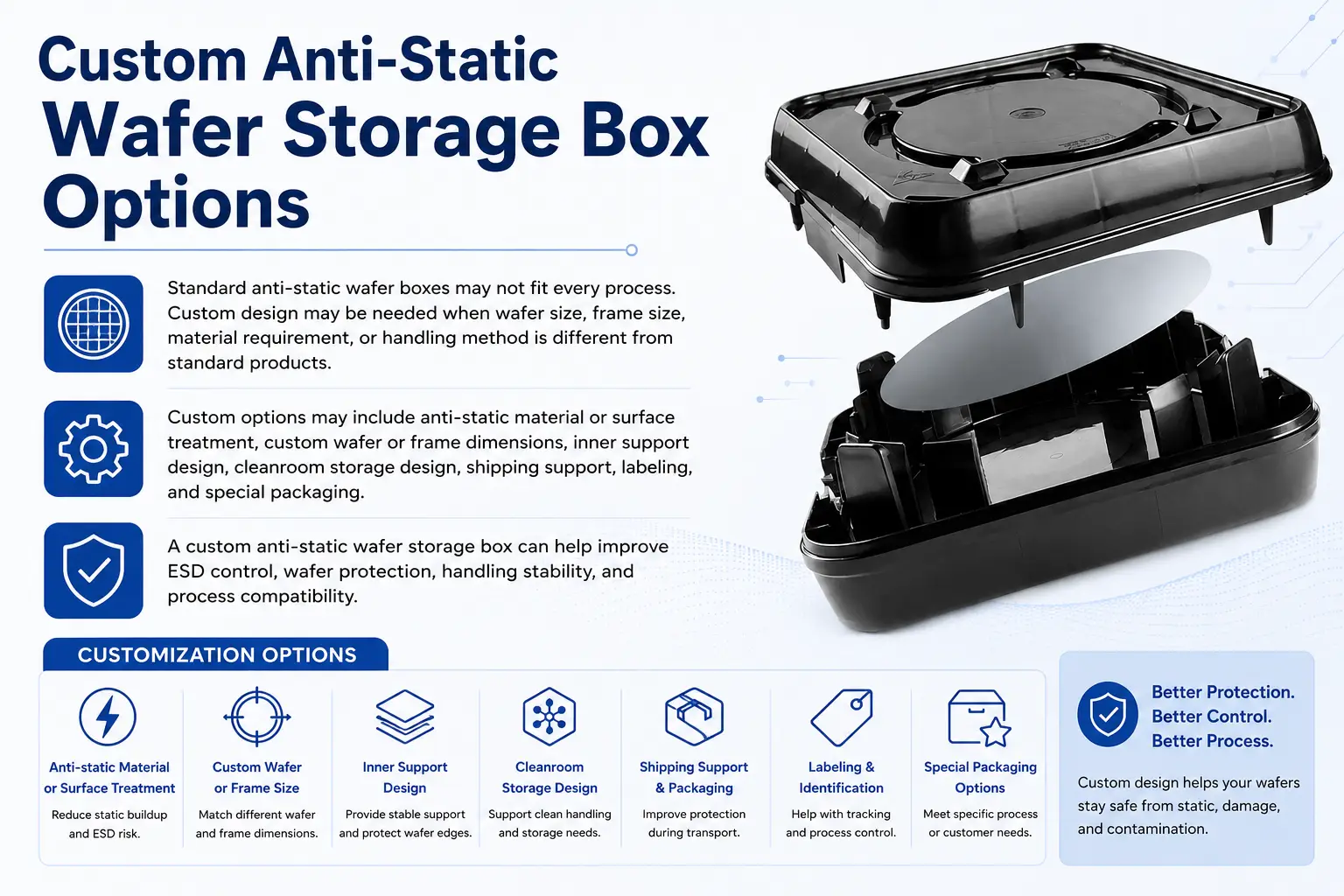
Standard anti-static wafer boxes may not fit every process. Custom design may be needed when wafer size, frame size, material requirement, or handling method is different from standard products.
Custom options may include anti-static material or surface treatment, custom wafer or frame dimensions, inner support design, cleanroom storage design, shipping support, labeling, and special packaging.
A custom anti-static wafer storage box can help improve ESD control, wafer protection, handling stability, and process compatibility.
YJ Corevia Anti-Static Wafer Storage Box Solutions
YJ Corevia provides wafer storage boxes, wafer shipping boxes, wafer frame boxes, wafer frame shippers, wafer cassette carriers, and custom semiconductor handling solutions.
When customers are not sure whether they need a standard wafer storage box, anti-static wafer box, wafer frame shipper, or custom design, YJ Corevia can review the wafer size, frame size, wafer condition, ESD requirement, cleanroom use, shipping method, and handling process before recommending a suitable solution.
For ESD-sensitive applications, the selection should not stop at material. YJ Corevia can also help review box fit, frame support, inner fixing design, closure stability, and whether the box will be used for storage, transfer, or shipment.
Our goal is to help customers choose a wafer storage box that protects the wafer, reduces handling risk, and supports stable semiconductor production.
Conclusion
An anti-static wafer storage box helps reduce ESD risk during wafer storage, cleanroom transfer, shipping, and frame handling. It is especially useful for processed wafers, diced wafers, ESD-sensitive devices, and wafers mounted on frames.
However, anti-static material should not be selected alone. Buyers should also review where static risk happens, how the wafer is handled, whether the wafer is mounted on a frame, and whether the box will be used for storage, transfer, or shipping.
Contact us today to discuss your anti-static wafer storage box, wafer size, frame size, ESD requirement, and custom semiconductor handling needs.
FAQ
1. What is an anti-static wafer storage box?
An anti-static wafer storage box is a wafer container made with anti-static material or surface treatment. It helps reduce static buildup and ESD risk during semiconductor wafer storage, transfer, or shipping.
2. When should I use an anti-static wafer storage box?
You should consider an anti-static wafer storage box when handling processed wafers, diced wafers, ESD-sensitive devices, wafers mounted on frames, or wafers that must meet customer-specified ESD requirements.
3. Is anti-static material always required for wafer storage boxes?
No. Anti-static material is not always required. For general storage or non-ESD-sensitive applications, a standard wafer storage box may be enough.
4. What is the difference between anti-static material and surface treatment?
Anti-static material has anti-static properties built into or selected as part of the material. Surface treatment adds anti-static function to the surface. The better option depends on handling frequency, cleaning method, reuse expectation, and ESD requirement.
5. Can anti-static wafer storage boxes be customized?
Yes. Anti-static wafer storage boxes can be customized based on wafer size, frame size, material, surface treatment, inner support, cleanroom requirement, shipping method, and process needs.