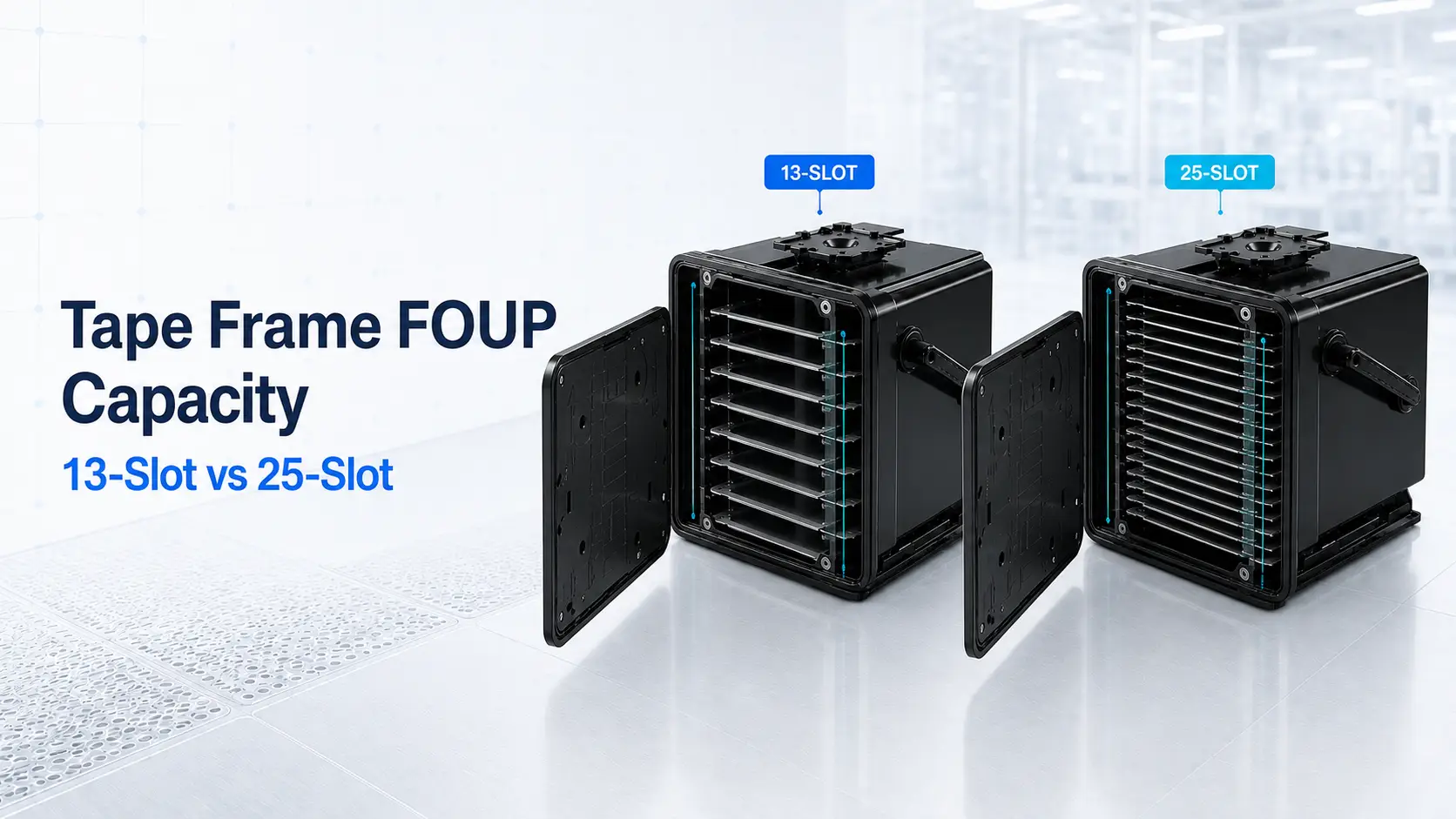
Tape Frame FOUP Capacity: 13-Slot vs 25-Slot Configurations
Tape Frame FOUPs are available in different capacities, including 13-slot and 25-slot configurations.
It is easy to assume that the choice is simply about how many frames you want to carry. In practice, the slot count is only one part of the carrier design.
A 13-slot FOUP does not always mean wider spacing, and a 25-slot FOUP does not automatically mean that all 25 positions will work with every tape frame.
The real question is whether the slot pitch, frame dimensions, equipment, and production flow work together.
13-Slot vs 25-Slot: What Is the Difference?
SEMI development work for 300 mm Tape Frame FOUP systems has included configurations such as:
- 25 positions with 10 mm pitch
- 13 positions with 20 mm pitch
This is useful because it shows that capacity and pitch are related, but they are not the same specification.
There are also newer 13-frame Film Frame FOUP designs based on different carrier architectures. So two carriers labeled “13-slot” may not have the same pitch, dimensions, or equipment interface.
| Configuration | What to Check |
|---|---|
| 13-slot | Pitch, carrier architecture, frame format, and equipment interface |
| 25-slot | Pitch, frame clearance, equipment access, and usable capacity |
Do not choose a carrier from the slot number alone.
Slot Pitch Determines How the Positions Are Spaced
Slot pitch is the spacing between payload positions inside the carrier.
Closer spacing can increase nominal capacity, but the available space still has to work with the actual tape frame.
Frame thickness, outer profile, tape projection, and handling tolerance can all affect how much clearance is needed between positions.
This creates an important distinction: Nominal capacity is the number of positions designed into the carrier. Usable capacity is the number of positions that can actually be used with the selected frame and equipment.
A 25-slot carrier only delivers a practical 25-frame capacity when all 25 positions can be loaded and accessed reliably.
13 Slots Does Not Always Mean Wider Spacing
One common assumption is that a 13-slot FOUP simply provides more space between frames than a 25-slot version.
That may be true for a particular design, but it is not a rule.
Different 13-slot carriers may use different pitches, internal layouts, carrier heights, or interfaces. This is especially relevant when comparing Tape Frame FOUP and Film Frame FOUP architectures.
In other words, the label “13-slot” tells you the nominal capacity. It does not tell you exactly how the carrier is built.
If you are replacing an existing carrier, check the actual pitch and interface instead of assuming another 13-slot model will be interchangeable.
When Does a 25-Slot FOUP Make Sense?
A 25-slot configuration can be useful when larger lots move through production and the equipment can reliably access every position.
More frames per carrier can mean:
- Fewer carrier exchanges
- Fewer transport cycles
- Higher storage density
But the extra positions only matter if they are actually used.
If a process normally runs smaller lots, or the equipment is designed around a different carrier layout, a 25-slot configuration may provide little practical advantage.
This is why higher capacity is not automatically better capacity.
Equipment Can Decide the Final Capacity
The carrier and equipment have to work as a system.
A load port, EFEM, stocker, or process tool may expect particular slot locations and transfer positions. Changing the carrier capacity can therefore affect how the equipment maps and retrieves the frames.
A carrier may physically hold the tape frames and still be unsuitable if the equipment cannot access the required positions.
For an existing production line, compare the new carrier with the current equipment layout before changing from 13 slots to 25 slots, or vice versa.
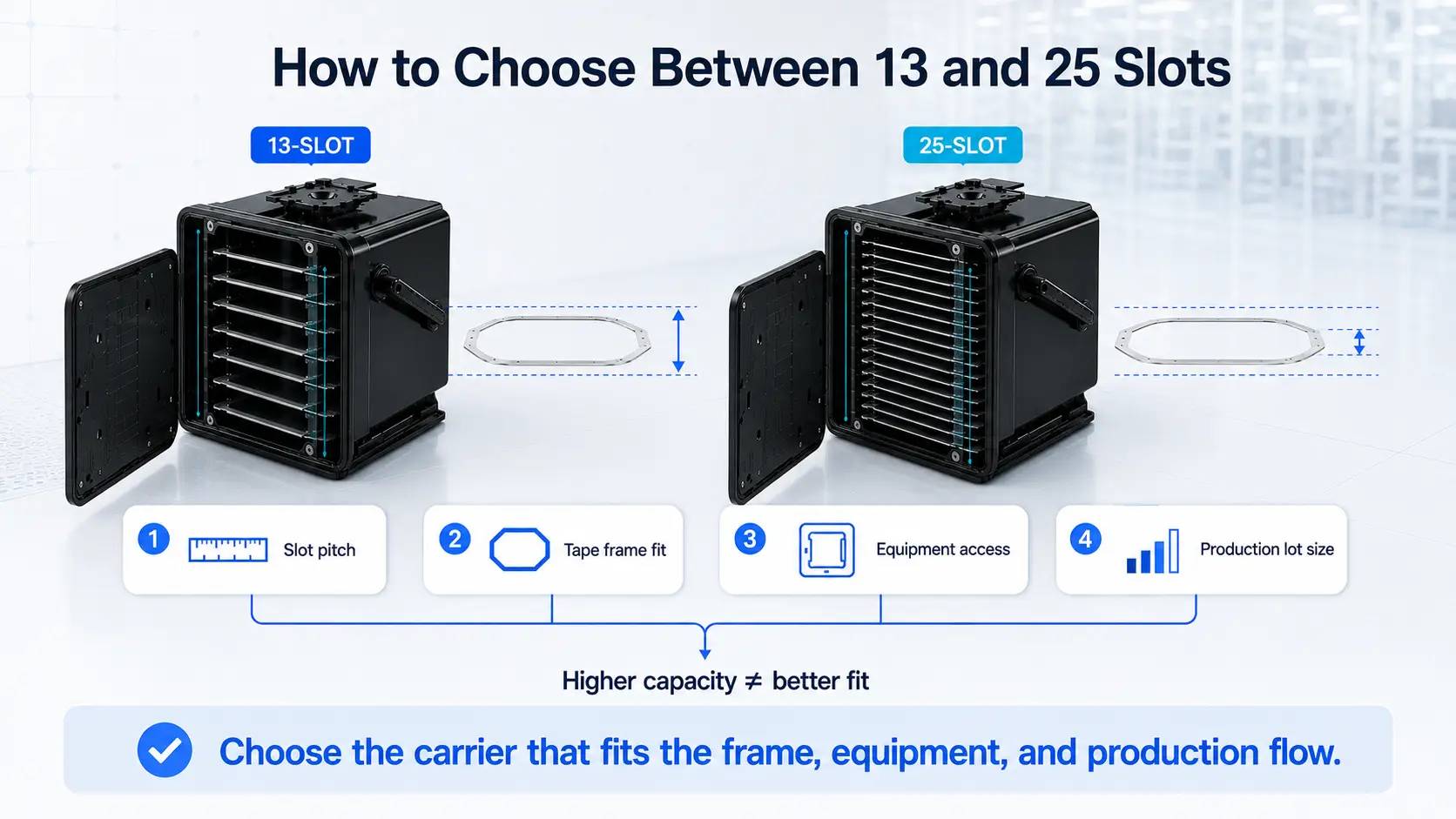
How to Choose Between 13 and 25 Slots
Before choosing, answer four questions:
- What is the carrier’s slot pitch?
- Does the actual tape frame work with that spacing?
- Can the equipment access the required positions?
- Does the capacity match the lot size used in production?
A 13-slot carrier may be the right choice for one equipment platform, while a 25-slot design may reduce handling for another.
The better choice is not the carrier with the larger number. It is the one that fits the frame, equipment, and production flow.
YJ COREVIA 25-Slot Tape Frame FOUP
YJ COREVIA provides the TJF-U12-25S, presented as a 12-inch Wafer FOUP, Wafer SMIF Pod, and Tape Frame FOUP with a nominal 25-slot configuration.
The published capacity is useful as a starting point, but it does not by itself confirm that every tape-frame design can use all 25 positions.
For a specific application, the most useful information to provide is:
- Tape-frame dimensions
- Frame thickness
- Required lot size
- Equipment model and interface
Slot pitch and applicable frame dimensions should also be confirmed for the actual carrier configuration.
This makes it possible to determine whether the listed 25-slot capacity is also practical for the production process.
YJ COREVIA currently offers the TJF-U12-25S in a 25-slot configuration. If your application requires a 13-slot Tape Frame FOUP, contact us with your frame dimensions and equipment requirements to discuss the available options.
Summary
Tape Frame FOUP capacity should not be judged from slot count alone.
A 13-slot carrier does not always have wider spacing, and a 25-slot carrier does not guarantee 25 usable positions for every tape frame.
Before selecting a configuration, compare:
- Slot pitch
- Tape-frame dimensions
- Equipment layout
- Production lot size
These factors determine whether the nominal capacity is also the capacity you can actually use.
FAQ
1. Is a 25-slot Tape Frame FOUP always better than a 13-slot carrier?
No. Higher capacity is useful only when the frame, equipment, and production flow can use the available positions.
2. Does a 13-slot Tape Frame FOUP always use wider spacing?
No. Different 13-slot carrier designs can use different pitches and interfaces.
3. What matters more, slot count or slot pitch?
Both matter. Slot count shows how many nominal positions are available, while slot pitch helps determine whether the actual frame can be handled within those positions.