
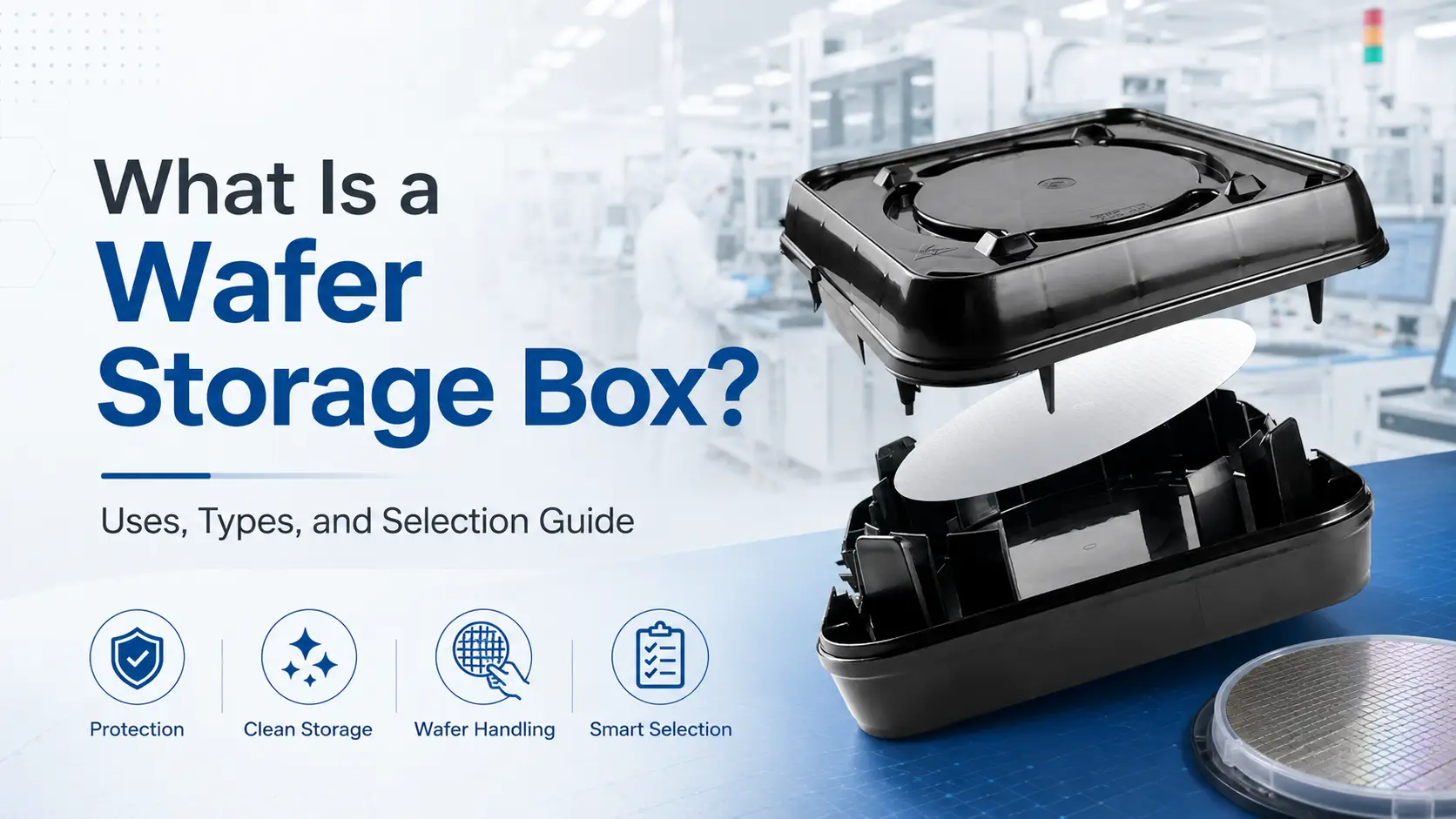
What Is a Wafer Storage Box? Uses, Types, and Selection Guide
A wafer storage box is a protective container used to store, transfer, or ship semiconductor wafers during manufacturing, inspection, cleanroom handling, and logistics. Its main purpose is to protect wafers from dust, particles, electrostatic discharge, friction, collision, and handling damage.
In semiconductor production, wafers are fragile and valuable. Even a small scratch, particle, or movement during transfer may affect wafer quality. This is why wafer storage boxes are not just simple packaging. They are part of the wafer handling system.
Depending on the application, a wafer storage box may also be called a wafer box, wafer shipping box, wafer stack box, wafer pizza box, single wafer box, wafer carrier, or wafer frame box. These terms are sometimes used together, but each type is designed for different storage, transport, and cleanroom handling needs.
This guide explains what a wafer storage box is, where it is used, what types are available, and how to choose the right solution for semiconductor wafer handling.
What Is a Wafer Storage Box?
A wafer storage box is a container designed to hold semiconductor wafers safely during storage, movement, or shipment. It helps reduce direct contact with the wafer surface and protects the wafer from contamination, friction, and mechanical impact.
A wafer storage box may be used for bare wafers, processed wafers, thinned wafers, diced wafers, or wafers mounted on frames. The correct box depends on the wafer condition, wafer size, handling method, and process environment.
The main functions of a wafer storage box include:
- Protecting wafers during storage and transfer
- Reducing dust and particle contamination
- Lowering the risk of wafer collision or friction
- Supporting cleanroom handling
- Helping control electrostatic discharge risk
- Keeping wafers organized between process steps
- Supporting safer shipping or internal logistics
For semiconductor manufacturers, choosing the right wafer storage box helps improve handling stability and reduce unnecessary wafer damage.
Why Wafer Storage Boxes Matter in Semiconductor Manufacturing
Semiconductor wafers may go through many process steps before they become finished chips. During these steps, wafers often need to be stored temporarily, moved between equipment, transferred to another facility, or shipped to a customer or packaging partner.
Without proper protection, wafers may face several risks:
- Particle contamination
- Surface scratches
- Wafer edge damage
- Electrostatic discharge
- Collision during transport
- Friction between wafers
- Movement inside the container
- Handling mistakes during loading or unloading
A well-designed wafer storage box helps reduce these risks by keeping wafers stable, separated, and protected. For cleanroom and semiconductor applications, buyers should consider wafer size, material, anti-static performance, contact points, rigidity, closure design, and compatibility with the production flow.
Common Uses of Wafer Storage Boxes
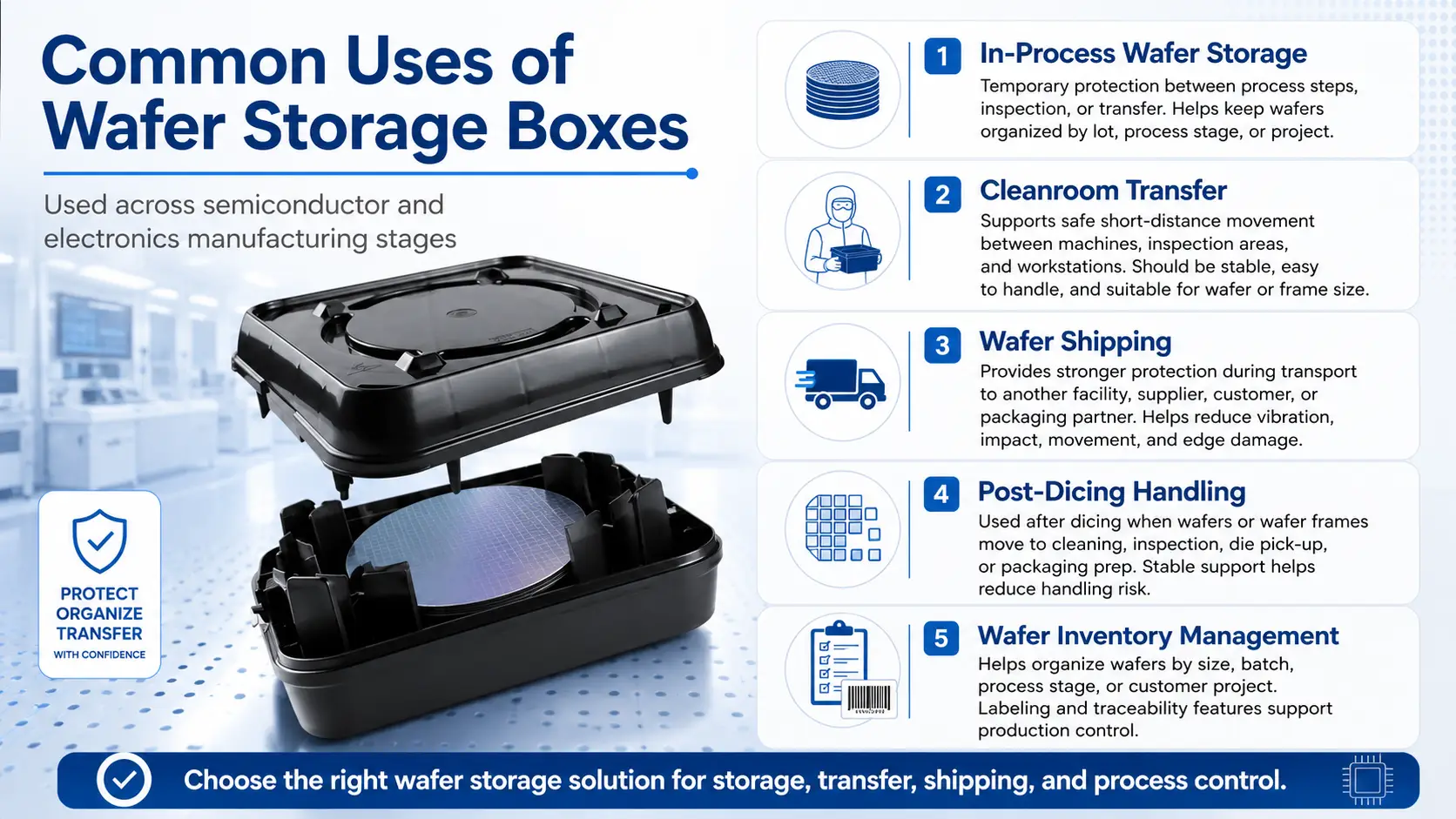
Wafer storage boxes are used across different semiconductor and electronics manufacturing stages. Depending on the process, they may be used for temporary storage, cleanroom transfer, shipping, post-dicing handling, or wafer inventory management.
1. In-Process Wafer Storage
During production, wafers may need to be stored temporarily between process steps. A wafer storage box helps protect the wafer while it waits for the next process, inspection, or transfer.
This is especially important when wafers are not immediately moved to the next tool. A proper storage box reduces unnecessary contact and helps keep wafers organized by lot, process stage, or project.
2. Cleanroom Transfer
Inside a cleanroom, wafers may move between machines, inspection areas, and workstations. A clean and stable wafer storage box helps reduce handling risk during short-distance movement.
For cleanroom transfer, the box should be easy to handle, stable during movement, and suitable for the wafer size or frame size being carried.
3. Wafer Shipping
When wafers are sent to another facility, supplier, customer, or packaging partner, a wafer shipping box may be used to provide stronger protection during transport.
For shipping applications, the box should help reduce vibration, impact, wafer movement, and edge damage. Additional outer packaging may also be needed depending on the shipping distance and wafer value.
4. Post-Dicing Handling
After wafer dicing, wafers or wafer frames may need to be moved to cleaning, inspection, die pick-up, or packaging preparation. In this case, wafer frame boxes or frame shippers may be used.
Post-dicing handling requires stable support because the wafer has already been separated into individual dies. The storage solution should help keep the wafer frame stable and reduce handling risk.
5. Wafer Inventory Management
Wafer storage boxes can also help organize wafers by size, batch, process stage, or customer project. Labeling and traceability features may be useful for production control.
For manufacturers handling multiple wafer lots, proper storage and identification can help reduce mix-ups and improve internal workflow.
Main Types of Wafer Storage Boxes
Different wafer handling situations require different box designs. The right choice depends on wafer size, wafer condition, storage method, shipping requirements, and cleanroom process.
1. Single Wafer Storage Box
A single wafer storage box is designed to hold one wafer at a time. It is suitable when individual wafer protection is needed, especially for sample wafers, inspection wafers, special process wafers, or fragile wafers.
Single wafer boxes help reduce wafer-to-wafer contact and are useful when a wafer needs to be handled separately.
2. Wafer Stack Box
A wafer stack box is used for horizontal wafer storage. Wafers may be stacked with proper spacing or separation, depending on the design.
This type of box is often used when multiple wafers need to be stored or transferred together. The design should reduce movement and help prevent friction between wafers.
3. Wafer Pizza Box
A wafer pizza box is a flat wafer storage box used for horizontal wafer placement. It is commonly used for storage, transfer, and cleanroom handling.
The flat design helps keep wafers supported during short-distance movement or temporary storage. It is often selected when wafers need to remain flat and protected.
4. Wafer Frame Box
A wafer frame box is designed to store wafers that are already mounted on wafer frames or dicing rings. It is commonly used after wafer mounting, dicing, cleaning, or inspection.
This type of box is different from a bare wafer storage box because it must fit the wafer frame size, not only the wafer diameter.
5. Wafer Shipping Box
A wafer shipping box is used when wafers need to be transported over a longer distance. It should provide stronger protection against vibration, impact, movement, and handling during logistics.
For shipping applications, buyers should check the box rigidity, closure design, wafer fixing structure, and outer packaging method.
6. Wafer Cassette Carrier
A wafer cassette carrier is used to hold wafers or wafer-related components in a cassette-style structure. It is useful for organized storage, process transfer, and handling compatibility.
This type of solution is often selected when multiple wafers or wafer frames need to be arranged in a controlled and repeatable way.
Wafer Storage Box vs Wafer Shipping Box
The terms wafer storage box and wafer shipping box are sometimes used together, but they are not always the same.
| Comparison Item | Wafer Storage Box | Wafer Shipping Box |
|---|---|---|
| Main Purpose | Storage and internal handling | Transport and logistics |
| Main Concern | Cleanliness, organization, and wafer protection | Impact, vibration, and shipment protection |
| Usage Area | Cleanroom, production line, inspection area | Shipping, outsourcing, customer delivery |
| Protection Level | Depends on process needs | Usually stronger for movement and handling |
| Design Focus | Wafer stability and clean handling | Secure holding and transport safety |
A wafer storage box is usually used for cleanroom storage, internal transfer, and temporary wafer protection. A wafer shipping box is designed more specifically for transportation, logistics, and external movement.
In many cases, the same product may support both storage and short-distance transfer. For long-distance shipping, buyers should confirm whether the box design is suitable for transport conditions.
Key Factors to Consider When Choosing a Wafer Storage Box
Choosing the right wafer storage box requires more than checking wafer diameter. The box must match the wafer, process, handling method, and cleanroom requirements.
1. Wafer Size
The box should match the wafer size, such as 2-inch, 4-inch, 6-inch, 8-inch, or 12-inch wafers. For YJ Corevia applications, 6-inch, 8-inch, and 12-inch wafer storage and handling solutions are especially common.
If the wafer is mounted on a frame, buyers should check the frame size instead of only the wafer diameter.
2. Wafer Condition
Bare wafers, processed wafers, thinned wafers, diced wafers, and framed wafers may require different storage designs.
For example, a box used for bare wafers may not be suitable for wafers mounted on dicing rings or wafer frames.
3. Storage Method
Some wafers are stored individually, while others are stored horizontally in stacks or inside cassette-style carriers. The storage method should match the wafer type and handling process.
A single wafer box may be suitable for individual wafer protection, while a wafer stack box may be better when multiple wafers need to be stored together.
4. Material
Material affects durability, cleanliness, anti-static performance, transparency, rigidity, and chemical resistance. Common wafer box materials include PP, PC, PET, and anti-static treated plastics.
The best material depends on whether the box is used for cleanroom storage, shipping, single wafer protection, wafer frame storage, or repeated handling.
5. Anti-Static Requirement
Electrostatic discharge may damage sensitive semiconductor materials or devices. For cleanroom and semiconductor applications, anti-static or ESD-safe material may be required.
This is especially important when wafers or processed devices are sensitive to electrostatic discharge during handling or transfer.
6. Contamination Control
The box should help reduce dust, particles, and unnecessary wafer contact. Smooth surfaces, proper fit, clean material, and clean packaging are important for contamination control.
For cleanroom use, buyers should also consider whether the box design may generate particles during repeated opening, closing, or handling.
7. Wafer Movement Protection
A good wafer storage box should reduce wafer movement during handling. Poor fit may allow wafers to slide, collide, or rub against the box surface.
This is especially important for thinned wafers, processed wafers, and wafers that need to maintain surface quality before the next process.
8. Equipment and Cassette Compatibility
The box should fit the production flow. If wafers need to move between cassettes, frame boxes, cleaning stations, or inspection tools, compatibility should be checked before ordering.
This helps prevent loading issues, transfer problems, and unnecessary process delays.
9. Shipping and Packaging Requirements
For transport or shipment, the box should provide enough protection against vibration, shock, and movement. Additional packaging may be needed for long-distance shipping.
Buyers should also consider whether the box needs labeling, sealing, or customer-specific packing requirements.
10. Customization Needs
Some projects require custom dimensions, labeling, color options, fixing accessories, or special packaging. Custom wafer storage boxes can help match specific equipment or process requirements.
Customization is useful when standard boxes do not fit the wafer size, frame size, storage method, or handling process.
Common Wafer Storage Box Materials
Wafer storage box material should be selected according to the application, wafer type, handling environment, and cleanliness requirement.
1. PP Wafer Storage Box
PP, or polypropylene, is commonly used for wafer boxes and wafer frame boxes. It is lightweight, practical, and suitable for many cleanroom handling applications.
Depending on the product design, PP wafer storage boxes may also include anti-static treatment to reduce ESD risk.
2. PC Wafer Storage Box
PC, or polycarbonate, offers higher rigidity and good impact resistance. It may be used for applications that require a stronger structure, transparency, or repeated handling.
PC can be useful when the user needs to see the wafer or confirm the contents without opening the box frequently.
3. PET Wafer Shipping Box
PET may be used for certain wafer frame shippers or transport-related containers. It can support lightweight protection and clean handling depending on the design.
For shipping or transfer, buyers should confirm whether the PET design provides enough structure and wafer fixing support.
4. Anti-Static Material or Surface Treatment
Anti-static or ESD-safe material helps reduce electrostatic risk during wafer handling. This is important in semiconductor environments where wafers or devices may be sensitive to ESD.
The best material choice depends on storage duration, wafer condition, handling frequency, cleanroom requirements, and shipping needs.
Wafer Storage Box Sizes
Wafer storage boxes are available in different sizes based on wafer diameter and application.
Common wafer storage box sizes include:
- 2-inch wafer storage box
- 4-inch wafer storage box
- 6-inch wafer storage box
- 8-inch wafer storage box
- 12-inch wafer storage box
- Custom wafer storage box sizes
For semiconductor back-end handling, 6-inch, 8-inch, and 12-inch sizes are commonly used. However, the correct size should be confirmed based on wafer diameter, wafer thickness, frame size, and equipment compatibility.
For wafers mounted on frames, buyers should check the wafer frame or dicing ring size rather than only the wafer size.
Cleanroom and ESD Considerations
Wafer storage boxes are often used in cleanroom environments, where contamination control is critical. The box should protect the wafer without creating new handling risks.
Important cleanroom and ESD considerations include:
- Anti-static material or surface treatment
- Low particle generation
- Smooth internal surfaces
- Controlled wafer contact points
- Secure closure design
- Clean packaging before shipment
- Compatibility with cleanroom handling procedures
A wafer storage box should reduce unnecessary contact, control wafer movement, and support clean transfer between process steps. This is especially important for processed wafers, thin wafers, and wafers that will continue into inspection, dicing, or packaging.
Custom Wafer Storage Box Options
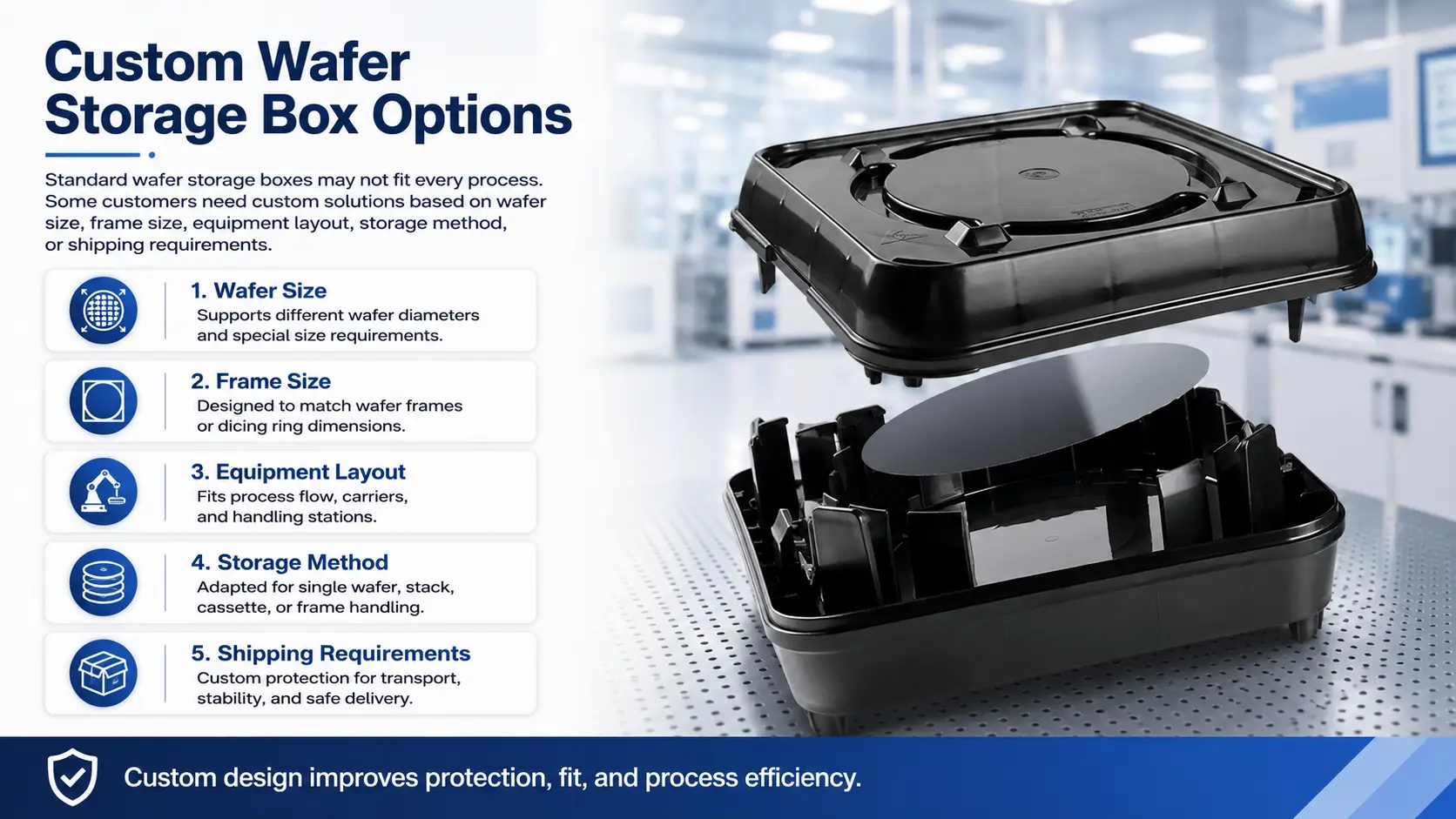
Standard wafer storage boxes may not fit every process. Some customers need custom solutions based on wafer size, frame size, equipment layout, storage method, or shipping requirements.
Custom wafer storage box options may include:
- 6-inch, 8-inch, and 12-inch box sizes
- Custom inner structure or wafer fixing design
- Custom dimensions for wafer frames or special carriers
- Anti-static material or surface treatment
- PP, PC, PET, or other material options
- Labeling or identification support
- Custom packaging for shipment
- Special design for storage, transport, or cleanroom handling
A custom wafer storage box can improve wafer protection, handling efficiency, equipment fit, and long-term process stability.
Common Problems Caused by the Wrong Wafer Storage Box
Using the wrong wafer storage box can create hidden risks in semiconductor handling. These problems may not be obvious at first, but they can affect wafer quality, production flow, and long-term cost.
1. Wafer Movement
If the box does not hold the wafer properly, the wafer may slide or move during handling. This may cause friction, scratches, or edge damage.
2. Particle Contamination
Poor material, rough surfaces, or weak closure design may increase the risk of particles entering the box or contacting the wafer.
3. ESD Risk
If the box does not provide proper anti-static performance, electrostatic discharge may become a concern during handling.
4. Poor Equipment Fit
A box that does not match the wafer size, frame size, cassette, or storage system may create loading and transfer problems.
5. Shipping Damage
For external transport, a weak or unsuitable box may not protect wafers from shock, vibration, or impact.
6. Higher Operating Cost
Low-quality boxes may need frequent replacement or may create additional handling problems, increasing long-term cost.
Choosing the correct wafer storage box helps reduce these risks and supports more stable wafer handling.
How to Choose a Wafer Storage Box Supplier
A reliable wafer storage box supplier should understand semiconductor handling requirements, not only plastic container production.
1. Semiconductor Handling Experience
The supplier should understand wafer storage, cleanroom transfer, wafer frame handling, and shipping protection requirements.
This helps ensure the box design supports real semiconductor production needs instead of only basic packaging.
2. Material Selection Support
A good supplier should help customers choose suitable materials such as PP, PC, PET, or anti-static options based on the process.
Material selection should consider durability, cleanliness, ESD control, rigidity, and handling frequency.
3. Custom Design Capability
Different wafers, frames, and equipment may require custom dimensions or fixing structures. Custom design support is important for special projects.
This is especially useful when standard wafer storage boxes cannot match the customer’s wafer size, frame size, cassette, or shipping method.
4. Stable Quality Control
Dimension accuracy, surface condition, closure fit, material quality, and packaging should be checked before shipment.
Consistent quality is important for repeat orders and long-term production use.
5. Anti-Static and Cleanroom Awareness
The supplier should understand ESD control, particle reduction, and clean handling requirements for semiconductor applications.
For sensitive wafers and cleanroom environments, this knowledge can reduce handling risk.
6. Long-Term Supply Capability
For production use, repeat orders and consistent quality matter. A supplier should be able to support stable long-term supply.
This helps customers reduce supplier changes, product variation, and process uncertainty.
YJ Corevia Wafer Storage Box Solutions
YJ Corevia provides wafer storage box and semiconductor wafer handling solutions for cleanroom storage, transfer, shipping, and back-end processing applications.
Our product range includes:
- Wafer storage boxes
- Wafer stack boxes
- Wafer pizza boxes
- Single wafer boxes
- Wafer frame boxes
- Wafer shipping boxes
- Wafer cassette carriers
- Wafer metal frame shippers
- Custom wafer storage box solutions
YJ Corevia supports 6-inch, 8-inch, and 12-inch wafer handling requirements, as well as custom solutions based on wafer size, frame size, material, anti-static needs, and process requirements.
With experience in semiconductor-related handling products, YJ Corevia helps customers protect wafers during storage, transport, cleaning, inspection, and production transfer.
Conclusion
A wafer storage box is an important part of semiconductor wafer handling. It helps protect wafers from contamination, ESD risk, movement, friction, collision, and handling damage during storage, transfer, and shipment.
The right wafer storage box should match the wafer size, wafer condition, storage method, material requirement, cleanroom environment, and shipping needs. Buyers should also consider whether the application requires a single wafer box, wafer stack box, wafer pizza box, wafer frame box, wafer shipping box, or custom wafer storage solution.
YJ Corevia provides wafer storage boxes and custom semiconductor wafer handling solutions for customers who need reliable protection, stable handling, and process-compatible designs.
Contact us today to discuss your wafer size, storage method, material requirement, anti-static needs, and custom wafer storage box specifications.
FAQ
1. What is a wafer storage box?
A wafer storage box is a protective container used to store, transfer, or ship semiconductor wafers. It helps protect wafers from contamination, movement, friction, collision, and handling damage.
2. What is a wafer storage box used for?
A wafer storage box is used for cleanroom storage, wafer transfer, inspection handling, shipping, logistics, and semiconductor back-end processing.
3. What is the difference between a wafer storage box and a wafer shipping box?
A wafer storage box is mainly used for storage and internal handling. A wafer shipping box is designed for transport and logistics, where stronger protection against vibration and impact may be needed.
4. What material is used for wafer storage boxes?
Common materials include PP, PC, PET, and anti-static treated plastics. The best material depends on wafer size, handling process, cleanroom requirements, and shipping conditions.
5. What sizes are available for wafer storage boxes?
Common sizes include 2-inch, 4-inch, 6-inch, 8-inch, and 12-inch wafer storage boxes. Custom sizes may also be available based on wafer or frame requirements.
6. Why is anti-static protection important for wafer storage boxes?
Anti-static protection helps reduce electrostatic discharge risk during wafer handling. This is important in semiconductor environments where wafers or devices may be sensitive to ESD.
7. Can YJ Corevia provide custom wafer storage boxes?
Yes. YJ Corevia provides custom wafer storage box solutions based on wafer size, frame size, material, anti-static requirements, storage method, and shipping needs.